Lecornu’s Budget: Anatomy of a Puzzle on the Brink of a Crisis
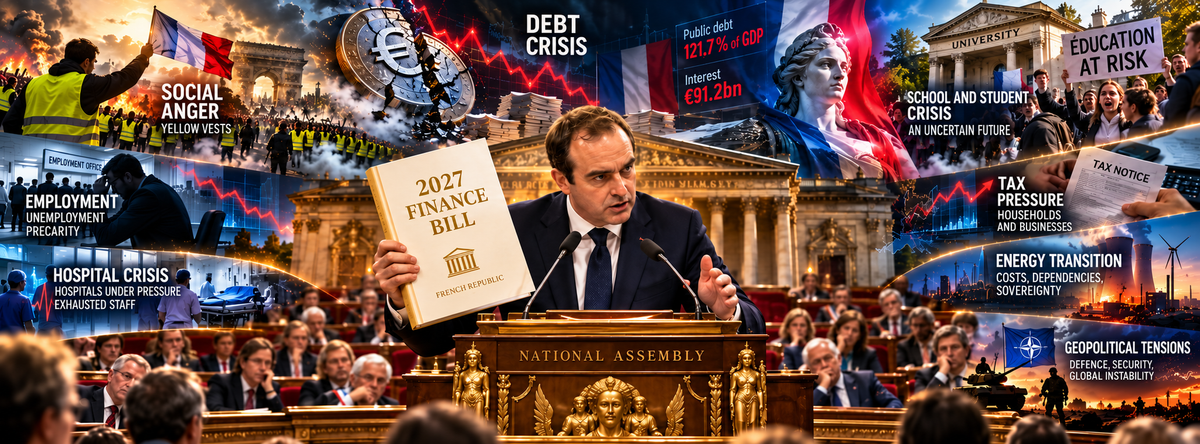
France is set to reduce its deficit. And yet its debt will keep rising.
Raymond Barre, Prime Minister from 1976 to 1981, used to quote Paul Valéry:
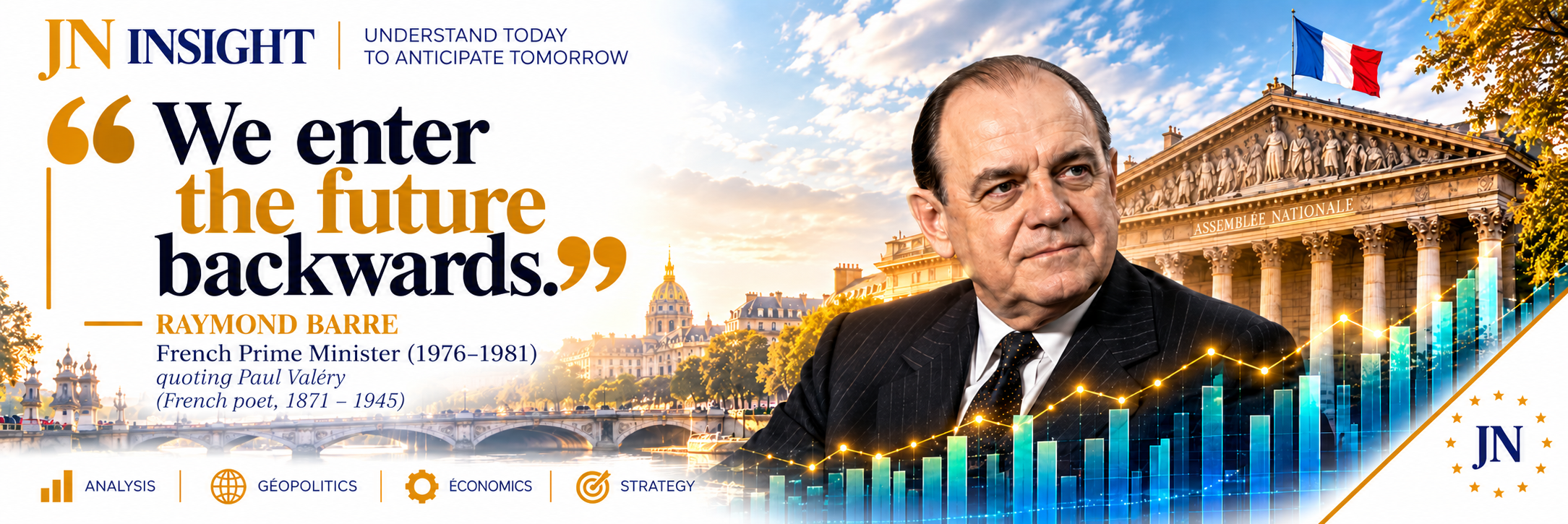
This paradox is no accounting accident. It is a choice: stabilise the signal sent to markets while accepting that debt itself will continue to grow. What this budget chooses to do—reduce the deficit—and what it chooses not to do—tackle structural spending—are two sides of the same political trade-off.
So is this fiscal discipline, or procrastination?
That is the question posed by Lecornu’s budget. And the answer reveals less a technical dead end than a deliberate political calculation, with its winners, its losers and its fragile assumptions.
PROLOGUE — The impossible equation
Paris, October 2026.
A document several hundred pages long lies on the table of the National Assembly. A bundle of budget papers. In it, France promises effort, discipline and a virtuous fiscal trajectory.
Two figures tell the whole story.
The first: −5.0%. That is the public deficit France is targeting in 2027. Falling. A real effort.
The second: 121.7% of GDP. That is the public debt level expected in the same year. Rising.
The deficit falls, certainly, but debt rises—simultaneously, in the same document signed by the same hands.
This is not a contradiction. It is a precise, documented and deeply troubling mechanism. Because nobody blinks. Because it has become normal. And perhaps that is the most alarming signal in this entire article: we have learned to live in the eye of the storm without recognising the wind.
That is the equation posed by Lecornu’s budget. To make it work: €43 billion in fiscal adjustment measures. We will dissect it piece by piece.
PART I — The patient whose treatment makes the illness worse
France borrows to reduce how much it borrows. That is the starting diagnosis. And it deserves a closer look.
The gradualist logic has its own coherence: abruptly cutting the deficit over two years could dampen domestic demand, weaken growth and risk worsening the debt-to-GDP ratio. A slower approach is therefore defensible. But it rests entirely on a +1% growth assumption that neither the IMF nor the Banque de France guarantees for 2026–2027.
In 1976, Raymond Barre called it “reasonable austerity”. Fifty years later, France still borrows to finance its fiscal discipline. Treating a haemorrhage on credit. The diagnosis has not changed since Giscard d’Estaing.
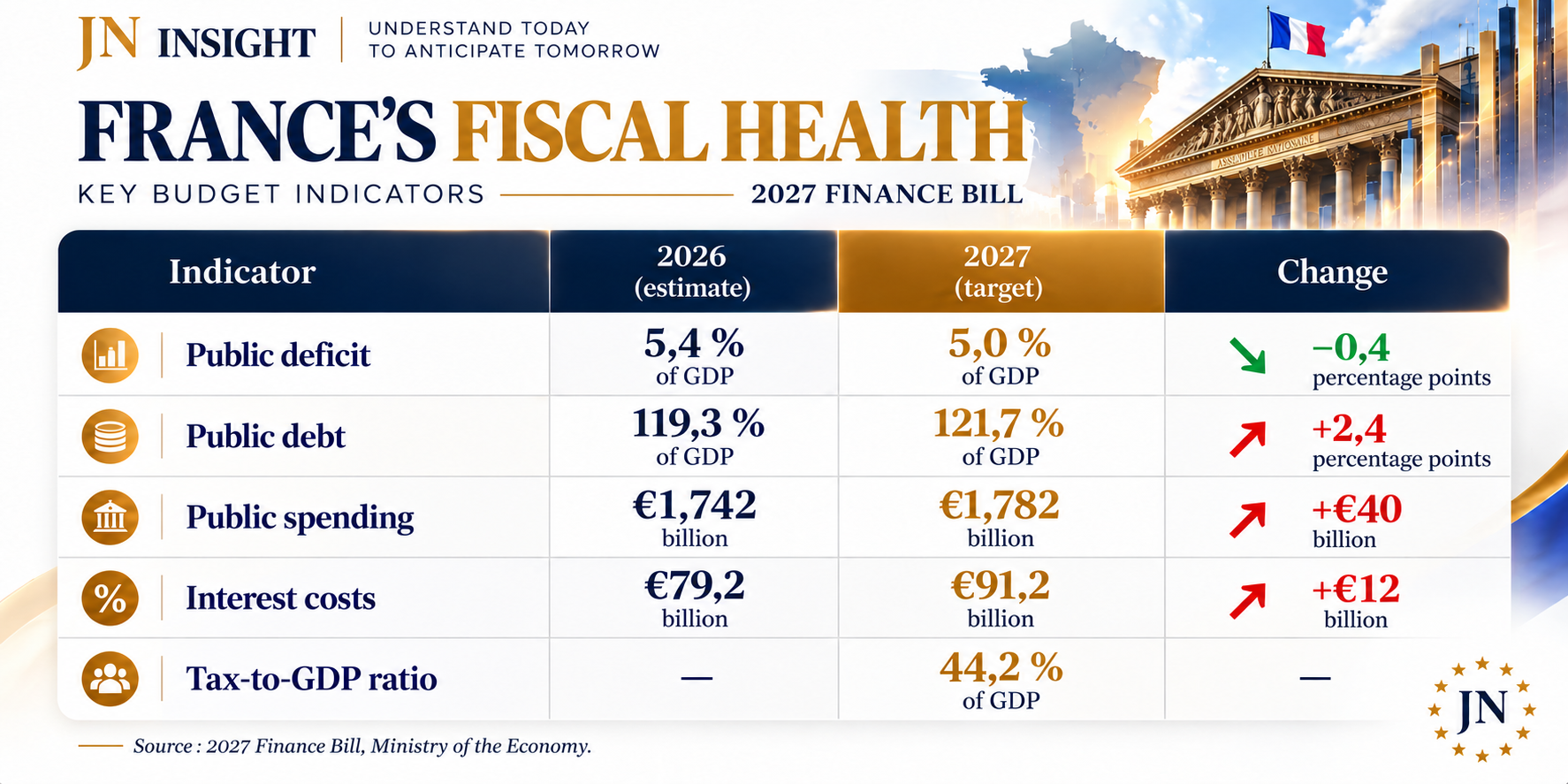
Let us open the 2027 Finance Bill. The figures are there, page after page, in a document few French citizens will read to the end. A deficit of 5% of GDP, debt at 121.7%, rising spending, rising interest costs.
These four lines do not tell the same story. And it is precisely this tension that makes this one of the most complex budgets to read in years.
Source: 2027 Finance Bill, Ministry of the Economy.
Look closely at this table. Its message is striking. The deficit falls. But debt keeps climbing. Spending continues to rise, and the interest bill grows heavier.
A country trying to heal itself while the fire keeps spreading.
And why?
Simply because a smaller deficit is still a deficit. As long as it exists, the state borrows. And as long as it borrows, debt grows. The speed slows, certainly, but the direction does not change.
Let us open the black box of the €43 billion in fiscal adjustment measures and see what is inside.
PART II — Opening the box
Imagine a CEO announcing €5 million in savings while planning to hire 200 people. It is legal. It is honest. And it is exactly what the French state is doing.
Now put those elements on their actual scale: €43 billion.
That is the figure the government has put on the table. The one meant, all by itself, to sum up France’s fiscal adjustment.
Except that is not what the figures say.
Behind that amount lie two very different mechanisms. Confusing them means missing the essential point.
- The first: spend less than planned.
- The second: bring in more money.
Spending less and taxing more are not the same thing. One lightens an administration’s expenditure, while the other weighs on a taxpayer. Both can help reduce a deficit. Neither is painless.
On the spending side: freeze some appropriations, postpone investment, slow the growth of spending by local authorities or social security.
On the revenue side: reduce certain tax breaks and increase some levies.
So €43 billion in fiscal adjustment does not mean €43 billion in spending cuts.
Announcing €43 billion does not mean saving €43 billion. That is the golden rule of reading a budget.
Then another figure, as interesting as it is intriguing, appears in the presentation of the adjustment: €54 billion.
Why the difference?
Because this amount covers a broader scope, including the effects of measures initiated in earlier years.
€43 billion. €54 billion. Two figures, but not necessarily two contradictory efforts. Two scopes, two readings of the same effort. Everything depends on what is included.
€43 billion refers to the measures contained in the budget legislation for 2027.
€54 billion reflects a broader view of the total fiscal adjustment, also including the effects of earlier measures.
And that distinction changes everything.
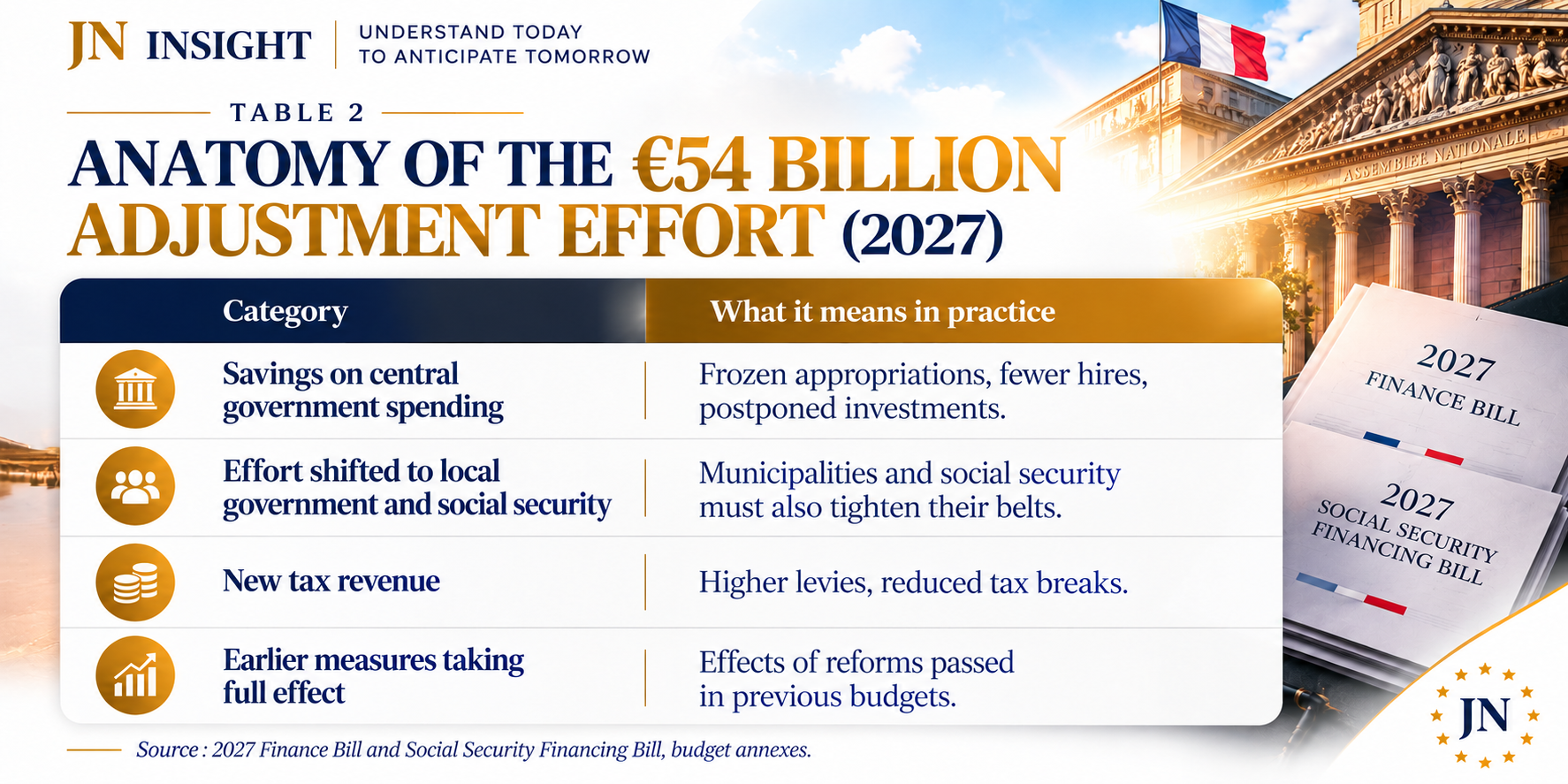
The real question is not how much France wants to save.
It is who spends less, who pays more, and how much of the effort already existed before this budget.
PART III — Money: as odourless as it is hard to follow
Following public money in France is like reading IKEA furniture instructions in Koasati, a Native American language of Texas: the pieces are there, but the final result is less obvious.
A budget is never neutral.
Behind every accounting line stands someone:
A household, a business, a local authority, a pensioner, a taxpayer or a public service. In official documents, the vocabulary is sanitised: “exceptional contribution”, “fiscal adjustment effort”, “new revenue”.
Behind these expressions lies a very concrete question: who pays?
JN INSIGHT went back to the articles of the 2027 Finance Bill to identify the measures and the groups affected. The result comes down to three questions:
WHO PAYS? WHO CONTRIBUTES? WHO IS PROTECTED?
The table below summarises the main groups involved in this effort, according to the data in the 2027 Finance Bill.
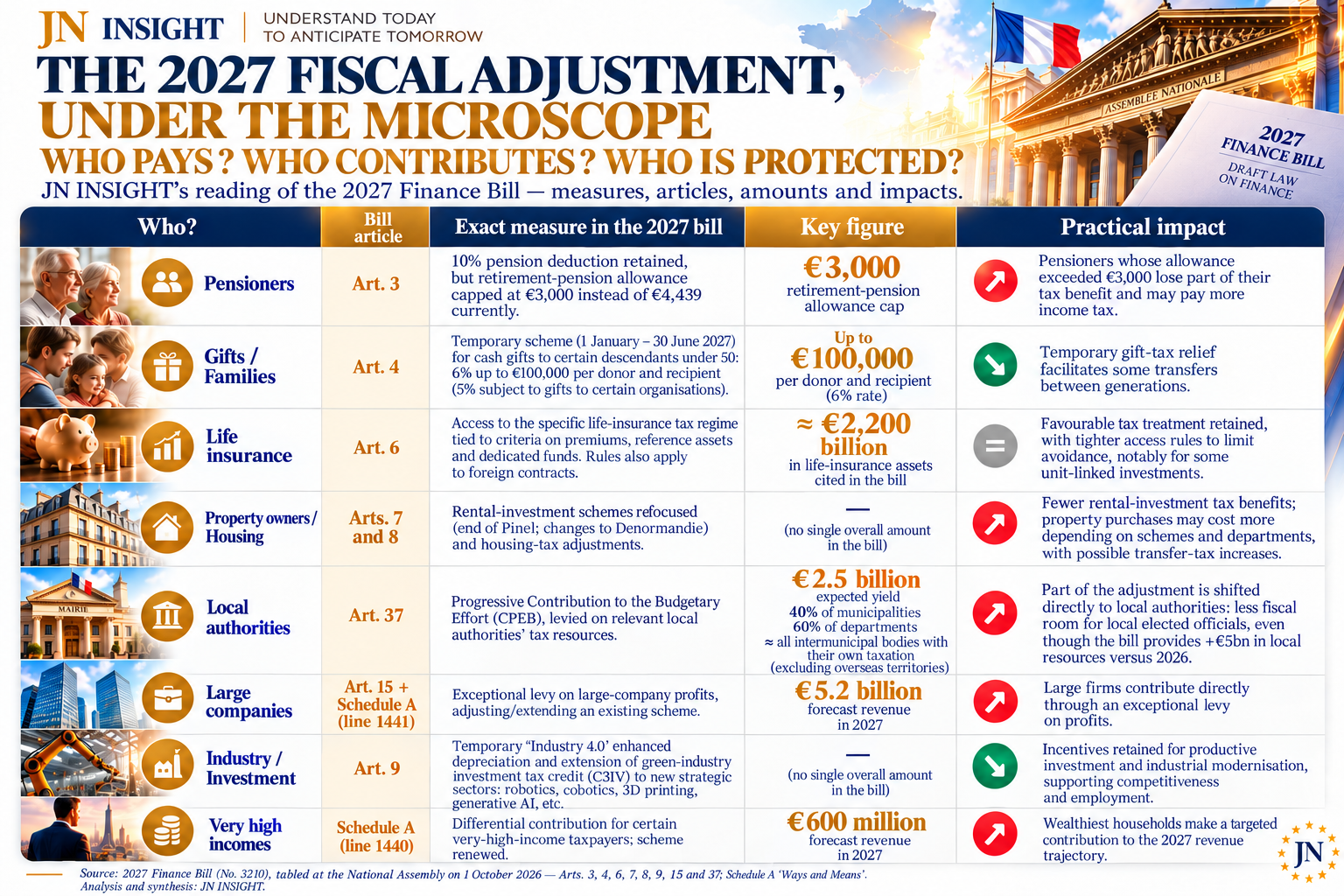
At a glance, the trade-offs are clear. Unfortunately, those taking part in the effort do not all have the same tools at their disposal.
Some can move their capital, postpone an investment or negotiate. Others have far less room to manoeuvre.
A pensioner, for example, cannot move a pension the way a company moves an investment. A town of 8,000 residents cannot reorganise its resources like a financial wealth manager. To illustrate, a cut in grants might lead a municipality to reduce its swimming pool’s opening hours. A freeze in the public-sector pay index can erode a hospital nurse’s purchasing power if prices keep rising.
And this is precisely where accounting ends… and politics begins.
The real question is therefore no longer just how much the state must find.
It goes much further: on whom can it impose the effort without damaging the very thing it seeks to repair? On this question, a phrase traditionally attributed to Colbert takes on particular resonance:
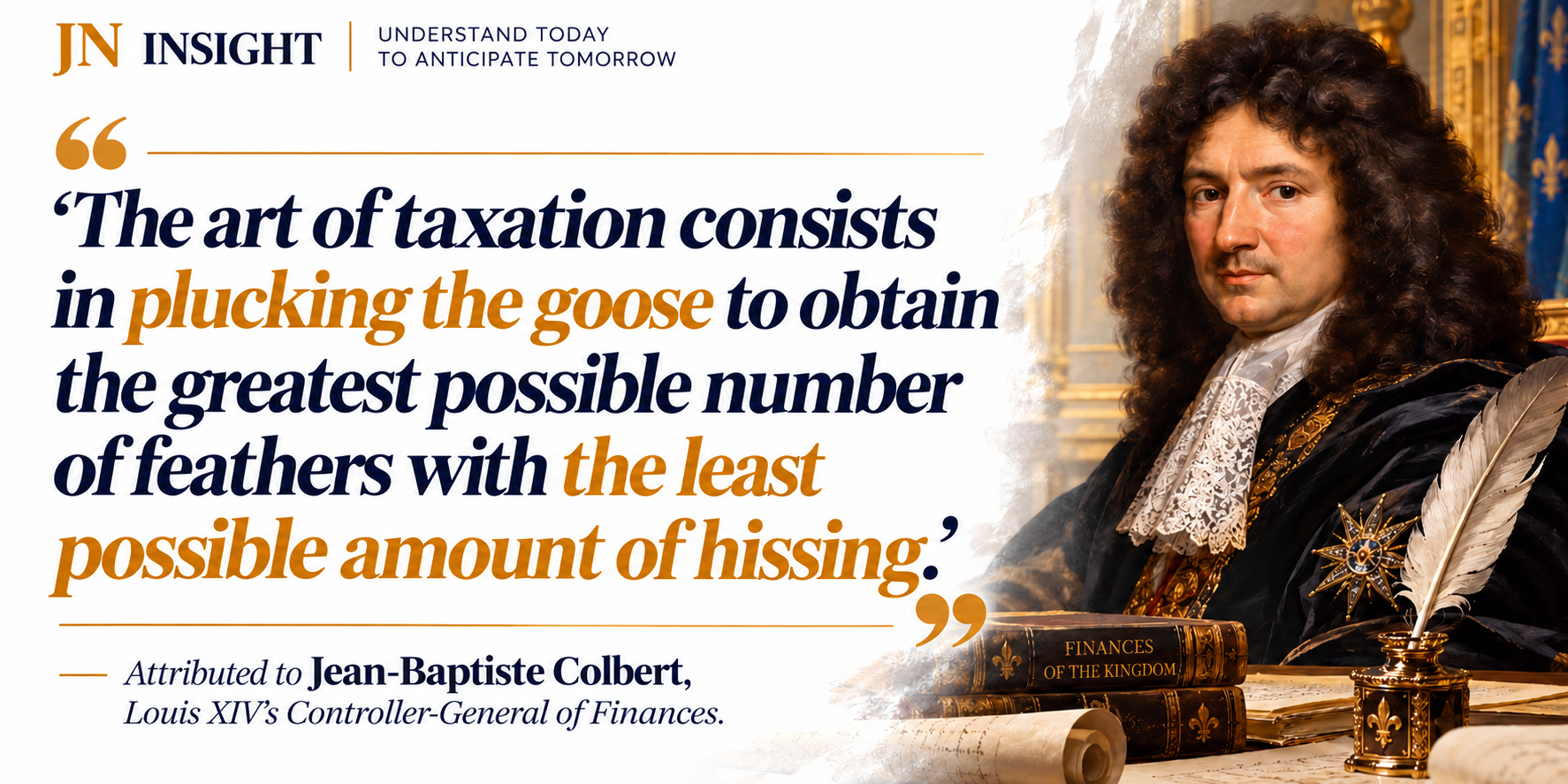
Returning to the image of the goose, the aim is to extract as much as possible while provoking as little hissing as possible. Today, the French state is still looking for the right approach, and the goose is beginning to lose patience.
The X-ray is complete. The trade-offs are visible. But what is alarming is that, even with these choices, France may be making savings and yet spending more.
How is that possible? The answer lies in the paradox.
PART IV — The paradox: France saves by spending more
The state can announce savings while spending more: spending need only rise less than planned. The French state has turned this into an industrial process. Just spend it—but less than planned.
Reading the 2027 Finance Bill, public spending would rise from €1,742 billion in 2026 to €1,782 billion in 2027.
THAT IS AN ADDITIONAL €40 BILLION.
France announces savings. And still plans to spend more.
A contradiction? Not exactly.
MAKING SAVINGS DOES NOT ALWAYS MEAN SPENDING LESS.
It can mean spending less than planned, rather than less than before. That is how a budget can announce savings while projecting higher expenditure.
€1,782 BILLION. WHERE DOES THIS MONEY ACTUALLY GO?
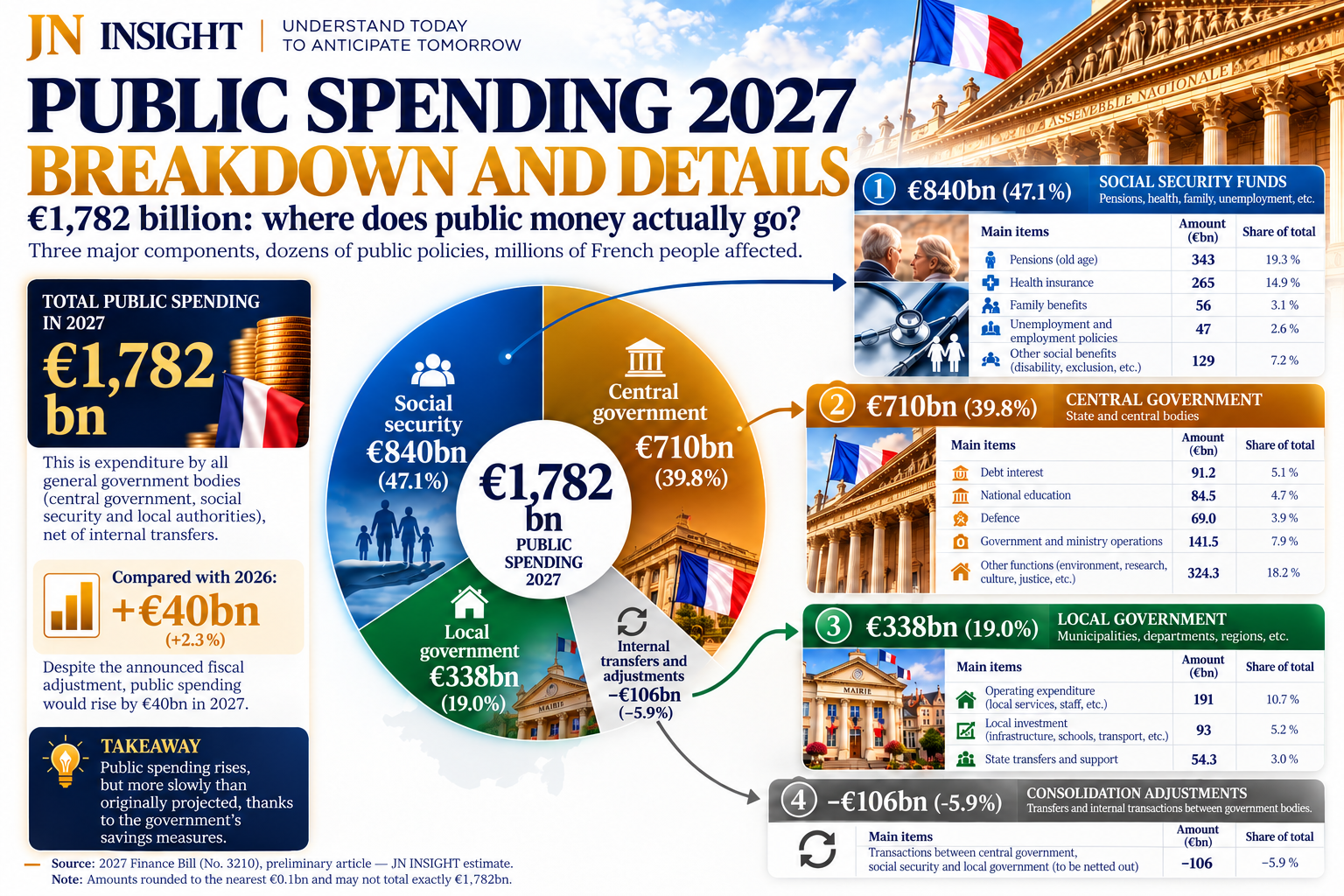
Central government, social security, local authorities. These blocks cannot simply be added together as they stand.
The amounts include transfers between government bodies. The table in the preliminary article of the 2027 Finance Bill shows, excluding tax credits, €840 billion for social security, €710 billion for central government and €338 billion for local government, with a total of €1,782 billion. The equation 840 + 710 + 338 − 106 = 1,782 is correct: €106 billion is the calculated difference between the sum of the three blocks and the published total. The details of this difference and the accounting adjustments still need to be substantiated.
All this spending cannot be reduced with a stroke of the pen.
Behind the accounting lines are pensions to pay, healthcare to fund and commitments to honour. Take the €840 billion projected for social security funds: a saving may mean a revised reimbursement, a longer wait or a capped benefit. These figures have faces. They also have votes.
The amount matters. So does the trajectory.
Reducing the deficit therefore means narrowing the gap between spending and revenue.
And slowing spending growth is not enough, on its own, to reduce debt. John Maynard Keynes said we could spend our way out of a crisis. He did not anticipate that we would spend our way out of spending.
Yet one expenditure still deserves a closer look. It builds nothing, and still weighs on the budget every year.
PART V — €91 billion that builds nothing
In 1975, interest on public debt represented approximately 0.9% of GDP. In 2027, it could exceed the national education budget. The rent has risen. The apartment has not changed.
Amid these billions, however, there is an expenditure unlike the others.
Nobody takes to the streets to demand it. No minister cuts a ribbon to inaugurate it. No mayor proudly poses in front of it. It builds no school, opens no hospital and funds no train.
And yet it swallows more public money every year.
That expenditure is debt interest. In 2027, it could reach €91.2 billion: €12 billion more than in 2026, in a single year. And the most troubling part? These billions do not repay the borrowed principal. They primarily compensate those who have lent money to France. With these payments, France pays the rent on its debt. Debt can be rolled over, refinanced, pushed into the future. Its interest comes due every year. Without exception.
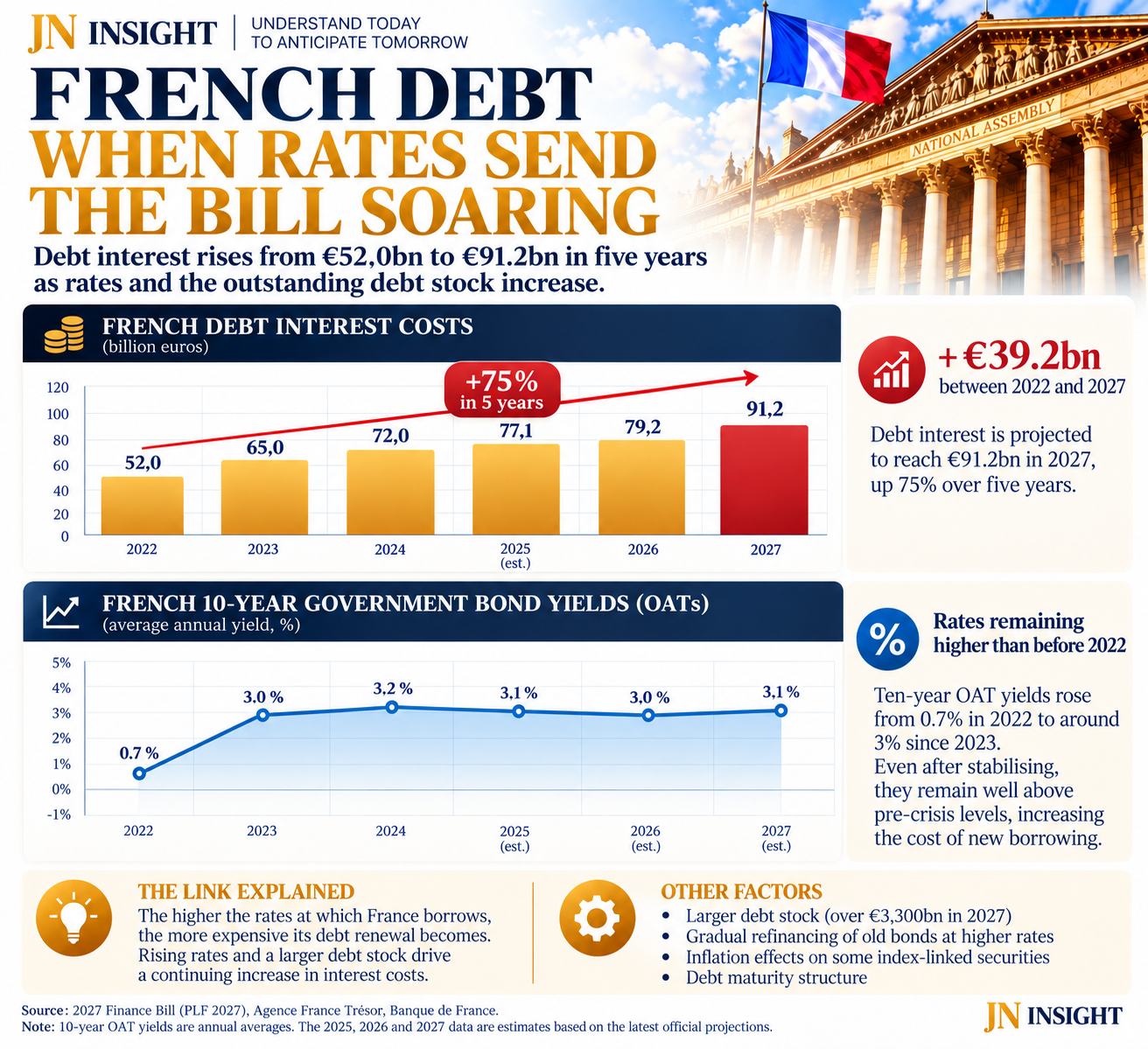
For years, this mechanism remained almost invisible. New borrowing cost very little. In 2021, France could borrow for ten years at rates close to zero. Debt grew without a comparable immediate increase in the bill.
Then central banks raised rates to contain inflation. Borrowing conditions tightened.
Even if rates stabilise or fall, the burden can keep increasing as long as refinancing terms remain more expensive than those of the securities being replaced.
That is what the chart shows.
CHEAP DEBT CAN END UP BEING EXPENSIVE.
The bill is there, on the table. What remains is to find out what those lending us money think about it.
PART VI — When the world watches us lose control
When your creditors become your auditors, fiscal sovereignty changes sides. History has known this since the Treaty of Versailles.
Sometimes those watching from a distance see most clearly.
Outside assessments question the same equation: persistent deficits, high debt and an adjustment that must last.
In their mission concluding statement of 21 May 2026, IMF staff recommend improving public spending efficiency and strengthening revenue. The adjustment must be credible and durable.
On a proposal from the Commission, the Council of the European Union formally opened an excessive deficit procedure against France on 26 July 2024. This is no symbolic warning. It is a binding mechanism.
Persistent failure to comply with this framework could complicate access to the TPI—the ECB’s Transmission Protection Instrument, designed to counter disorderly tensions in bond markets. Its activation depends on published criteria and an ECB decision.
This safety net exists. But its activation depends on criteria and a decision by the ECB.
Eight centuries of financial crises. And one recurring belief: this time would be different. The external assessment is on the table. Markets, meanwhile, have started moving.
One signal in particular deserves a closer look.
PART VII — The day France cost more to finance than Greece
When France costs more to finance than Greece, it is more than a market signal. It is a warning for an era.
For a long time, Europe’s collective imagination drew a dividing line: fragile countries on one side, major sovereign borrowers on the other. France naturally belonged to the second group. Then markets began sending a strange signal.
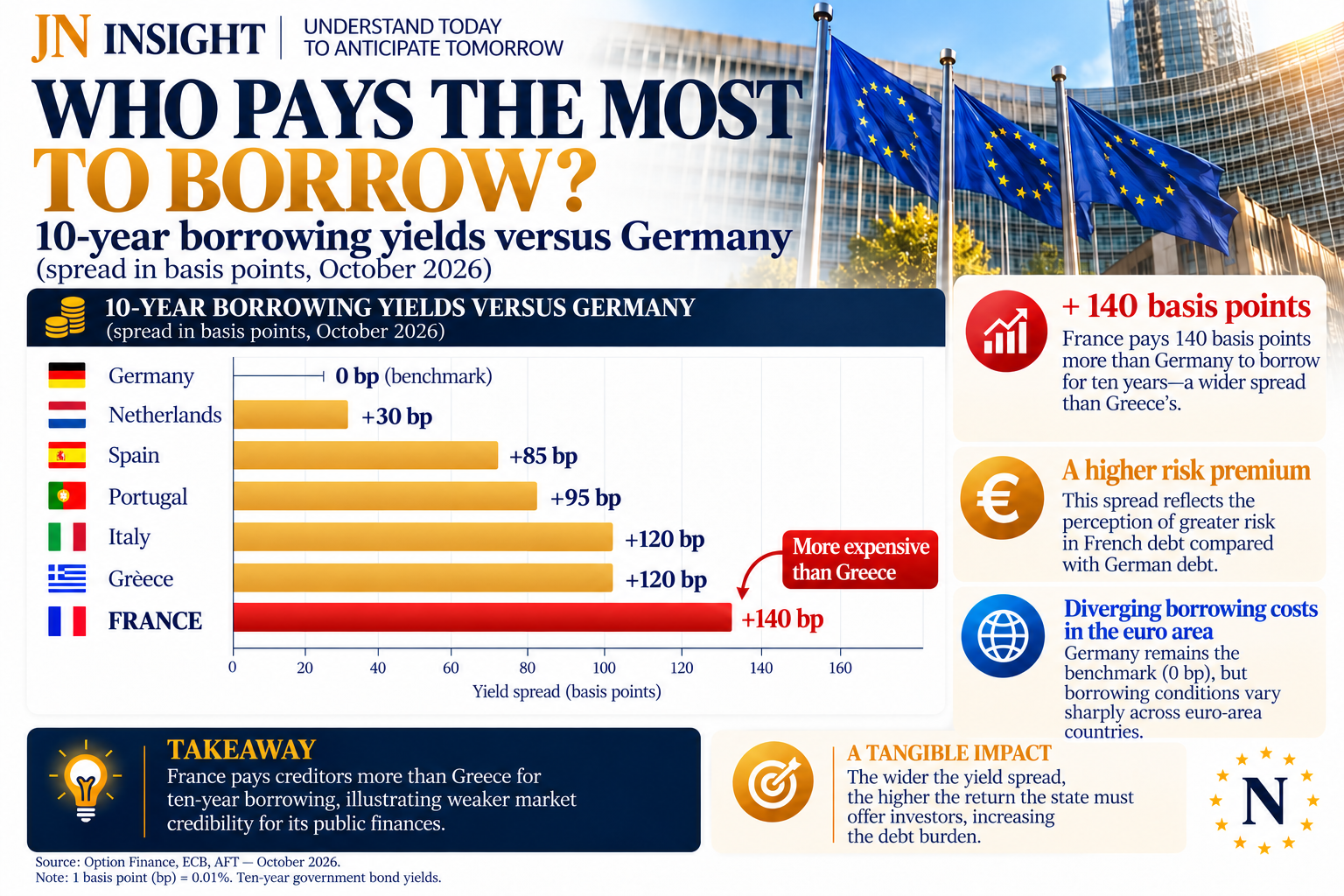
Look at this table. In the comparison shown, France’s ten-year yield exceeds Greece’s—a country at the heart of the European sovereign debt crisis.
A caution: this does not mean France has become Greece. But when markets occasionally demand comparable returns to lend to two states with such different economic profiles, the signal deserves to be taken seriously.
That signal brings us back to a single question. What does Lecornu’s budget really say about France’s choices?
PART VIII — What the budget leaves unsaid: the real priorities
What a budget does not fund says as much as what it does. Budgetary silences are a policy in themselves.
Budget choices draw a map of priorities.
The bill sets its priorities. Defence is strengthened. Central and local government are asked to contribute. Social spending rises, with its growth to be contained. The government has chosen its lines.
These choices have concrete consequences.
France Travail: the bill provides for 400 fewer full-time-equivalent staff positions, a reduction in the operating subsidy and less use of outsourced services. The government is relying on efficiency gains to maintain support for jobseekers.
Energy renovation: Anah’s remit would be refocused on comprehensive renovations and collective housing, particularly run-down condominium buildings. Assistance remains, but public support is more targeted.
Student housing: from 1 September 2027, students from the most affluent households would have to choose between APL housing assistance and the tax benefit their parents receive on their behalf. Combining these forms of support would therefore be restricted.
These are trade-offs set out in the bill, still subject to Parliament. They show where the state is narrowing its intervention; on their own, they are not enough to measure the needs that would remain unfunded.
One assumption supports this trajectory: 1% growth in 2027.
If growth disappoints, revenue may rise less than expected. And the gap to close widens.
A budget rests on assumptions. What happens to its trajectory when growth disappoints or the announced measures are not implemented?
PART IX — Three scenarios to test the trajectory
Three assumptions, three possible trajectories. The infographic below compares them: growth, deficit and debt, depending on whether the government’s scenario materialises, growth disappoints or political instability disrupts implementation.
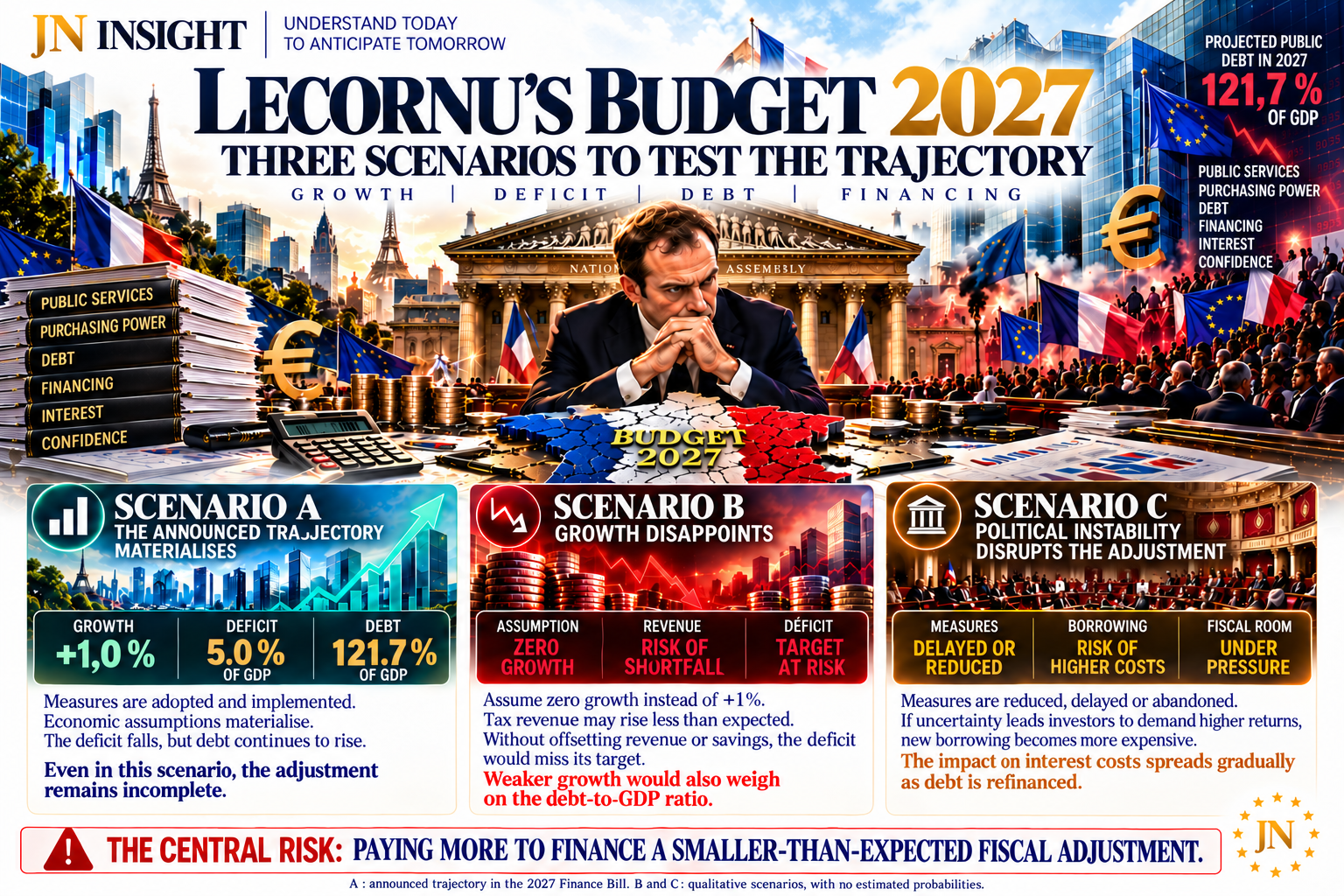
These scenarios illustrate risk mechanisms. They are neither numerical forecasts nor a ranking of probabilities.
Source for trajectory A: 2027 Finance Bill — National Assembly.
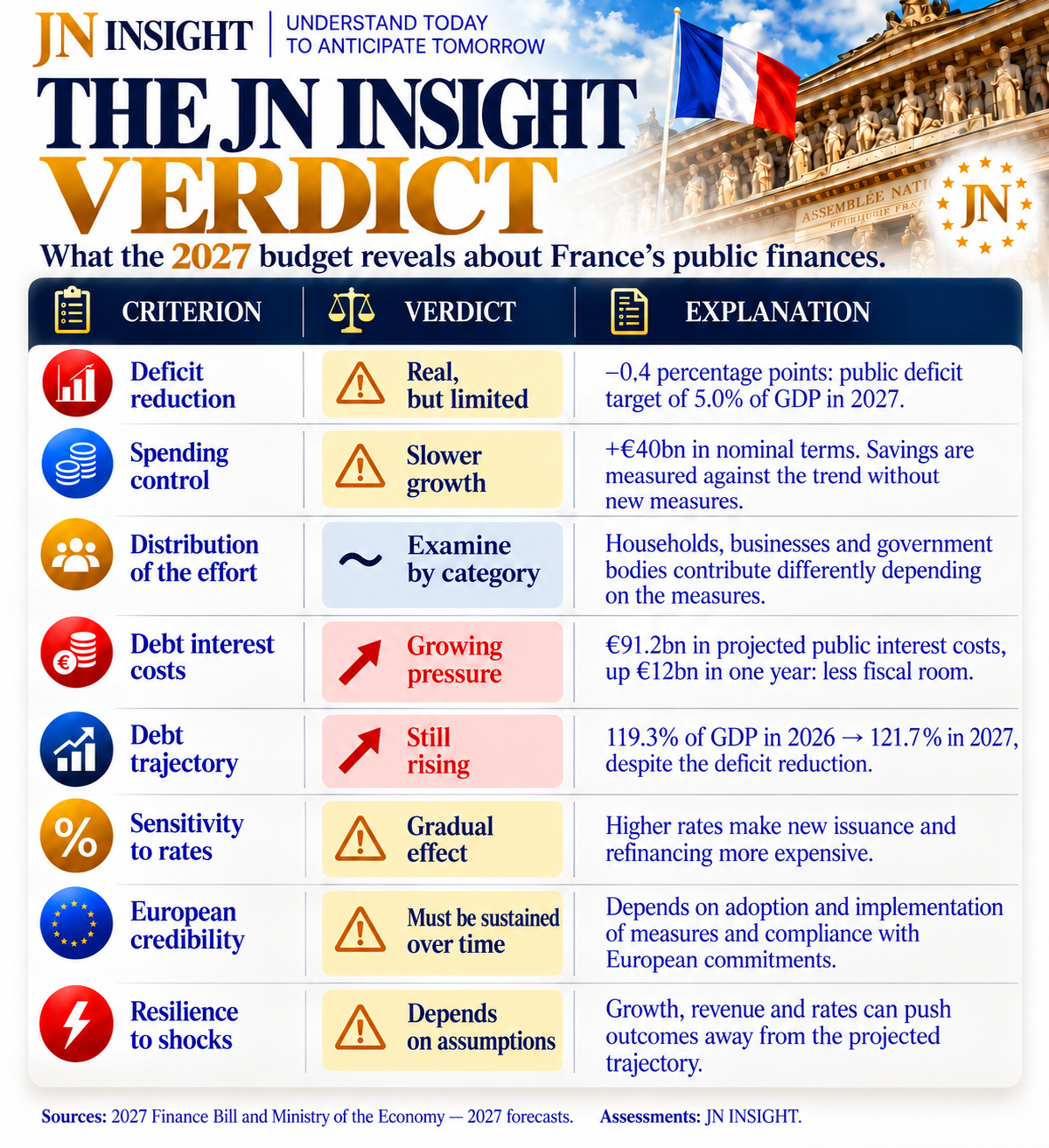
5%. That is the target. Remember that figure.
5% is still a deficit. It is not a cure, but a slowing of the haemorrhage. Here lies the most important truth in this entire budget.
France is not yet seeking to reduce its debt. Initially, it is trying to slow the rate at which that debt grows. These are not the same thing. Even if the plan works, growth reaches the target, savings are delivered and markets remain calm.
Debt is still projected to reach 121.7% of GDP.
Lecornu’s budget therefore promises no cure. It attempts something more modest.
Stabilise the patient before the condition becomes uncontrollable.
France has one of the highest tax burdens in the European Union. And yet it remains in deficit. That is the central equation of the French problem.
Behind this trajectory are the public services we fund, the levies we bear and the room to manoeuvre we will leave to those who follow.
The question is no longer whether France can put its public finances back in order. It is whether it still has time before markets take that choice away.
That is the almost impossible equation.
What should we take away?
This budget aims for a real improvement: reducing the deficit. But along the trajectory presented, that improvement is not enough to stop debt and its interest costs from rising. Success depends on several conditions: adoption of the measures, their implementation, growth, revenue actually collected and financing conditions. The wager is therefore twofold: put the public finances back in order without choking economic activity, while retaining lenders’ confidence.
And yet, in October 2026, France’s ten-year yield exceeded Greece’s. No small detail—a market verdict. Quiet. Unforgiving.
The real question is not whether France can keep going. It can. It always has.
The real question is how much longer debt will absorb what politics refuses to resolve. And when that calculation stops working, markets will not be the ones paying the bill.
Next stop: Africa—with this mechanism in mind, and additional constraints.
Intellectually yours,
Jean-Noël Niamké
Financial Expert
Geostrategic and Geopolitical Analysis
JN Insight — The Mechanisms of Power | The truth beyond appearances.
Sources: Find the full references here 👉