French Debt: How did we end up here?
DEBT — SERIES II/IV | JN Insight | September 25, 2026
3,500 billion euros. 52 years of uninterrupted deficit. And a mechanism that no one really dares to explain.
September 11, 2026. Paris. Roland Lescure, Minister of the Economy, addresses the National Assembly:
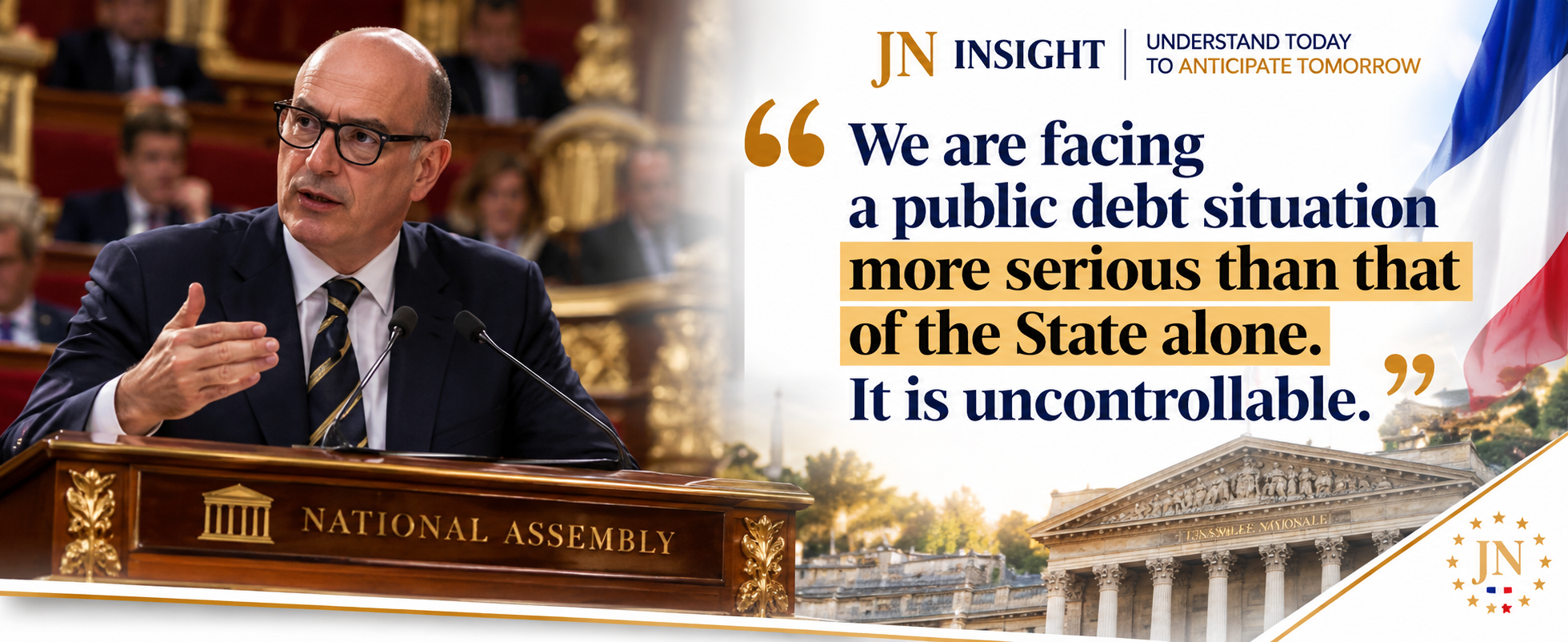
He is not talking about a social program, nor an investment. He is talking about the interest on the French debt.
74 billion euros in 2026. Every year, just for interest.
Every day, the French state pays around €203 million to its creditors. And this is not to invest, treat or even teach, but only to honour the interest on what it has borrowed before.
- €3,536 billion in public debt at the end of March 2026, i.e. 117.5% of GDP;
- €74 billion for interest paid in 2026 alone;
- 57.5% of the share of government debt held by non-residents.
How did we get here? And who really holds France by its debt? To understand everything, we have to go back fifty years.
Part I — 1975: The Year It All Began
To understand 1975, we have to go back to 1973.
On January 3, 1973, a law of a few lines, which went almost unnoticed, was to change the financial destiny of France for a long time.Before this law, when the state ran out of money, it could turn to the Bank of France, and the printing press turned. It was like having an overdraft allowed at home. Not exactly free, but almost.
After 1973, this shortcut was regulated: the Banque de France's advances to the Treasury were henceforth subject to capped agreements, voted by Parliament. It was not definitively closed until 1993, in the wake of the Maastricht Treaty. In the meantime, the State got into the habit of looking for money elsewhere: financial markets, banks, investment funds, foreign investors.
And these have a price: the interest rate. And when this famous rate rises, as it has since 2022, the bill explodes.
This decision remains to this day one of the most debated in French economic history : a founding act of debt for some, a simple symptom for others, since we spent more than we earned. The result is indisputable.
1. 1974 – last French public surplus: +0.1% of GDP.
2. 1975 – The deficit sets in. And since then, there has been no surplus year.
Since then, 52 years of uninterrupted deficit under the right, as well as under the left.
And here's what each president left behind (current nominal values not adjusted for inflation or GDP):
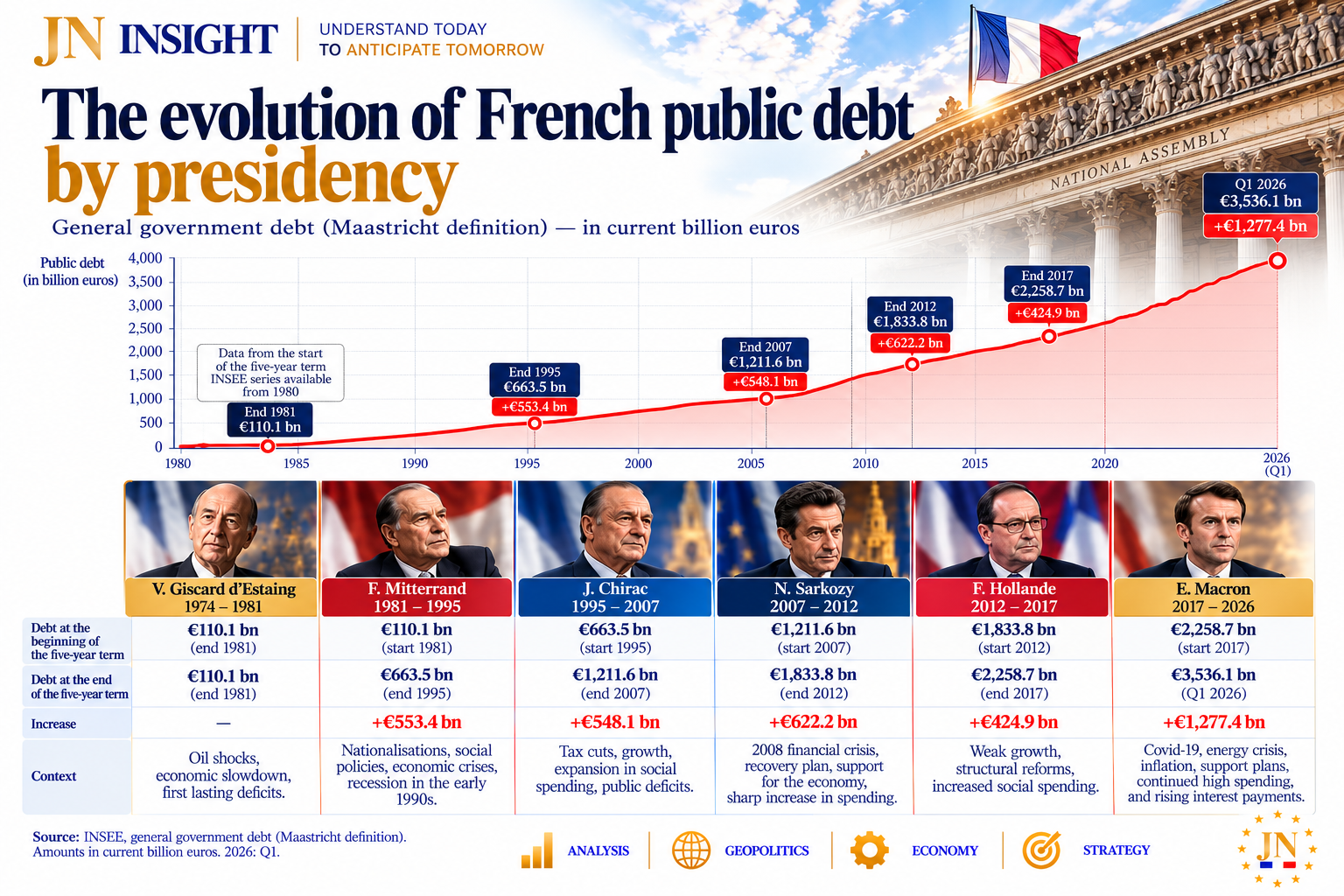
Read this table carefully.
No president, right or left, leaves with a debt lower than the one he found. Not a single one. In 52 years.
The increase under Macron of nearly 1,300 billion in nine years is the most spectacular in the history of the Fifth Republic. But dissecting these figures changes everything. Of these €1,277.4 billion added, three crises explain a significant part: Covid (€≈424 billion in exceptional spending), the energy crisis (≈ €70-90 billion in price shield before recovery to land at €36 billion) and recovery plans ("whatever it takes" ≈ €100 billion).
That is to say about 600 billion linked to crises, hence about 700 billion in added structural debt excluding crises.
The crises have therefore accelerated the trajectory, they have not created it.
The problem is therefore neither a president nor a party. It is a system.
And to understand this system, we have to look at where public money really goes in France.
Part II — The French paradox: we spend everything, and we lack everything
France is not a poor state. With public spending representing about 57% of GDP, it spends 7 points of GDP more than the average of its European neighbors.
Here's where the money actually goes:
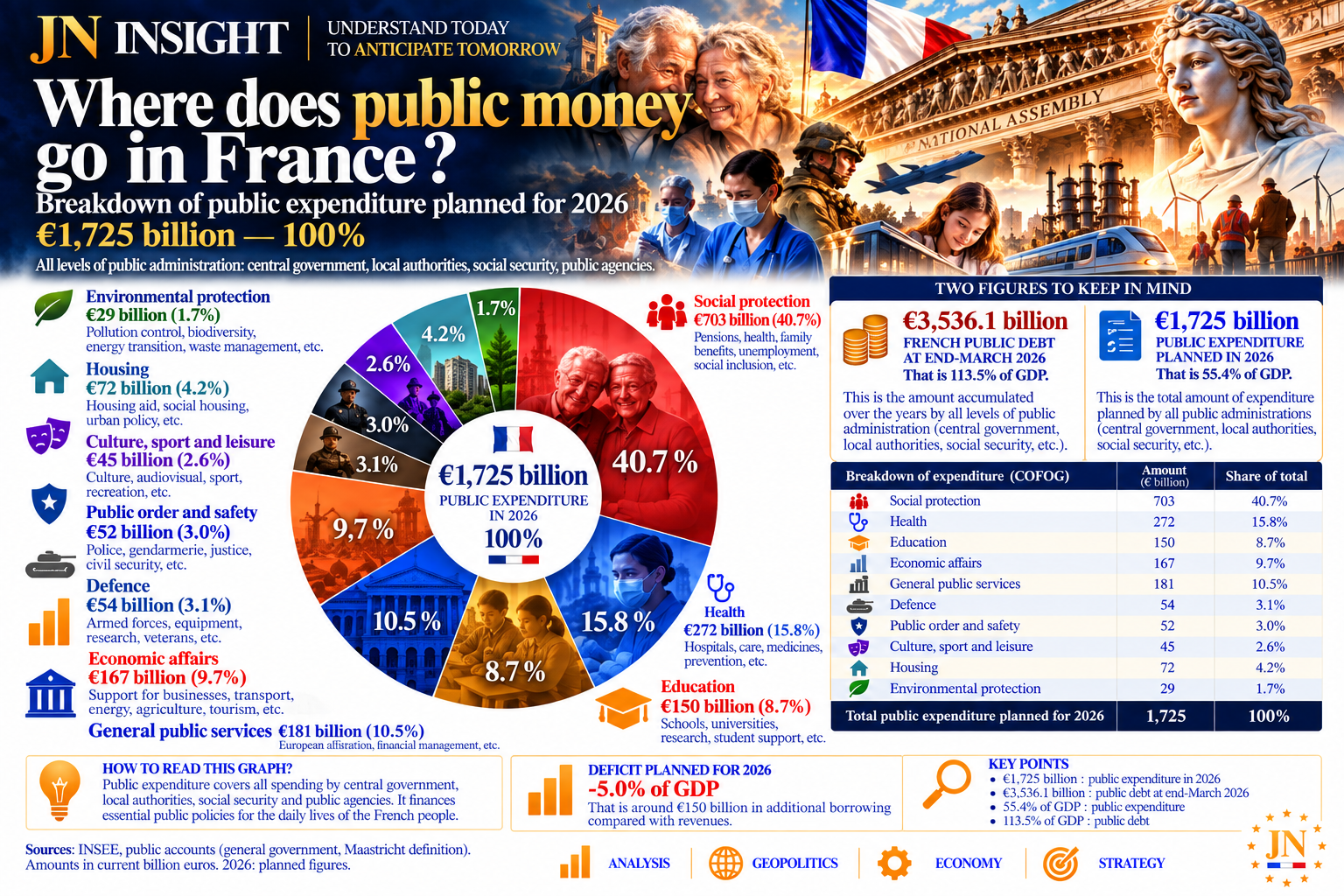
Be careful not to confuse the two main figures in this article.
3,536 billion is the debt: all that remains owed, accumulated over the past fifty years. 1,725 billion is public spending for the year 2026 alone. A stock on one side, a flow on the other. The link is the deficit: spending exceeds revenues by about 150 billion, which is added to the debt every year. And the pie chart is clear: 4 out of 10 euros go to social protection, of which pensions are by far the first item.
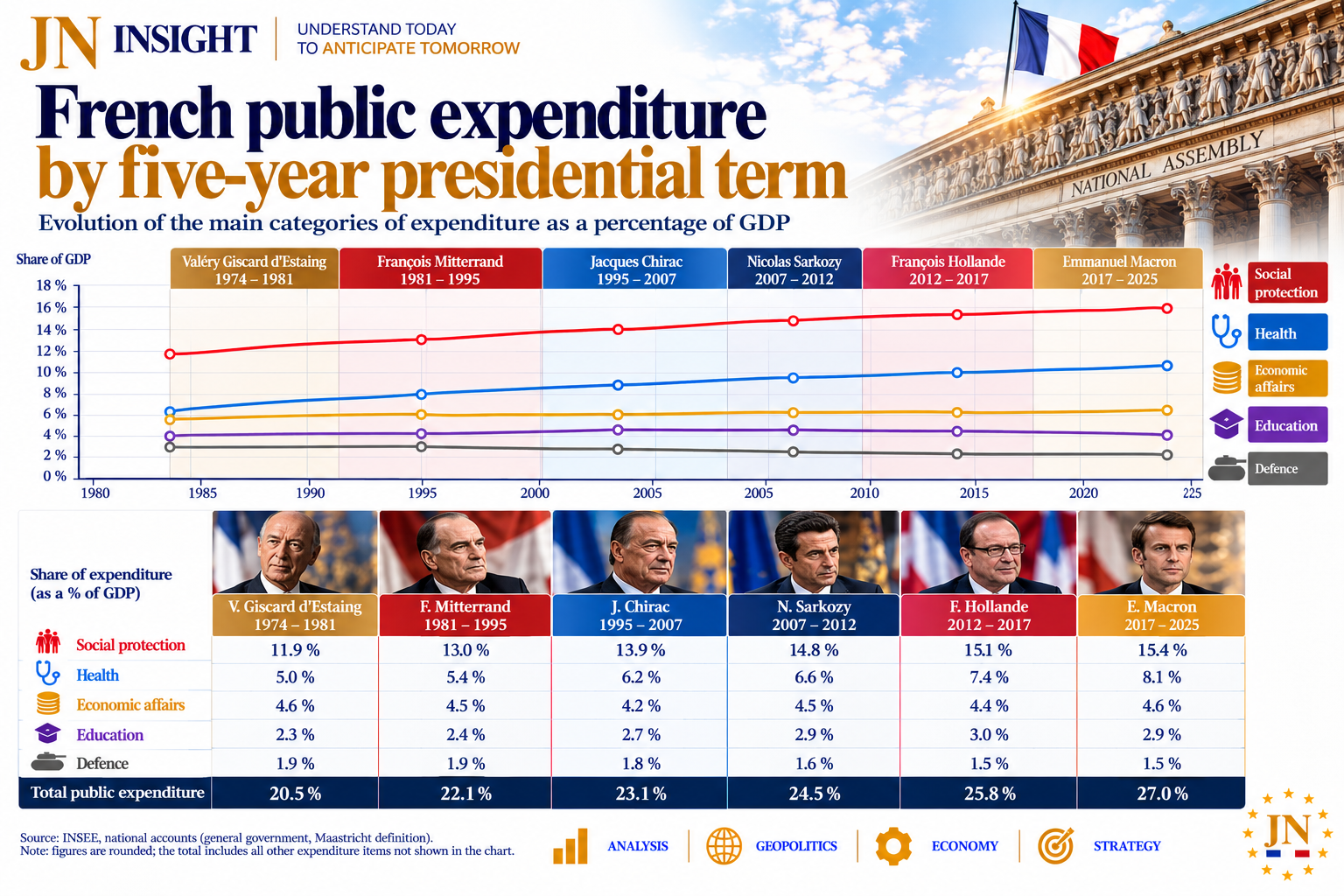
Five-year changes — main items as a % of GDP:
And meanwhile, debt interest is rising: €65.7 billion in 2025, €74 billion in 2026. +14% in one year.
This is not the result of a political decision. It is the automatic result of the rise in interest rates on a colossal stock of debt.
France is not short of money. It already levies some of the heaviest in the world. So what's the problem? In the structure. In what it chooses to finance.
Look at what the table says. France now spends more money on pensions (14.4% of GDP) than on education, defence and research combined.
A country that spends more on its past than on its future is heading for disaster.
The numbers are relentless:
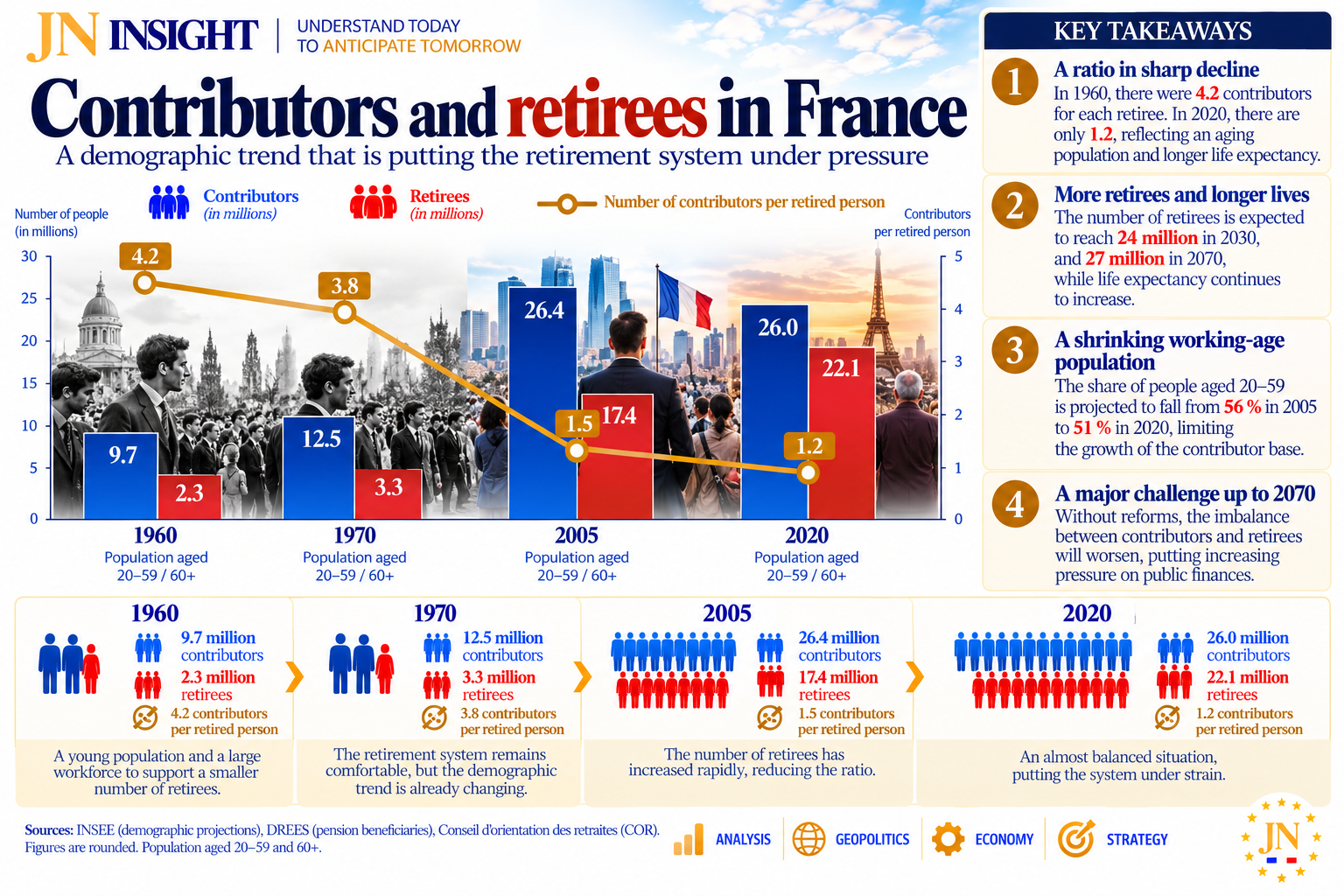
And that's what your pay slip never says clearly. You don't contribute to your own pension. You contribute to pay for your parents' pension.
That's the pay-as-you-go method. Today's workers finance today's retirees, with the promise that future generations will do the same. But at 1.7 contributors for every 1 retiree,the promise is starting to break down.
This system was not absurd when it was created. In the 1950s, when pay-as-you-go was imposed in France, life expectancy was around 67 years old and the retirement age was set at 65 years old. Those who reached this age received their pension between 9 and 13 years old on average.
At that time, the calculation held up. But with the evolution of science, life expectancy has jumped. A French person who retires today will still live on average between 23 and 27 years later.
Designed to finance 9 to 13 years of retirement, the system now finances 25 years.
It is not a question of generosity: it is a demographic equation whose funding has not kept up. We cannot continue to promise what we can no longer keep arithmetically.
But this structural problem didn't arise alone. It was fueled by a mechanism that no one likes to describe clearly. Because it doesn't have a simple solution.
Part III — The Infernal Spiral: How Debt Is Suffocating the Economy
In episode I, we saw that the United States is caught in a mechanism where debt feeds debt. France is experiencing the same problem, on its own scale:
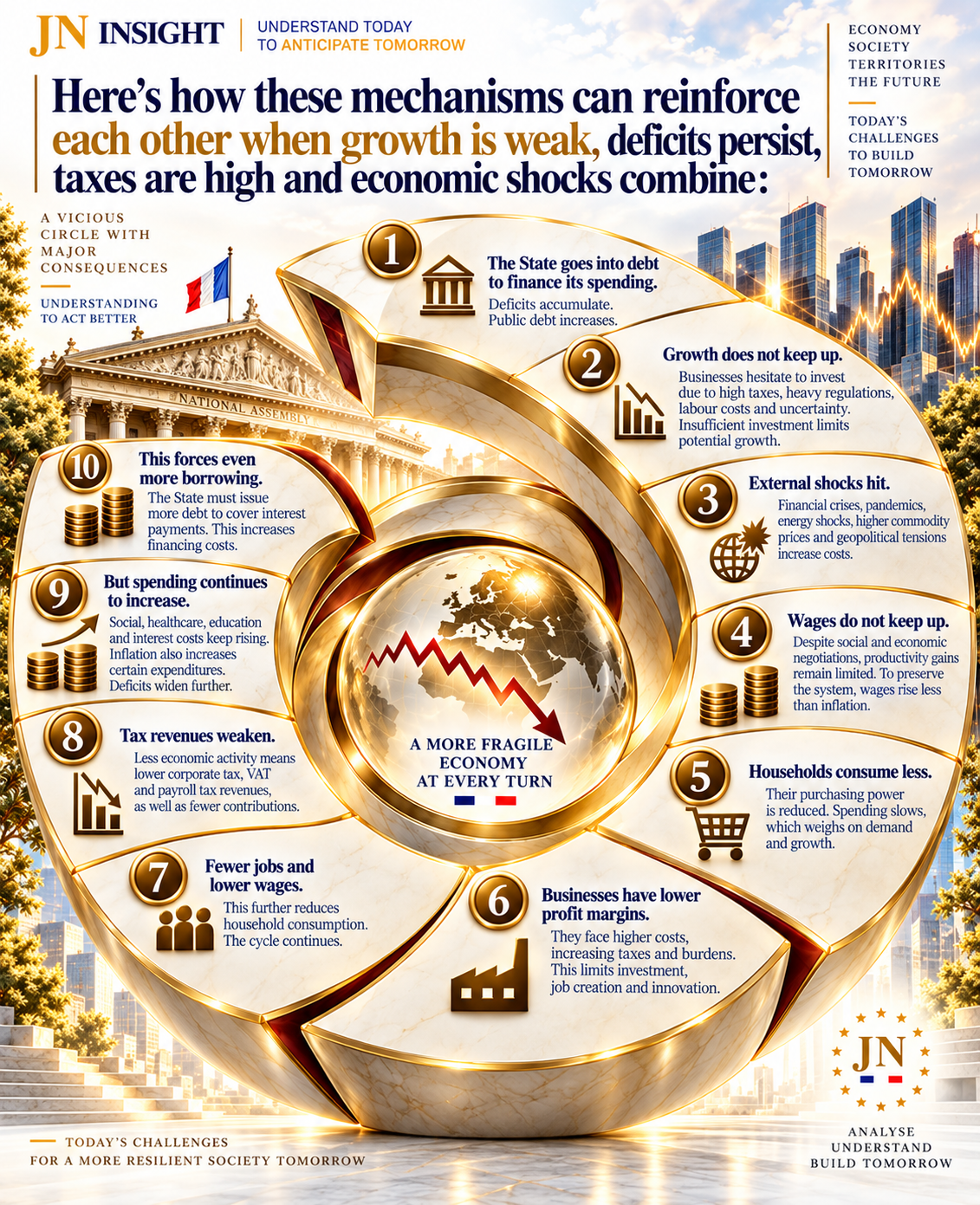
How should we read this diagram? Each step feeds into the next. The government borrows to finance its spending (1), but growth does not follow (2). So a shock is coming: energy, war, inflation (3). Wages are falling behind prices (4), which means that households are consuming less (5), no consumption, less sales for companies (6) and companies will hire less (7). This leads to a decline in tax revenues (8), while spending continues to rise, with interest and indexed benefits in the lead (9). So you have to borrow more (10), and the loop starts again, a notch lower.
That's the downward spiral. Not a collapse: a slow cutback, budget after budget.
46% of the deficit is now used to pay past financial charges.
It is in this context that we must understand the sudden rise in interest rates. Because it did not happen alone.
Part IV — The Interest Rate Trap: When Markets Lose Confidence
For about twenty years, France has benefited from an extraordinary gift. Interest rates close to zero. It has taken advantage of this, without reducing its debt. It has simply borrowed more, cheaper. Then rates rose sharply without warning.
But why have these rates risen so much?
The answer is twofold. First, the ECB's monetary policy, which has raisedrates to fight post-Covid and energy inflation. All eurozone states are concerned.
Secondly, the markets have less confidence in France than in Germany. And this mistrust has a name: rating downgrades.
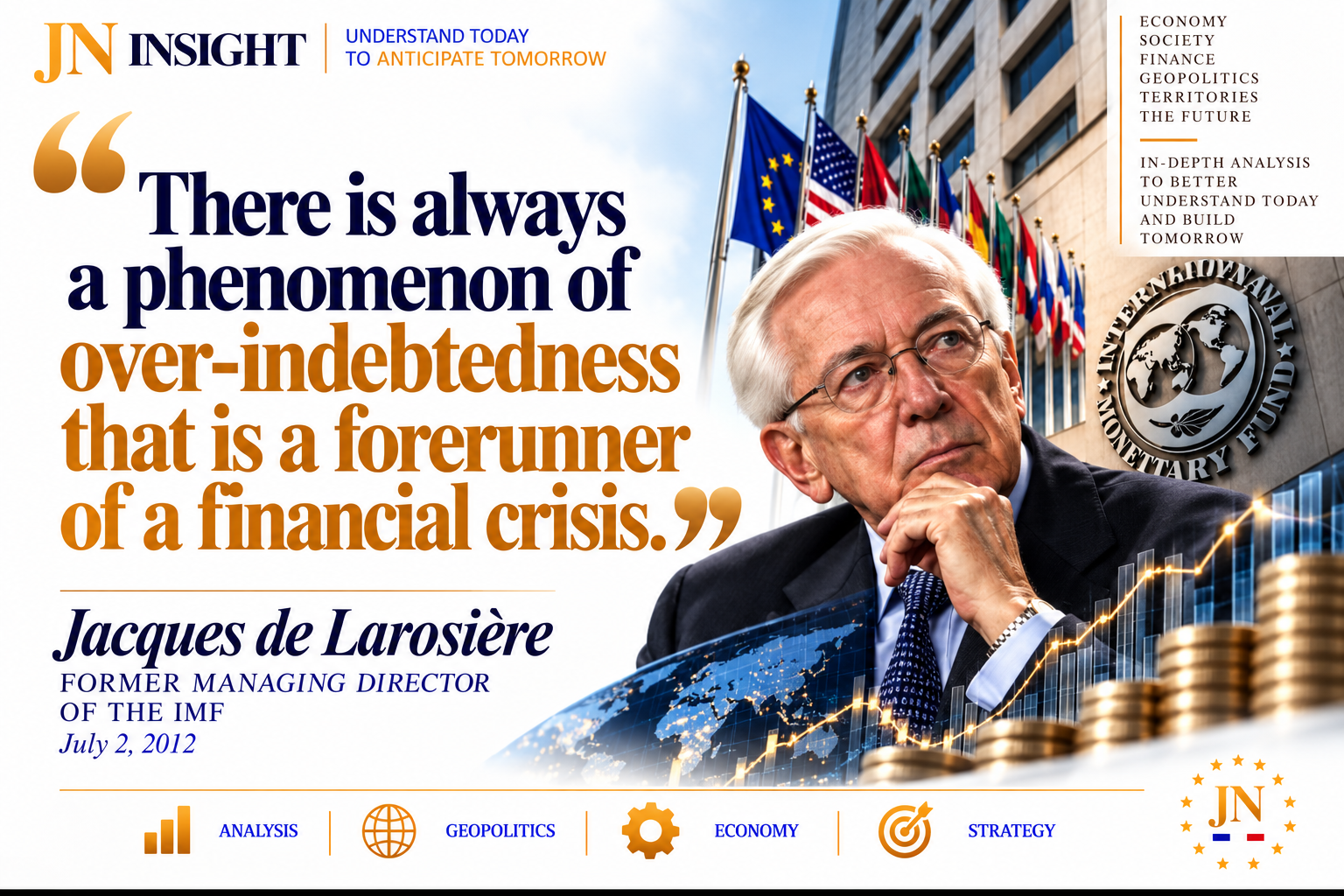
S&P and Fitch (financial rating agencies) downgraded France to A+ in the fall of 2025. Moody's placed France on a negative outlook in October 2025, and kept it there in April 2026. Three rating agencies, three warning signs. In less than a year. These agencies are sending a message to investors around the world: France is borrowing too much, growing too little, and not reforming fast enough. A circle that you now recognize.
But before understanding the solutions, we need to know exactly to whom France owes all this money. And the answer is more disturbing than you think.
Part V — To whom does France owe all this money?
Episode I mentioned about half. The precise figure is higher: At the end of March 2026, non-residents held 57.5% of the government's marketable debt — the highest proportion among G7 countries.
Here is the exact map of the creditors:
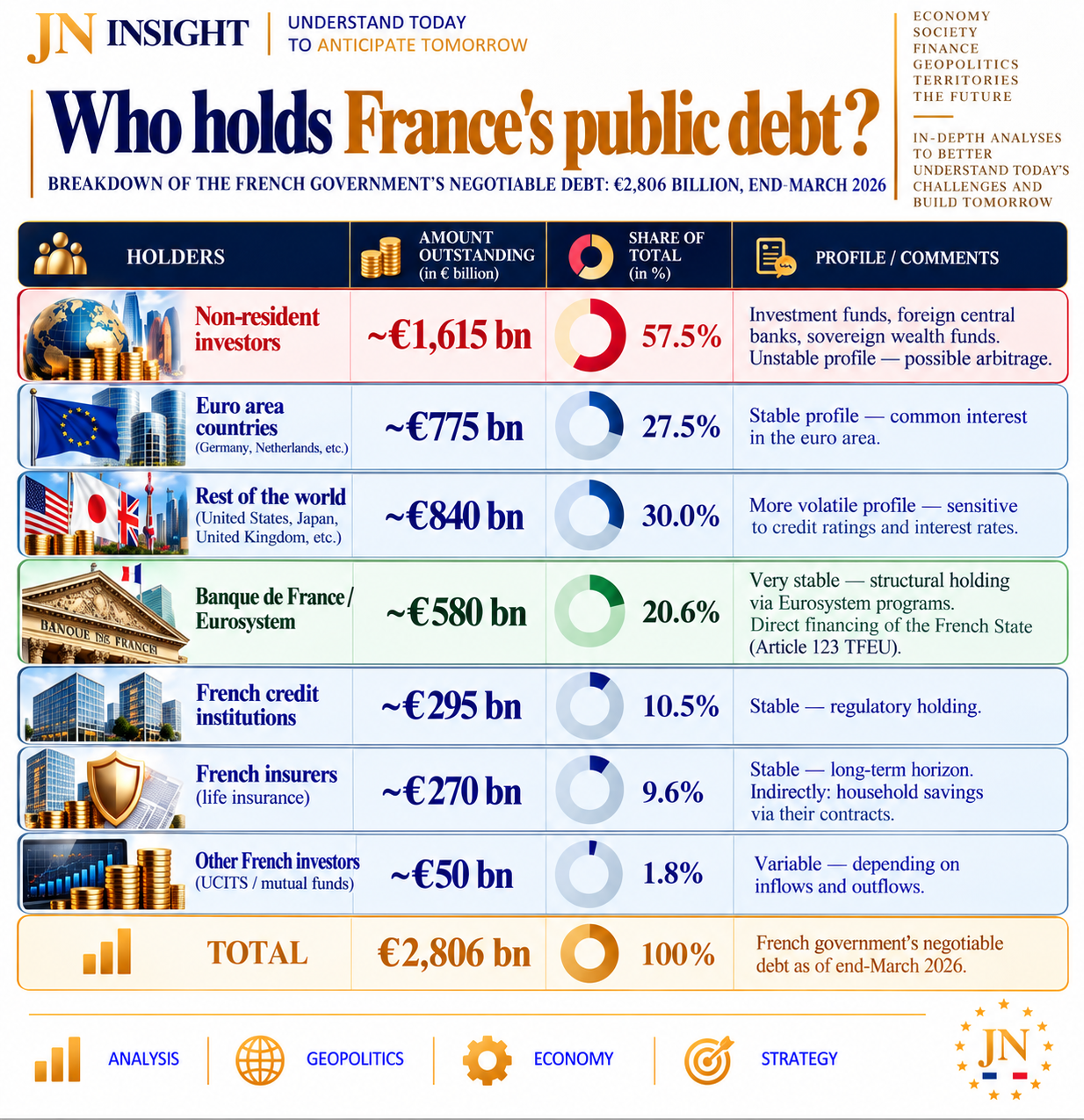
Sources: Agence France Trésor, Banque de France, National Assembly, le-francais-moyen.com, March 2026
Be careful not to confuse the "negotiable debt of the State" with the "total public debt" of 3,536 billion, which is that of the State, but also of Social Security, local authorities and hospitals. The marketable debt of the State, on the other hand, represents about 2,806 billion: these are the bonds issued by the State on the financial markets, which are bought and resold every day like shares. It weighs nearly 80% of the public debt. The rest, especially bank loans to local authorities and Social Security debt, are not traded in the same way. It is precisely this negotiable debt that is exposed to the markets: it is this debt that foreign investors buy, and it is this debt that they can sell overnight.
So let's now look at this table, and then compare it with Japan. Its public debt exceeds 200% of its GDP, almost double that of France. And yet, Japan sleeps peacefully. Why? Because more than 80% of its debt is held by Japanese investors: banks, pension funds and the central bank. So the circle is closed. When the international markets panic, Japan does not tremble. Its creditors are at home.
France, on the other hand, presents the opposite situation. 57.5% of its marketable debt is in the hands of non-residents. Nearly half are in the euro zone (Germany, Luxembourg, Ireland in the lead), the rest mainly in the United States and Japan. They are first and foremost asset managers and banks; foreign central banks and sovereign wealth funds represent only a minority. Their logic is purely financial. If France loses their confidence simply because of a downgrade in its rating, or a deficit that gets out of hand, or if a government staggers, they sell. And when they sell, the rates go up. And when the rates go up, the bill explodes.
This is the Achilles heel of the French debt. And every year, an increasing share of the interest paid by the French taxpayer goes abroad.
France no longer has a printing press. It has the markets, and they have a memory.
So what exactly is the structure of this 3,500 billion? What do they correspond to in detail?
Part VI — The structure of the debt: anatomy of the €3,500 billion
As mentioned above, the latest official INSEE figure stands at €3,536.1 billion at the end of Q1 2026 (117.5% of GDP).
But behind this overall figure lie several very different realities:
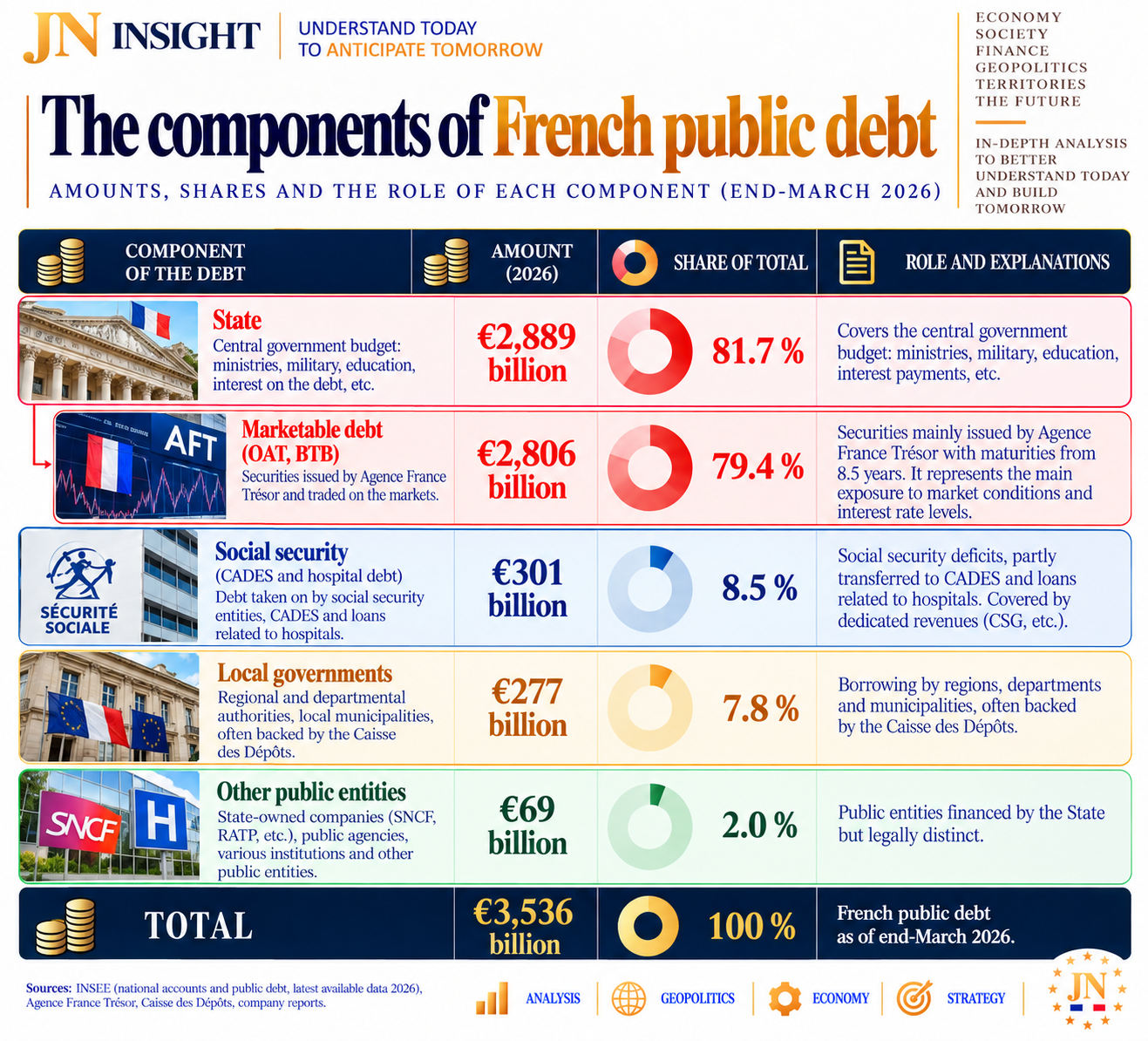
This table says one essential thing: 80% of this debt is government bonds. However, a bond is not repaid like a mortgage. The state pays the interest every year, then returns all the capital at once, at maturity. And to return it, it borrows again. This is the illusion of repayment: France does not repay its debt, it rolls it over. Each bond that matures is replaced by a new one, like a credit card that is repaid with another credit card. In 2026, the state plans to borrow €310 billion on the markets, a record. Except that bonds issued at around 1% are now refinanced at more than 4%.
The irony of the picture is that the only debt that is really repaid is that of the Social Security system housed in CADES, financed by a dedicated tax, the CRDS. The State, for its part, has never planned anything of the kind. The debt does not disappear. It grows, and ends up costing more and more money.
It is therefore necessary to think about the outlines of solutions.
Part VII — Where to Start: Early Leads
France's real problem is now clearly structural. And the infernal spiral leaves almost no room for manoeuvre.
Let's think like a company manager. In a profit and loss account, when expenses exceed revenues without the possibility of increasing turnover, there is only one option: to tackle the expenses. This involves opening the hood, looking at and analyzing each item line by line, and then making a decision. But some items are more challenging than others:
1. Tax loopholes : these are exemptions, reductions and tax credits granted to certain companies or households. Nearly 100 billion euros in lost revenue each year, more than the interest charge. Some are legitimate (research tax credit, energy transition), others survive only by political habit or lobbying. A line-by-line review is necessary.
2. Pensions: we cannot continue to finance 25 years of retirement with 1.7 contributors for every 1 retiree. This is arithmetically impossible. Without a profound reform of the system, no other lever will be enough.
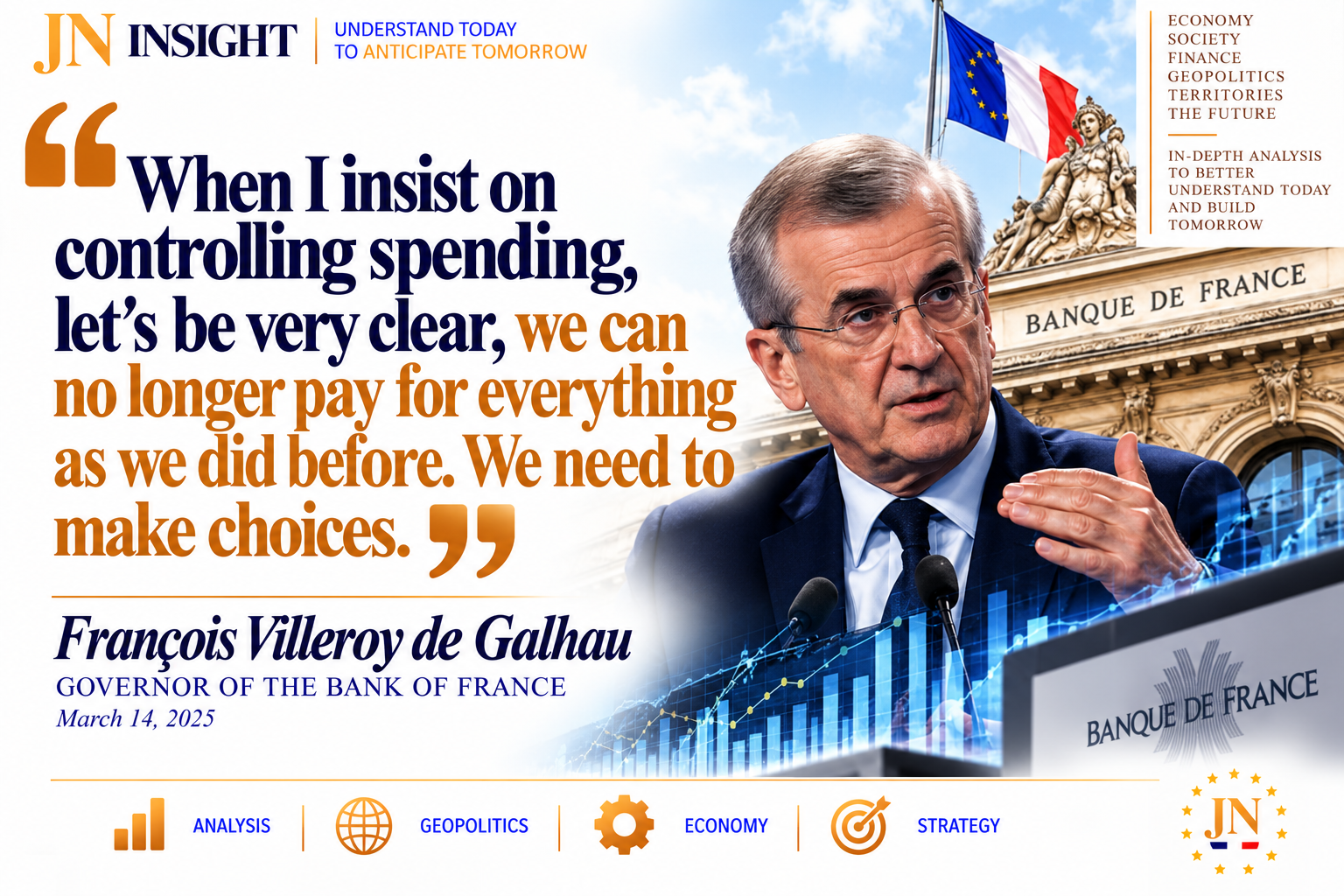
3. A spending rule that really commits. Cap the increase in spending below that of growth, over several years, under the control of an independent arbitrator whose opinion is necessary. Today, the High Council of Public Finances issues opinions that no one is obliged to follow. Because confidence has a price: one point of interest will eventually be more than 32 billion euros per year. Trust cannot be decreed. It is proven, budget after budget.
These are only avenues. The real work, titanic, will have to cover every item of expenditure.
What to remember?
The French debt will not fall on you tomorrow morning. But it is already there.
Compared to 68 million inhabitants, the debt represents more than €50,000 per French person. But there is another, even more disturbing angle.
France is not bankrupt. A powerful economy, global companies, world-class researchers, euro debt with the ECB as a safety net: it has the means to get by. The real question is: "Will it want to?"
And there you have just found the question of Episode III.
→ Next week: THE UNITED STATES. More than $38 trillion in debt. Yet — the markets are sleeping quietly. Because the United States has a weapon that France doesn't. The dollar. And to understand that weapon — is to understand why the global monetary order is shaking. To be continued.
Intellectually yours,
Jean-Noël Niamké Financial Expert
Geo-Strategic and Geopolitical Analysis
JN Insight — The Mechanics of Power | The truth beyond appearances.
Our Sources: here 👉