Perfume: 5,000 Years of Invisible Dominion
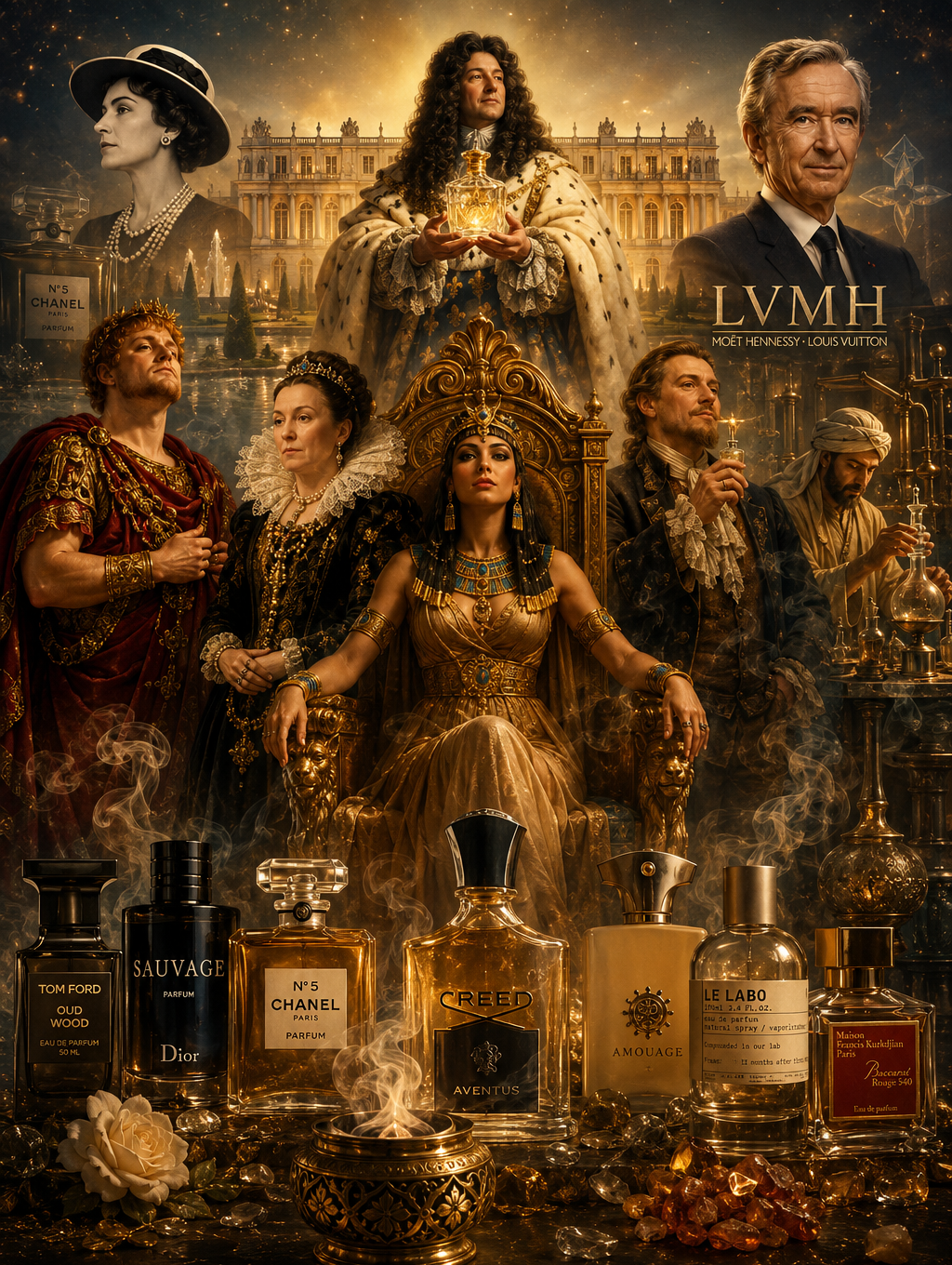
From the incense of the pharaohs to the wars of global luxury — the history, the business, and the psychology of an invisible weapon.
Long before it became a luxury, perfume was an emblem of power. Power has always made itself seen. Yet it has always made itself smelled as well.
From the temples of Mesopotamia and Egypt to the palaces of Versailles, scent has forever served to set the elite apart from the rest of the world. This is no accident. It is a strategy five thousand years in the making.
PART I — FROM GODS TO KINGS: PERFUME AS AN ATTRIBUTE OF POWER
Perfume did not begin as a pleasure, but as an offering. From the Latin per fumum — “through smoke” — it was the tongue in which the Mesopotamians addressed their gods. From its very origin it did not adorn: it distinguished.
It is a language.
In Egypt, sacred essences were not bought; they were earned. Reserved for the priesthood and the pharaohs, they were divine attributes slipped even into the tombs to accompany the dead into the hereafter. Cleopatra would go so far as to make of them an instrument of statecraft, turning the olfactory into a lever at once diplomatic and sensual.

In Rome, fragrance became a marker of rank worn to the point of intoxication.Caligula (Roman emperor of the first century AD, in power from AD 37 to 41) lavished fortunes upon imports from the East — nard, cinnamon, the frankincense of Judea — in defiance of all restraint, while Nero (Roman emperor, in power from AD 54 to 68) perfumed his mules and his banquets alike, leaving his guests scented for days on end. To smell stronger than others was to remind them all of one’s dominion.

To smell stronger than others was to remind them all that one stood above them.
In the eleventh century, the physician and philosopher Avicenna revolutionised the craft with steam distillation. The rose of Persia, oud, and ambergris would together compose the very vocabulary of global luxury.
An inheritance that Catherine de Médicis (sixteenth-century Queen of France, wife of King Henri II and mother to several kings of France) would carry to the French court in the sixteenth century, making Grasse the world capital of essences. It was under Louis XIV that perfume became a genuine instrument of governance. At Versailles, every chamber held its own fragrance, conditioning the visitor before a single word was spoken. In a France where a “true bath” was a rare, once-yearly affair, perfume allowed the high court to mask the odours of the body and to maintain an invisible — yet brutal — separation between those who govern and those who obey.
Versailles did not invent perfume, but it did much to transform it into the very language of aristocratic power.
If Guerlain, founded in 1828, laid the foundations of the modern house, it did so upon this royal inheritance: perfume is not a luxury but a social necessity. France had only to transform this courtly language into a worldwide economic empire.
From temple to palace, perfume has always traced the same dividing line between those who govern and those who obey. Invisible. Yet impossible to ignore. This olfactory frontier France would, in time, transform into a true economic empire.
PART II — FRANCE, THE DOMINANT POWER OF OLFACTORY LUXURY
In 1921, Gabrielle Chanel (better known as Coco Chanel, a French fashion designer of the twentieth century) launched N°5 in collaboration with Ernest Beaux (a Franco-Russian perfumer, celebrated above all for having created Chanel N°5 ). It marked a historic rupture: for the first time, one no longer sold the imitation of a flower, but an abstract identity. This revolution founded modern luxury — the selling of a sovereign promise rather than a mere product.Chanel N°5 became the first truly modern perfume. It no longer sought to imitate the rose or the jasmine. It embodied a woman — abstract, free, sovereign.

Today, this inheritance makes France the undisputed leader. LVMH reigns with a 12.5% market share in 2025, followed by Chanel, Hermès, and L'Oréal. One figure alone captures this hegemony: Sauvage by Dior has been the best-selling perfume in the world since 2021, across every category combined.
Yet behind the prestige lies a cold financial truth: perfume is the cash cow that bankrolls haute couture. Where a runway show conjures dreams at a loss, perfume yields gross margins exceeding 90%. It is this “democratic” volume that sustains the elitist illusion of the catwalk.
Herein lies the true European moat: where the United States dominates through code and China through minerals, Europe holds the monopoly on history. The legacy of Grasse cannot be replicated by algorithms. It is an intangible power — yet structurally unassailable.

France did not invent perfume. It invented the idea that perfume could become an empire. This empire of desirability — patiently built over centuries of craft and prestige — now confronts a marketplace profoundly reshaped by the digital age, by globalisation, and by the emergence of new olfactory centres of gravity.
KEY FIGURES — THE GLOBAL PERFUME INDUSTRY IN 2026
+5.7 to 6.1% per year — Projected average annual growth rate through 2033–2035.
+12.5% — LVMH global market share in 2025 — the undisputed leader.
Sauvage by Dior — The best-selling perfume in the world in 2025, across all categories. One bottle sold every thirty seconds.
€3.5 bn — The price Kering paid to acquire Creed in 2023, before reselling it to L'Oréal two years later.
+$100 bn — Projected global market by 2034–2035 (Precedence Research: $101.47 bn; Grand View: $96 bn).
PART III — THE MARKET TODAY: THE NICHE WARS, ARAB SOFT POWER, AND M&A
The global perfume market is estimated at around $60 billion in 2025, with a projection exceeding $100 billion by 2034. Yet behind these figures, the market is fracturing: on one side, a mass-market surge accelerated by the digital age; on the other, a reconquest through the rare and the exclusive.
- Democratisation and the simulation of status: The mass-market segment accounted for 58.7% of global revenue in 2024. From luxury “dupes” on TikTok to fast-fashion collections, perfume becomes a simulation of social status. The consumer purchases not a scent, but a symbolic sense of belonging.Against this mass-market tide, a contrary movement is taking shape: a reconquest through exclusivity.
- The niche countercurrent: in answer to this banalisation, houses such as Byredo, Le Labo, and Diptyque are reinventing distinction. Here, exclusivity is the rule. Such value draws the giants of M&A: after Kering's purchase of Creed (€3.5 bn), it was L'Oréal that finalised, in 2026, the acquisition of Kering Beauté for €4 bn. The message is unmistakable: the great conglomerates are buying back their own prestige to guard against dilution.
The M&A battle: in luxury as elsewhere, independence is, more often than not, absorbed in the end by capital. Kering acquired Creed for €3.5 billion in 2023. Two years later, L'Oréal acquired the entire Kering Beauté portfolio — Creed included — for €4 billion, with it the exclusive Gucci, Balenciaga, and Bottega Veneta licences for 50 years. The largest acquisition ever made by L'Oréal. Luxury no longer merely sells; it buys back its own prestige to guard against dilution. Alongside this concentration of capital, new olfactory centres of gravity are emerging.
- The Middle East, the new olfactory superpower : a new centre of gravity is rising — the Middle East, $3.7 billion in 2025, growing steadily. Oud, once exotic, now establishes itself as the very benchmark of olfactory power in the West. It is a shift of influence: where the twentieth century smelled of France (florals), the twenty-first smells of Arabia (amber, precious woods). Once more the East perfumes the West, imposing its codes upon the new fortunes of the world.
- China as the next battlefield: the great conglomerates no longer merely export there — they are buying up local Chinese niche houses such as To Summer or Documents, the better to appropriate Asian olfactory codes before they can come into their own.
From the westernmost point (Honolulu, Hawaii, USA) to the easternmost (Auckland, New Zealand), by way of Hong Kong, Bombay, Paris, and New York — perfume remains synonymous with power. Everywhere on this planet, whatever the language, the culture, or the social rank, one truth holds: the better one smells, the greater one’s presence. Perfume may well be the only symbol of power that requires no translation at all.
PART IV — THE PSYCHOLOGY OF PERFUME: THE INVISIBLE POWER
Perfume does not act upon reason. It short-circuits reason. It acts directly upon memory and upon emotion.
Perfume does not act upon reason; it short-circuits it. Smell is the only human sense wired directly to the limbic system, the seat of emotion and of instinctive memory. Unlike the other senses, scent reaches the brain before it can ever be consciously processed.
This is what is known as olfactory priming. A woody fragrance summons authority; a fresh trail evokes trust. This is not marketing — it is applied neuroscience.
The elite have mastered this instrument for millennia. Today, multinationals and grand hotels (Ritz-Carlton, Hermès) diffuse signature scents to condition the customer’s experience before the first visual contact is even made. For leaders and heads of state, the signature scent is a strategy of presence. Perfume is the most sophisticated form of social influence there is, for it operates beneath the threshold of consciousness.
This is not marketing. It is applied neuroscience.

Jean-Claude Ellena, former in-house perfumer to Hermès
Perfume may well be the most sophisticated form of social influence ever devised — precisely because it operates beneath the threshold of consciousness.
WHAT TO TAKE AWAY?
Civilisations have changed. Empires have crumbled. Yet one thing has never disappeared: the need of the elite to smell different from the rest of the world.
Some powers dominate through armies, others through currency. Perfume, for its part, dominates through memory.

→ When you choose a perfume, do you truly choose freely — or do you let something far deeper speak on your behalf?
Intellectually yours,
Jean-Noël Niamké, FINANCIAL EXPERT. Strategic, cultural & geopolitical analysis