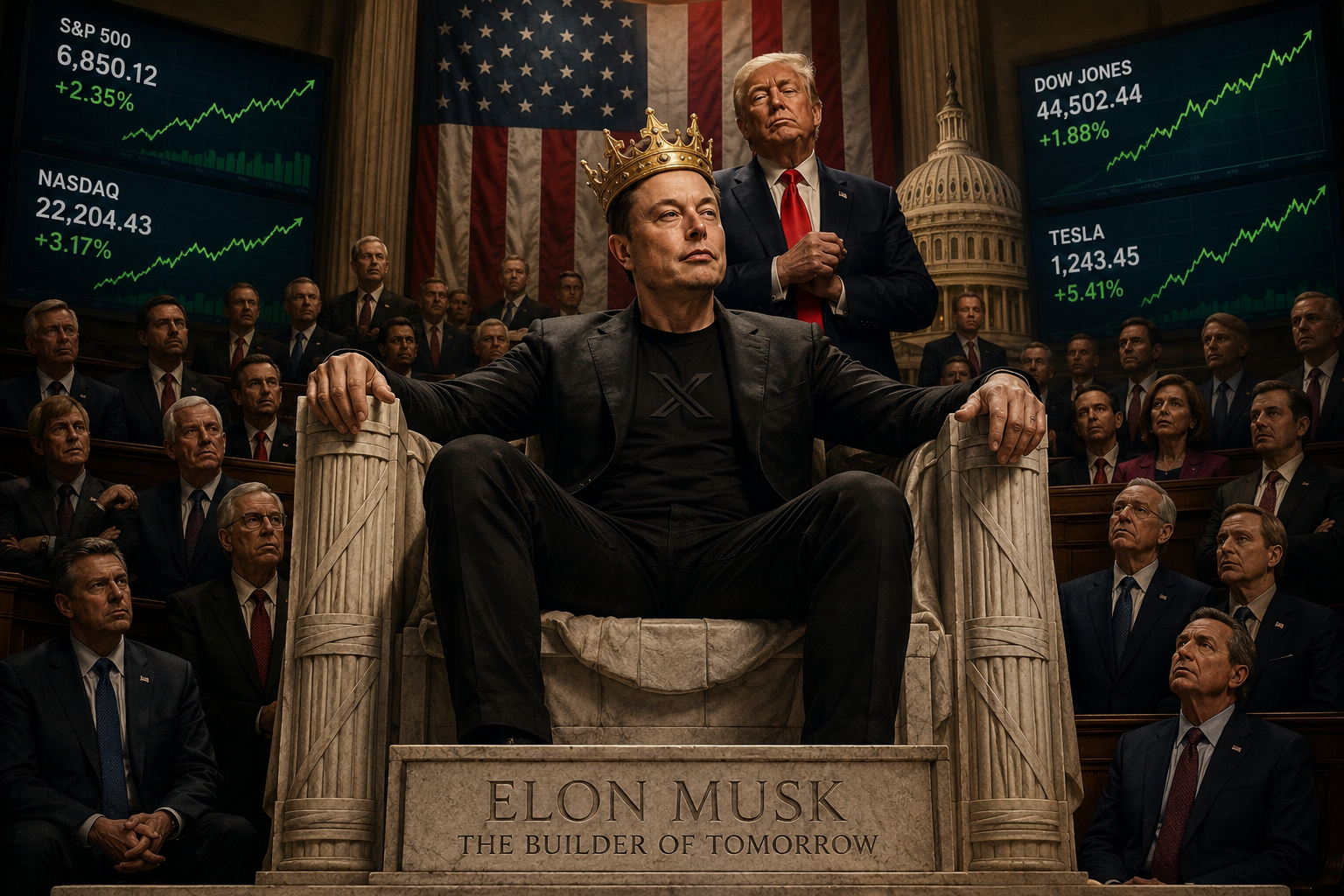
Elon Musk: Megalomania or Disproportionate Power ? How one man transformed three critical industries and multiplied his fortune from $300 billion to $800 billion
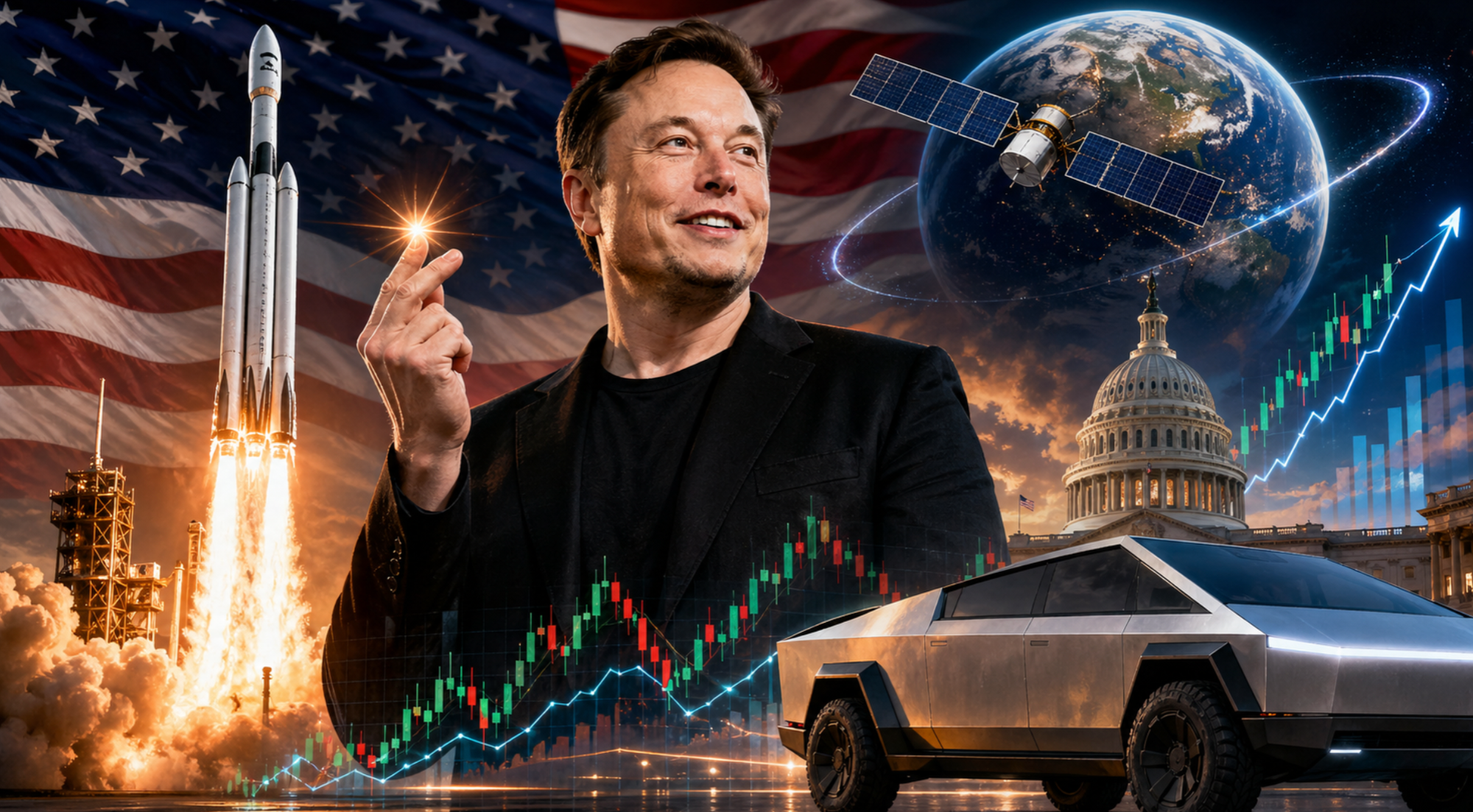
He does not run a company. He runs a myth
Within two decades, Elon Musk has transitioned from eccentric entrepreneur to systemic actor in the global economy. His personal fortune, estimated at around $300 billion only a few years ago, surpassed the $800 billion threshold in early 2026 according to Forbes Real-Time Billionaires. As of May 2026, Forbes estimates it at around $827.7 billion, whilst Bloomberg maintains a more conservative figure of $696 billion — the divergence reflecting different methodologies applied to SpaceX, xAI and private assets.
This is not merely a matter of patrimonial accumulation. It is the valuation of an empire that controls several critical infrastructures of the future: electric mobility, space, satellites, artificial intelligence, digital influence and the human-machine interface.
Musk does not build products — he builds levers of power.
PART I The Musk Myth: Three Critical Industries Under Control
The meteoric ascent of his fortune rests upon the capture of infrastructures vital to the future of civilisation.
Tesla — the financial platform. With 1.64 million vehicles delivered in 2025, Tesla is no longer a mere manufacturer: it is an option on the future, underpinned by the promise of high software margins around autonomy and robotics. Its Supercharger network, now established as the NACS standard across North America, functions as a potential toll upon electric mobility.
SpaceX — the sovereign infrastructure. Its valuation exceeds $1,000 billion according to recent secondary transactions reported by Reuters — with certain estimates placing it at approximately $1,250Bn for SpaceX alone, and up to $1,750Bn for the combined SpaceX-xAI entity. This renders it one of the most strategically significant private entities in the world. It is no longer a space company — it is a military and diplomatic infrastructure bound by deep contracts with the U.S. Space Force (the sixth branch of the United States Armed Forces, established on 20 December 2019 under the National Defense Authorization Act).
Starlink — the invisible weapon. With thousands of satellites in orbit and more than 20 million subscribers as of May 2026, Starlink has become a decisive instrument of power projection in modern conflicts. It is not merely an internet solution. It is an infrastructure of strategic continuity. In Ukraine, its role demonstrated that a private satellite network could prove vital to communication, coordination and wartime resilience. In Taiwan, the question is yet more sensitive: in a crisis scenario, access to independent satellite connectivity could become a major military and diplomatic stake.
When a single executive can influence connectivity across a war zone, we are no longer speaking of innovation alone. We are speaking of power.
To these must be added xAI, acquired by SpaceX in early 2026 in a transaction valuing the combined entity at $1,750 billion — one of the largest private transactions ever executed — X (formerly Twitter, a real-time influence terminal), Neuralink (brain-computer interface) and The Boring Company (a tunnelling enterprise founded by Musk in 2016). Six companies. Six strategic sectors. xAI is now positioned as the direct rival of OpenAI (proprietors of ChatGPT), placing Musk at the epicentre of the global battle for artificial intelligence: data, models, computing power and cloud infrastructure.
With the SpaceX-xAI merger, Musk no longer merely controls transport to space; he is positioning himself across the processing of global data. This is the fusion of technological hard power — rockets, satellites, physical infrastructure — and cognitive soft power — AI, algorithms, influence, public opinion.
The stake is no longer simply to produce a high-performing AI. The stake is to control the cognitive infrastructure of the world to come.
Bezos controls Amazon. Zuckerberg controls Meta. Cook has rendered Apple indestructible. Musk, for his part, controls the equivalent of six global giants simultaneously.
Yet his fortune did not explode by chance. It rests upon five strategic levers.
PART II The Five Levers Behind Musk's Fortune
Narrative as a market lever: Musk commands the art of storytelling. Each announcement becomes a multiplier of attention, anticipation and, at times, valuation. His public interventions have already moved entire markets — from Dogecoin (a cryptocurrency created in 2013 by engineers Billy Markus and Jackson Palmer) to Tesla. He does not merely sell products: he has transformed his own personality into a financial asset.
Total vertical integration: From battery supply chains to AI, Musk relentlessly seeks to reduce his dependency on third parties. Tesla controls software, data, batteries and the user experience; SpaceX controls rockets, engines, satellites and orbital access. The logic is straightforward: control the critical components to control the margins, the pace and the narrative.
Maximum risk as method: Musk does what others don't dare. He launches too early, fails publicly, burns through capital, and announces the impossible. For others, this would be reckless. For him, it has become a strategy: chaos attracts attention, and attention attracts capital. Musk himself sums up this logic with a now-famous phrase:
“Failure is an option here. If things are not failing, you are not innovating enough.”
By accepting the public failure of his prototypes (exploding rockets, rejected robotaxis), he saturates the media and discourages the competition.
Capture of public resources: The Musk paradox is that he defies the State whilst having been made largely possible by it. He deploys public money to build private infrastructures that ultimately render the State dependent upon him. SpaceX was built upon NASA and Pentagon contracts. Tesla benefited from carbon credits, from the Inflation Reduction Act subsidies, and from a regulatory environment favourable to electrification. Starlink becomes strategically critical precisely because States themselves may depend upon its satellites in crises or conflicts. Musk likes to present himself as a man against the system. Yet his empire is one of the most advanced products of the American system. He defies the State with the very power the State helped grant him. Musk is not the enemy of the American State — he is its enfant terrible.
The attention infrastructure: With the acquisition of X, Musk does not merely control a social network. He controls a real-time influence terminal capable of moving stock prices and public opinion within hours. The algorithm determines what rises, what disappears, what becomes debate, controversy or perceived truth. Beyond satellites, space and AI, Musk here touches an immaterial infrastructure: public opinion itself.
KEY FIGURES — The Musk Empire, May 2026
$782.1Bn — Personal fortune (Forbes).
$1,250Bn — SpaceX valuation.
$1,750Bn — Combined SpaceX-xAI valuation (Musk: 43%).
1.64M — Tesla vehicle deliveries in 2025.
20M — Starlink subscribers as of May 2026.
~2.5× — Wealthier than the world's second-richest individual (Larry Page).
PART III Power or Megalomania: A Deliberately Blurred Boundary
The line between visionary and megalomaniac is deliberately blurred in Musk's case — it is, in fact, part of his model.
This is precisely where the case becomes fascinating. Musk professes to wish to "save humanity" — by colonising Mars, by safeguarding freedom of expression, by preventing AI from destroying civilisation. Messianic discourse? Without question. Megalomania? On paper, yes. But consider the facts: SpaceX has reduced the cost of reaching orbit by 90%. Tesla has compelled an entire century-old industry to reinvent itself. Starlink connects rural areas that had never previously been served.
Two observations are warranted.
First, Musk has become an asset class unto himself — he carries weight in the investor imagination comparable to a major stock index. His interventions can shift attention, expectations and, at times, capital flows.
Second, he has established himself as a non-state geopolitical actor. His decisions regarding Starlink or the siting of Gigafactories (vast manufacturing facilities dedicated to batteries and electric vehicle powertrains) make him an interlocutor for heads of state, often outside conventional diplomatic channels. This is unprecedented in modern history.
Yet the darker side is unmistakeable. In 2025, his controversial role within DOGE (Department of Government Efficiency), within the orbit of the Trump administration, reinforced the image of a private executive capable of intervening directly in the mechanics of the State — before his relationship with Trump deteriorated spectacularly. The DOGE episode revealed the limits of the sovereign entrepreneur. Musk sought to apply to the federal government the logic of his enterprises: speed, cuts, ruthless execution, disregard for procedure. But the American State still disposes of countervailing forces: Congress, the courts, public opinion, the media. Even Musk may collide with democratic safeguards. This is precisely what distinguishes him from Jack Ma: in the United States, the limits are institutional; in China, they are partisan.
xAI is the subject of investigations in Europe, Asia, Australia and California for deepfakes generated by Grok (Radio France, February 2026). On 20 March 2026, a federal jury in San Francisco found Musk civilly liable for misleading Twitter investors through two tweets in May 2022 — damages estimated at between $2.1Bn and $2.6Bn (CNBC, CNN).
His megalomania has its limits: an excess of power that ultimately confronts the collective conscience and the democratic guardrails of society.
PART IV The GAFAM Connection and the American System
Musk is not an anomaly within the American system. He is its version 2.0. Whereas the GAFAM exercise institutionalised corporate power — boards of directors, executive structures, organised lobbying — Musk concentrates everything upon his own person. More brutal, more rapid, far more political. And above all, he is the private extension of American power: SpaceX has become the Pentagon's spatial arm. Starlink is deployed as a geopolitical weapon in Ukraine — and Musk controls its access personally, raising vertiginous questions about state sovereignty in the face of a private actor. xAI is now the direct challenger to OpenAI/Microsoft. Where the GAFAM dominate digital infrastructure, Musk assails the spatial, energetic and cognitive infrastructure. The same imperial logic — at another order of magnitude.
Where the GAFAM have institutionalised corporate power, Musk embodies personal and political power: a logical, if perilous, evolution of the American exorbitant privilege.
The GAFAM are administered empires. Musk is a personalised empire.
This renders him swifter, more unpredictable — and more fragile. A decision at Microsoft or Amazon passes through committees, boards and internal arbitrations. A decision by Musk may sometimes rest upon an intuition, an obsession or a message posted on X.
That is the strength of the model. It is also its fragility.
PART V A Parallel with Jack Ma?
To appreciate what is singular about this freedom, one need only look to his Chinese counterpart. Jack Ma criticised the Chinese financial system in October 2020. Days later, the Ant Group IPO was suspended. Musk, meanwhile, attacks the SEC, acquires Twitter, defies regulators, disrupts the federal government — and remains free.
Where Beijing broke Jack Ma to protect its sovereignty, Washington allowed Musk to become a part of its own.
Jack Ma was brought to heel because he threatened the financial infrastructure of the Chinese State. Musk, by contrast, has progressively become one of the infrastructures of the American system: space, satellites, defence, AI, influence.
Two entrepreneurs.
Two systems.
Two definitions of power.
On one side, a party-state that disciplines its billionaires.
On the other, an American system that sometimes allows its billionaires to become quasi-sovereign actors.
Jack Ma endured the system. Elon Musk defies it — whilst remaining one of its most advanced products.
→ Read also: Bonus — Jack Ma: The Billionaire Beijing Called to Order
The Musk risk is that the man has become as important as his companies. Tesla depends upon his vision. SpaceX upon his ambition. Starlink upon his arbitrations. X upon his moods. xAI upon his capacity to attract capital, talent and computing power. In other words, Musk is simultaneously the central asset of his empire and its principal concentration risk.
Key Takeaways
Elon Musk does not build companies. He builds dependencies.
He does not sell products. He sells futures. He does not merely seek power — he seeks centrality.
The real question is therefore not whether he is a megalomaniac.
It is whether one man can control so many choke points of the future without himself becoming a systemic risk.
→ In your view, is Musk a visionary who rewrites the rules — or a man whose concentration of power is becoming a systemic risk?
To receive weekly analyses, subscribe to JN Insight.
PREVIOUS ARTICLES IN THE SERIES
- The Foundations of the American Economy
- GAFAM: How Five American Companies Conquered the World
- China: A Giant of Stone or of Salt?
- Bonus — Jack Ma: The Billionaire Beijing Called to Order
Intellectually yours,
Jean-Noël Niamké
FINANCIAL EXPERT
Strategic analysis, macroeconomics & geopolitics