Global Debt: Who Does the World Owe All This Money To?
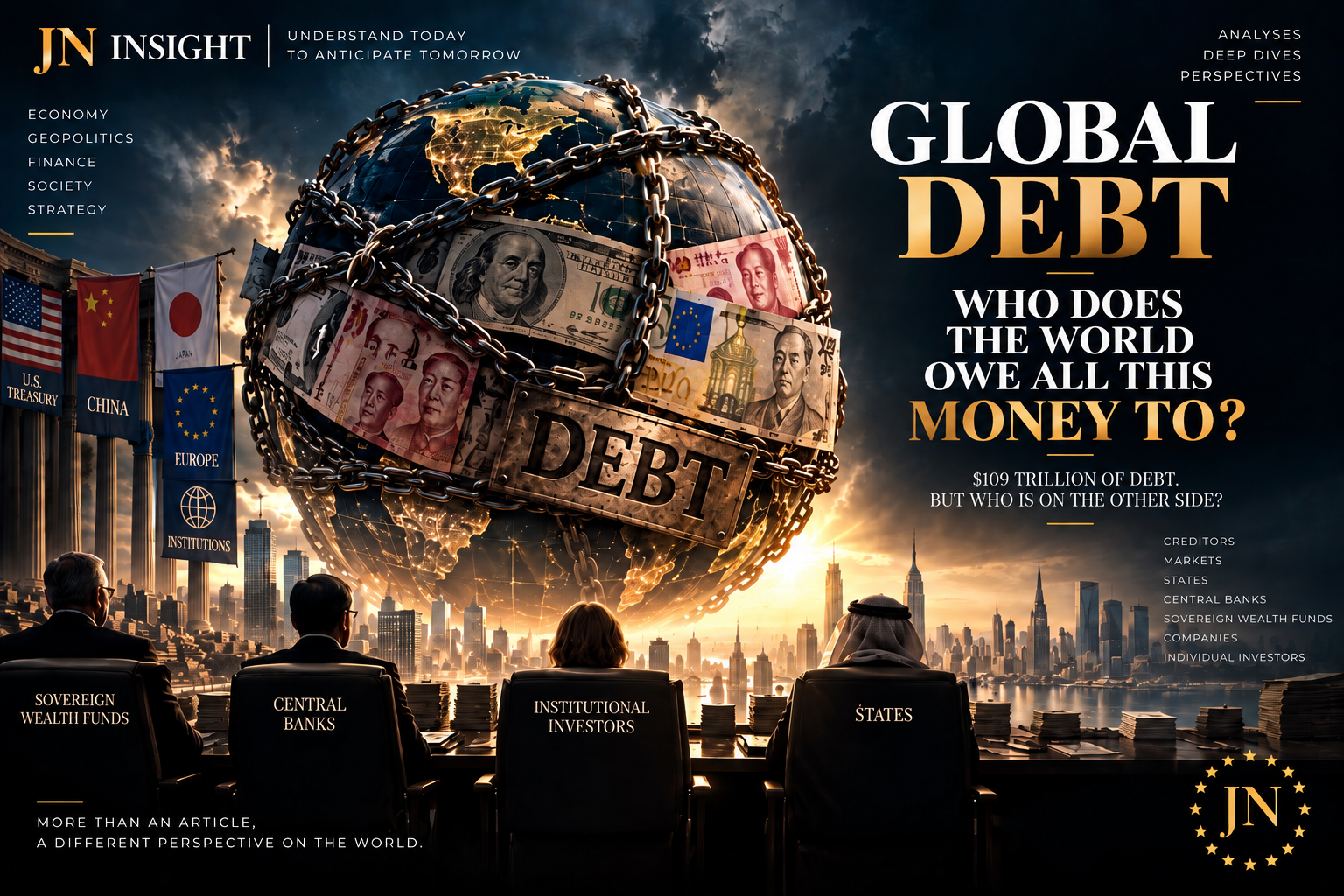
I/IV SERIES | JN Insight | September 2026
109,000 billion dollars. States that borrow to repay what they have borrowed. And a truth that no one wants to say clearly.
April 23th, 2010. Kastellorizo Island, Greece.
Georgios Papandreou, Greek Prime Minister, has just called the IMF. Presented as a "national and urgent necessity", it is no longer a choice. It is a capitulation. In the weeks that follow: pensions cut by 40% overnight. Hospitals without medicines. Queues in front of soup kitchens in the streets of Athens — the cradle of European democracy. A public debt that everyone had seen growing for years. And that everyone had preferred not to face up. It represented 146% of the national GDP.
What happened in Greece can happen elsewhere.
Not tomorrow. Maybe not in ten years. But the mechanisms that precipitated its crisis exist elsewhere — including in the most powerful economies. With one major difference: not all of them have the same weapons to deal with it.
Today, global public debt represents nearly 95% of the planet's GDP. And no one is queuing. Not yet.
States and companies have more than $109 trillion in securities in circulation.
109,000 billion.
If you spent a million dollars a day since the birth of mankind — about 300,000 years ago — you still wouldn't have spent $109 trillion. But that's not the most interesting number. The real question — the one no one asks — is: to whom?
And the answer will surprise you.
Part I — The Greatest Misunderstanding of the World Economy
When we talk to you about public debt, we very often draw a parallel with personal debt, namely: we borrow, we repay, otherwise it is bankruptcy. This is true for individuals; but it is fundamentally different for a state.
A state takes on debt by issuing bonds — securities bought by banks, pension funds, insurers, central banks, other states. These bonds have a maturity: 2 years, 5 years, 10 years, sometimes 30 years. When they mature, the government repays the holders well. But it does not pay off its debt for all that.
It issues new bonds to finance the repayments of old ones.
The debt is repaid. The debt remains, and starts again, and grows. Let's take a concrete example: in 2024, France borrowed €285 billion on the markets. Not to finance new hospitals or roads. But to repay €150 billion in maturing bonds, and pay €57 billion in interest.
In other words: more than half of what France borrows each year is used to repay what it has already borrowed.
JN Insight calls this the illusion of repayment : the misleading idea that public debt functions as a personal loan that ends up being paid off.
And going even further, the figure is just as spectacular: According to the OECD, governments and companies are expected to borrow $29,000 billion on the bond markets in 2026. For OECD governments alone, 78% of the borrowing will be used to refinance existing debt. This is not a scandal. This is the ordinary functioning of modern public finance.
But if states go into debt without ever really paying off — to whom do they owe all this money? The answer will make you smile.
Part II — To Whom Does the World Owe All This Money?
Here is the answer that no one gives you clearly.
To a large extent... to himself.
Central banks have become huge holders of government debt. The Fed holds US Treasuries. In the eurozone, the ECB and national central banks hold hundreds of billions of euros in sovereign bonds purchased as part of their monetary programs. In other words, the guardian of the currency has become one of the largest creditors of the state.
But there are also foreign creditors. And this is where preconceived ideas collapse. In September 2008, Lehman Brothers collapsed (subprime crisis), and Washington faltered.
Beijing thinks it sees an opportunity. It is therefore buying up US debt on a massive scale. At its peak, in 2013: $1,320 billion in Treasuries. China thinks it will become its rival's banker.
It was a trap.
By buying so many dollars, Beijing has tied its hands. Selling massively today would mean a fall in the value of its own reserves.
As a result, in June 2026, mainland China held only about $633 billion in Treasuries according to official US Treasury data; A 40% drop in thirteen years. It is now the third largest foreign creditor of the United States — behind Japan (1,147 billion) and the United Kingdom (940 billion).
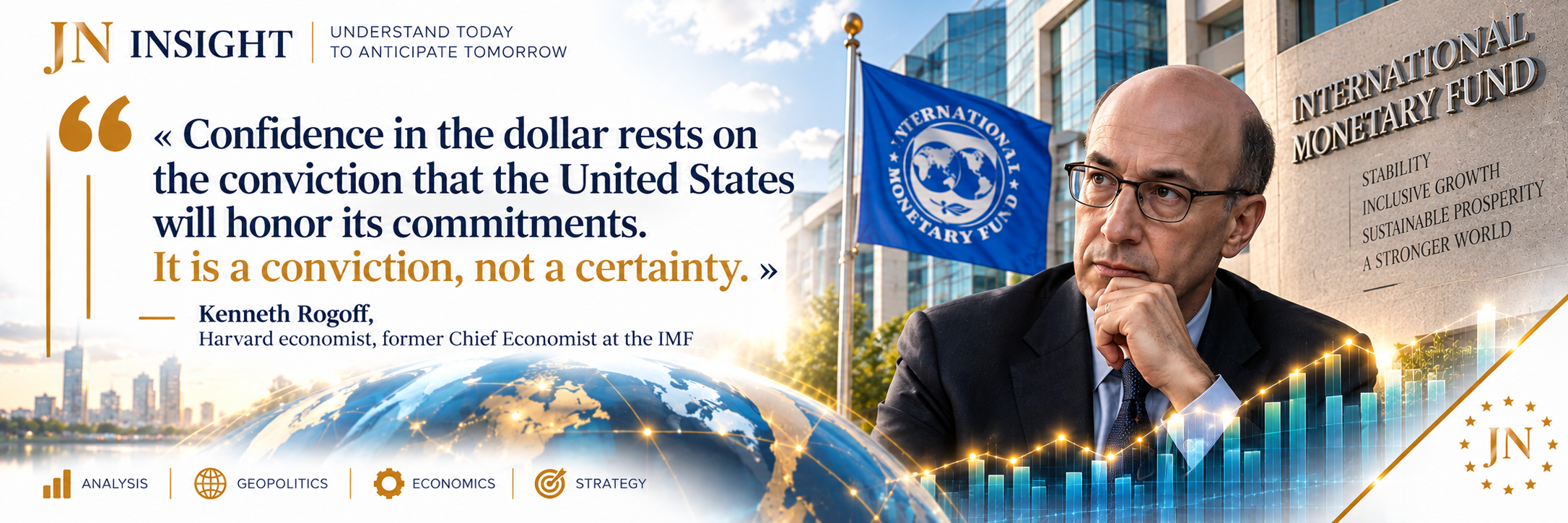
It is methodically retreating. This move is part of a broader strategy to reduce its dependence on the dollar. One thing is certain, its silent disengagement foreshadows something much bigger. How far does Beijing want to go? We'll get to that in the US episode. But first, there's a case that should terrify every finance minister in the world — and yet it's making almost no noise.
Part III — Japan: The Lesson No One Wants to Learn
Before going into details, here is a matrix that we would suggest to any Minister of Finance to post in his office.
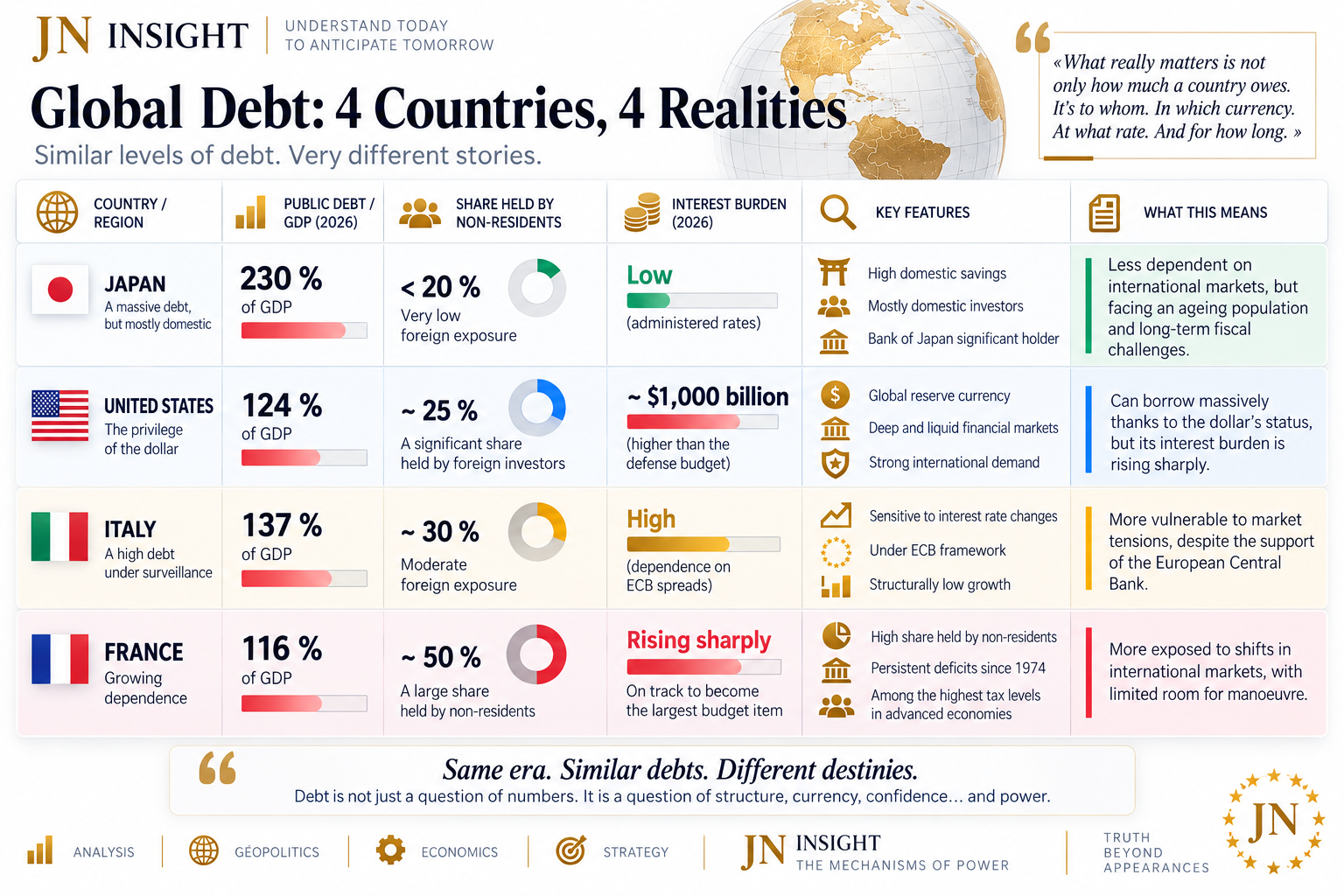
The gist is presented. Now, let's decode it.
Japan has a public debt that exceeds 230% of its GDP. Two and a half times what the country produces in an entire year. And it doesn't go bankrupt. Why? Because more than 80% of its debt is held by Japanese investors — and much of it by the Bank of Japan itself.
The Japanese owe money to themselves.
The country is therefore less exposed to the movements of foreign investors. The long-term challenges remain considerable: ageing, interest rates, sustainability, etc. but the structure of its debt gives it particular resilience.
Japan's lesson is simple and devastating: it is not the level of debt that decides everything. It is its structure, its creditors, its currency, and the confidence it inspires.
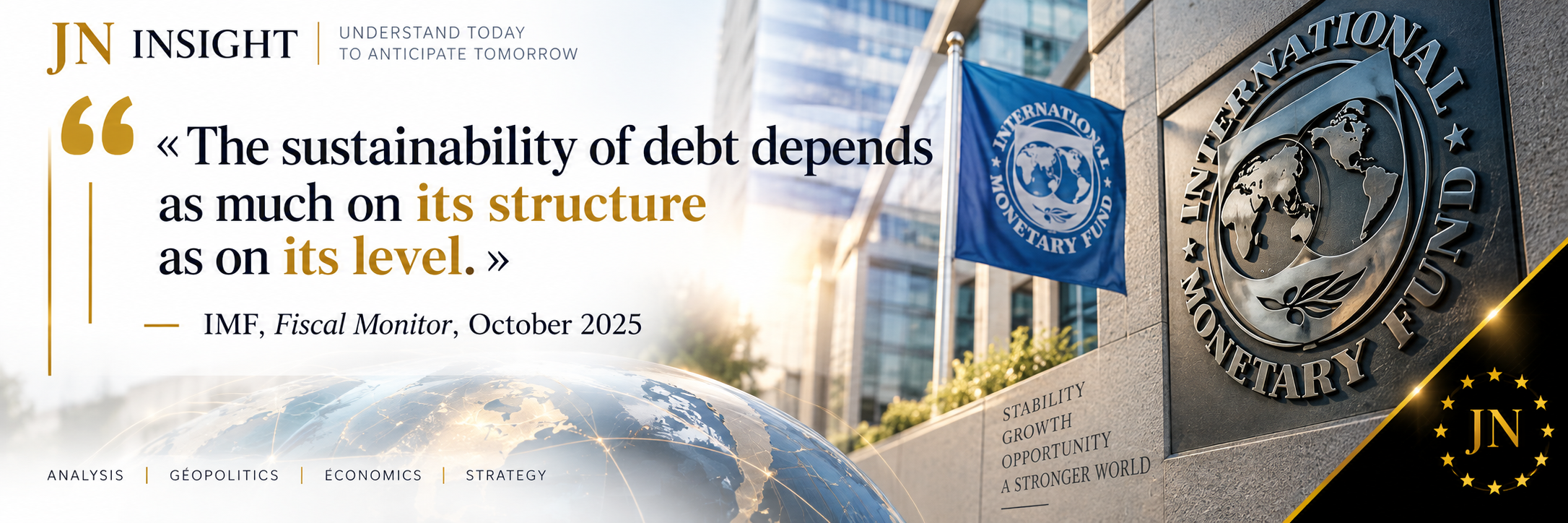
France, on the other hand, owes about 50% of its debt to non-residents.
But that's a whole other story that JN Insight will tell you next Friday. Before we get there, there is one more American piece of data that should be on the front page of all the newspapers. And that almost never does.
Part IV — The Number That Should Change Everything
This is the most intriguing information in this article.
In 2011, for the first time in its history, the United States lost its triple-A rating at Standard & Poor's.
The official reason: the political impasse over the debt ceiling and concerns about the US fiscal trajectory.
Fifteen years later, the trajectory has only worsened.
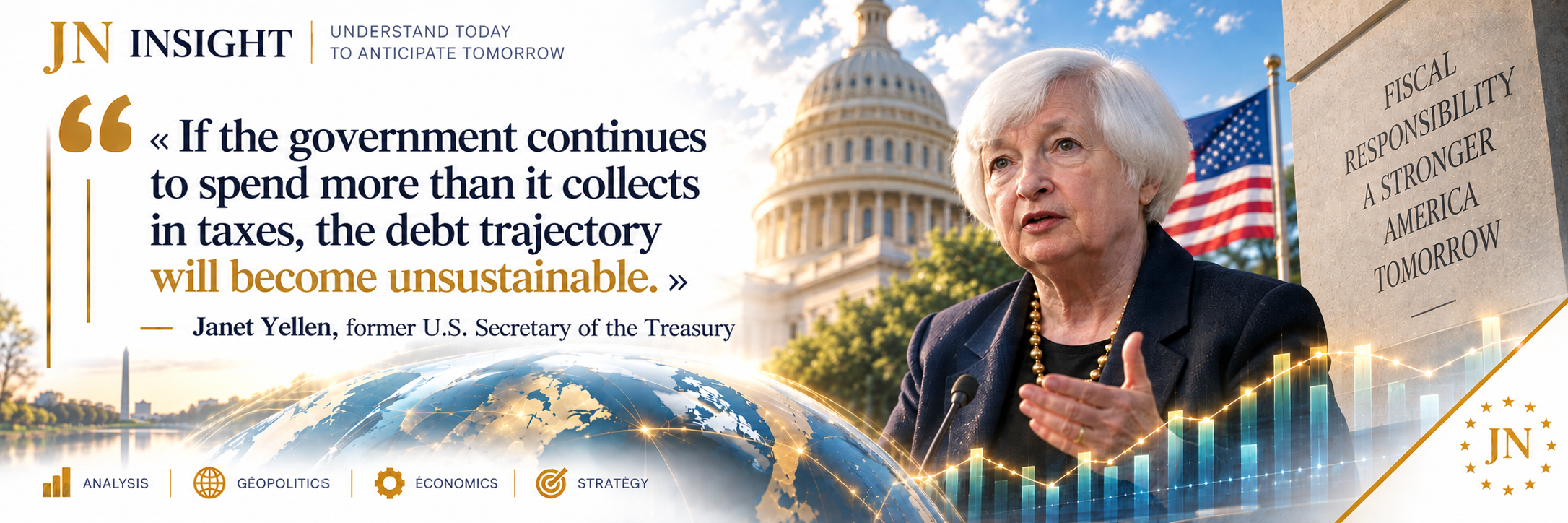
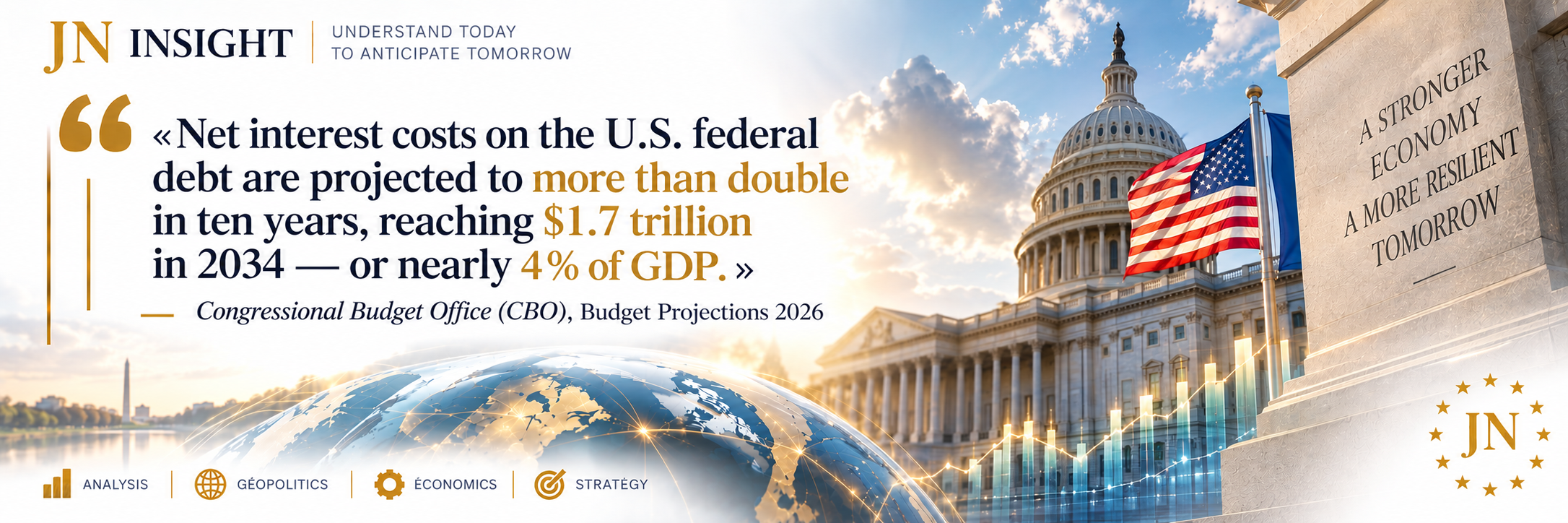
Today, in 2026, the United States spends about $1,000 billion on interest on its federal debt alone. More than its defense budget of nearly $918 billion.
Yes, you read that right!
The world's leading military power ends up paying more to service its debt than to finance its army. This is not an anecdote. It is a critical structural signal.
When debt servicing exceeds the army's budget, a spiral can be set in motion: each increase in interest rates increases the bill. The deficit widens, financing needs increase and, if rates remain high, refinancing in turn becomes more expensive.
This is how once strong countries have toppled over.
Greece didn't implode because it was small. It imploded because the spiral was set in motion, and the markets lost confidence before politicians had time to react.
France is experiencing the same mechanism. On a different scale and in a very different institutional context. But the arithmetic of debt remains the same.
So if it's so serious, why does it seem like the markets are sleeping?
Part V — Why it still holds
The answer can be summed up in one word:
Trust.
Investors do not lend to a state because they think it will repay everything. They lend to it because they believe that it will be able to continue to pay its interest, meet its maturities and refinance its debt under good conditions. As long as this conviction holds, the system works.
Sovereign debt is not based on the absence of debt. It is based on the credibility of the debtor.
But there is another reason why the United States, Japan or the eurozone countries can take on massive debt without sinking like Greece: they borrow in their own currency. The Fed can issue dollars. The Bank of Japan can issue yen. The ECB can issue euros.
Greece, on the other hand, borrowed in euros — a currency it did not control alone. It could not issue to save itself. When the markets refused to lend to it, there was no longer a safety net.
Controlling one's currency means having the last word on one's debt.
But trust is a fragile thing. Greece was credible — until the day it wasn't. Argentina was credible. Sri Lanka was credible. When trust cracks, debt doesn't go away.
It costs more, much more, and very quickly.
None of these solutions is politically comfortable. So the debt grows, and the question shifts.
What to remember – What it really changes for everyone
In 1816, after the Napoleonic Wars, France had to repay colossal debts. It never really repaid them. It refinanced them. For decades. Two centuries later, the mechanism is exactly the same. On a scale a thousand times larger.
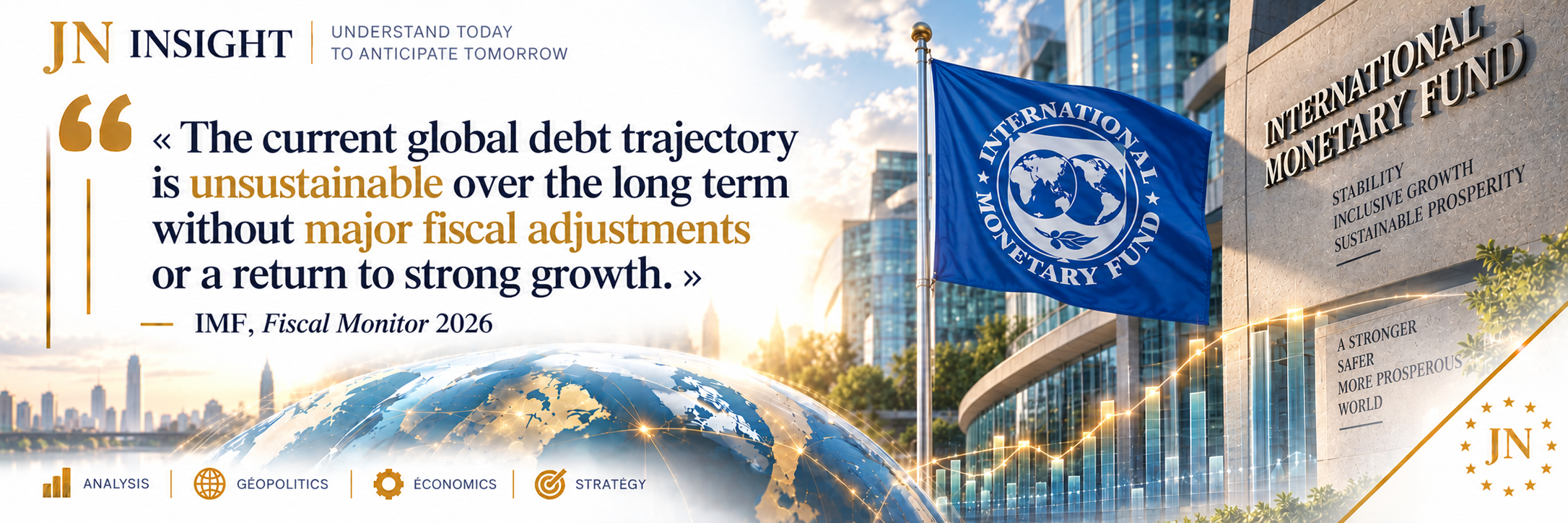
Global debt isn't falling on you tomorrow morning. But it's already weighing on your credit rates, on public services, on pensions, on infrastructure — and on governments' room for manoeuvre.
It also weighs on a generation that is not yet here to vote.
Poorly controlled, public debt has a formidable political particularity: it makes it possible to finance tomorrow what we decide today. To make citizens who do not yet have the right to vote pay for decisions that they have never approved.
But when it finances investments that also enrich these future generations — infrastructure, education, energy transition — the equation is different.
This is why the real question is never only: how much has been borrowed? Rather, what has been done with the money?
→ For next week: FRANCE.
Since 1974, France has not had a balanced budget, i.e. for fifty-two years. Under the right, under the left, under cohabitation. 3,500 billion euros. Nearly 50% held by non-residents. We will try to better understand the mechanisms and structure of this debt.
To be continued in the next issue 😊.
Intellectually yours,
Jean-Noël Niamké Financial Expert Geo-Strategic and Geopolitical Analysis
JN Insight — The Mechanics of Power | The truth beyond appearances.
Sources: Here 👉