African Debt: A Tool for Development or a Weapon of Dependence?
VOLUME I — THE GEOMETRY OF CREDITORS
JN INSIGHT — November 2026
117.5%.
That is the point at which a state stops governing and starts repaying.
Not a metaphor, but a number, a country and a date, all as real as they are concrete.
It all happens in Accra, in December 2022. Ghana suspends repayments on its external debt.
No coup, no war, no natural disaster.
Just arithmetic. Let me explain.
In fact, in 2022, Ghana’s debt service, including both interest and principal, amounted to 117.5% of its total government revenue, according to the IMF’s Article IV report on Ghana. Repayment obligations exceeded the state’s entire annual income. To meet its obligations to creditors, Ghana had to borrow more and more to repay what it had already borrowed.
And what about civil servants, hospitals and schools? All funded through fresh deficits or painful spending cuts.
This was not a country that had squandered its resources. It was a country turned inside out by the machinery of the system, magnified over the years by its own financing choices.
And Ghana is not alone.
Over the period 2019–2021, UNCTAD (the United Nations Conference on Trade and Development) recorded 25 African countries spending more on interest payments on their debt than on their healthcare systems.
Twenty-five countries, hundreds of millions of people; national budgets drained before the state could even decide what to do.
This article will not make the case for creditors. Nor will it make the case for debtors. Instead, it will dissect the machinery.
Because the real question is not: who is to blame?
But rather: how has this system lasted so long?
Part I – The Trap Was Not Built in a Day
The most common mistake about African debt is to make it begin in 1960. Independence did not leave behind massive debts. Most new states started with poor, but relatively clean, balance sheets.
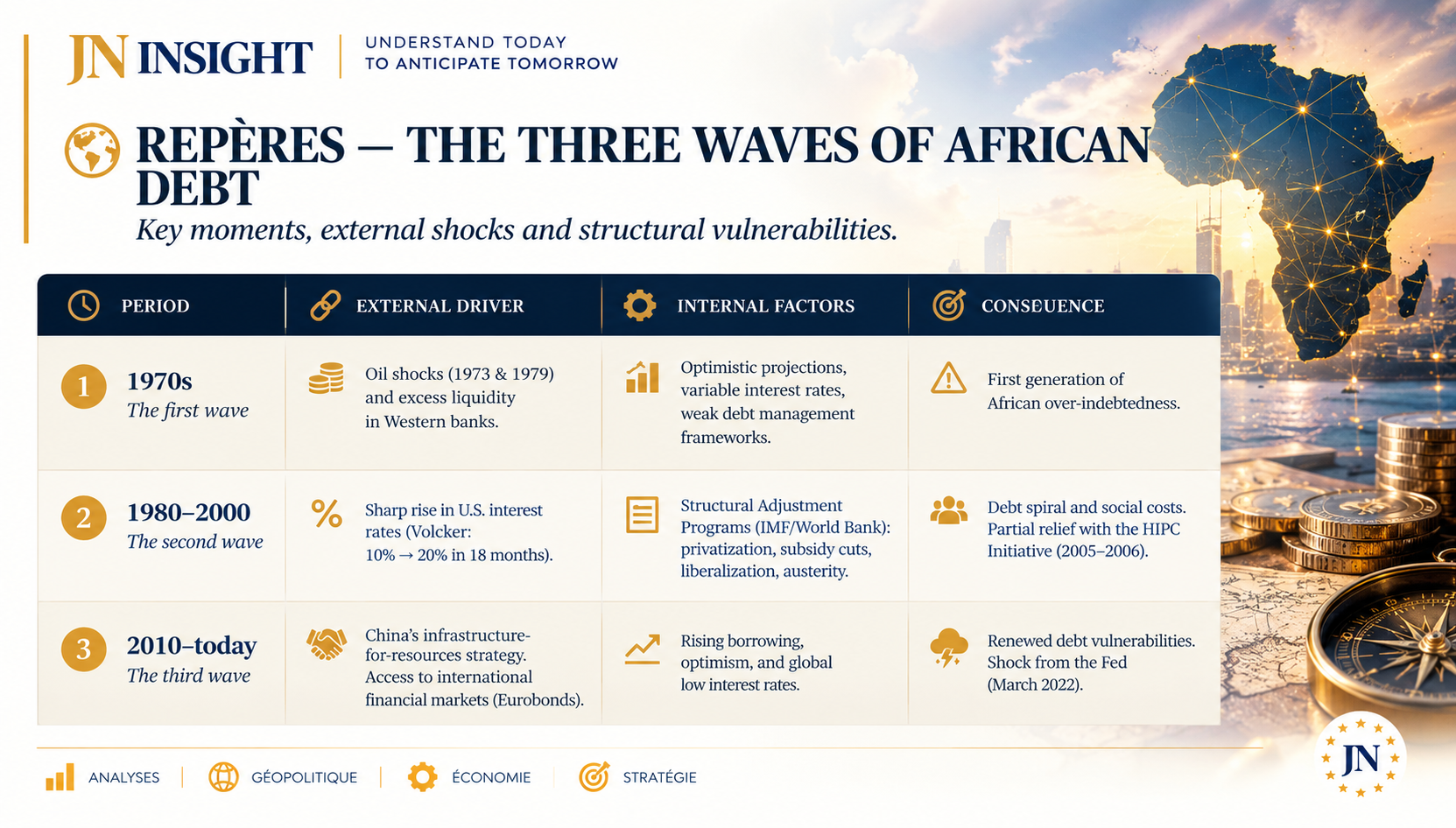
The trap was built in three waves. Decisions taken in Washington, Paris, Beijing and African capitals.
- First wave: the 1970s.
Petrodollars flood Western banks after the oil shocks of 1973 and 1979. The problem: too much liquidity and too little return in developed economies slowing under the weight of inflation.
The solution identified in the West? Lend to African states, at variable rates, on optimistic projections.
And so, in 1979, Paul Volcker, the renowned American economist and head of the United States Federal Reserve (Fed) from 1979 to 1987, does what few had anticipated on such a scale. In eighteen months, he raises the US policy rate from 10% to 20%.
Debts contracted at 6% become repayable at 18%, 20%, sometimes 22%.
In plain English: African countries had borrowed in dollars at low fixed rates. When Washington raises its rates, the cost of debt automatically explodes — not because the loan has changed, but because the reference currency has changed in value.
Overnight, debt sustainability calculations collapse like a house of cards.
The first generation of African over-indebtedness is born, triggered by a decision taken in Washington and amplified by debt structures that states could have managed more carefully. But this is nothing compared with the second wave.
- Second wave: the 1980s–2000s.
The IMF and the World Bank enter the picture.
Not as selfless saviours coming to the rescue of countries already suffocating under rising US debt interest rates. Rather, as creditors of last resort with a list of conditions: structural adjustment plans, privatisations, subsidy cuts and fiscal austerity programmes in exchange for concessional loans to repay earlier debts.
States see the beginnings of a solution and accept, because they have no choice: markets are closed, foreign currency exhausted and reserves empty.
Let us be honest: these programmes sometimes succeeded in stabilising public finances in disarray and restoring lost monetary credibility. This was particularly true of Jerry Rawlings’s Ghana and Museveni’s Uganda in the 1980s and 1990s, which spent a decade as the “model pupils” of the Bretton Woods institutions before history complicated the verdict. But at what cost: lower social spending, frozen public investment and slower growth in the short term. The effects on people were documented across the continent and debated for two decades.
The logic remains circular.
Borrow to repay what was borrowed to develop.
In 2005–2006, the HIPC Initiative cancels part of the debts of 36 African countries. Partial relief. A chapter closed, or so it seems, before the third wave arrives.
Third wave: 2010 – today.
This is where everything changes in nature.
China deploys its infrastructure-for-resources strategy on an unprecedented scale. Financial markets open to African states through Eurobonds, bonds issued in dollars or euros at rates reflecting the risk perceived by investors in New York and London. American pension funds discover African yields of 7–8% in a world of zero interest rates.
In other words: for the first time, African states can borrow directly on global financial markets without going through the IMF or the World Bank. An investor in New York can buy Zambian debt just as they would French debt. Money pours in, but rates are set by markets that can turn overnight at the slightest sign of risk. For ten years, it is a story of optimism.
In March 2022, the Fed brings it to an end by raising rates to fight American inflation. Investors who could earn 0% in safety or 8% in Africa can now earn 5% in the United States without taking any risk. Money flows back to Washington. African Eurobonds collapse. The window closes.
The strain of African indebtedness has therefore kept growing, never receding even during moments of faint hope, until we are forced to ask who, exactly, is lending to us, and at what price.
Part II – Who Lends, at What Price, and with What Guarantees?
Sub-Saharan Africa’s total external debt, public and private combined, exceeds $1 trillion according to the World Bank for 2025 alone. Public and publicly guaranteed external debt, a narrower measure, stands at more than $530 billion in the same year.
That figure tells us nothing until we know to whom it is owed.
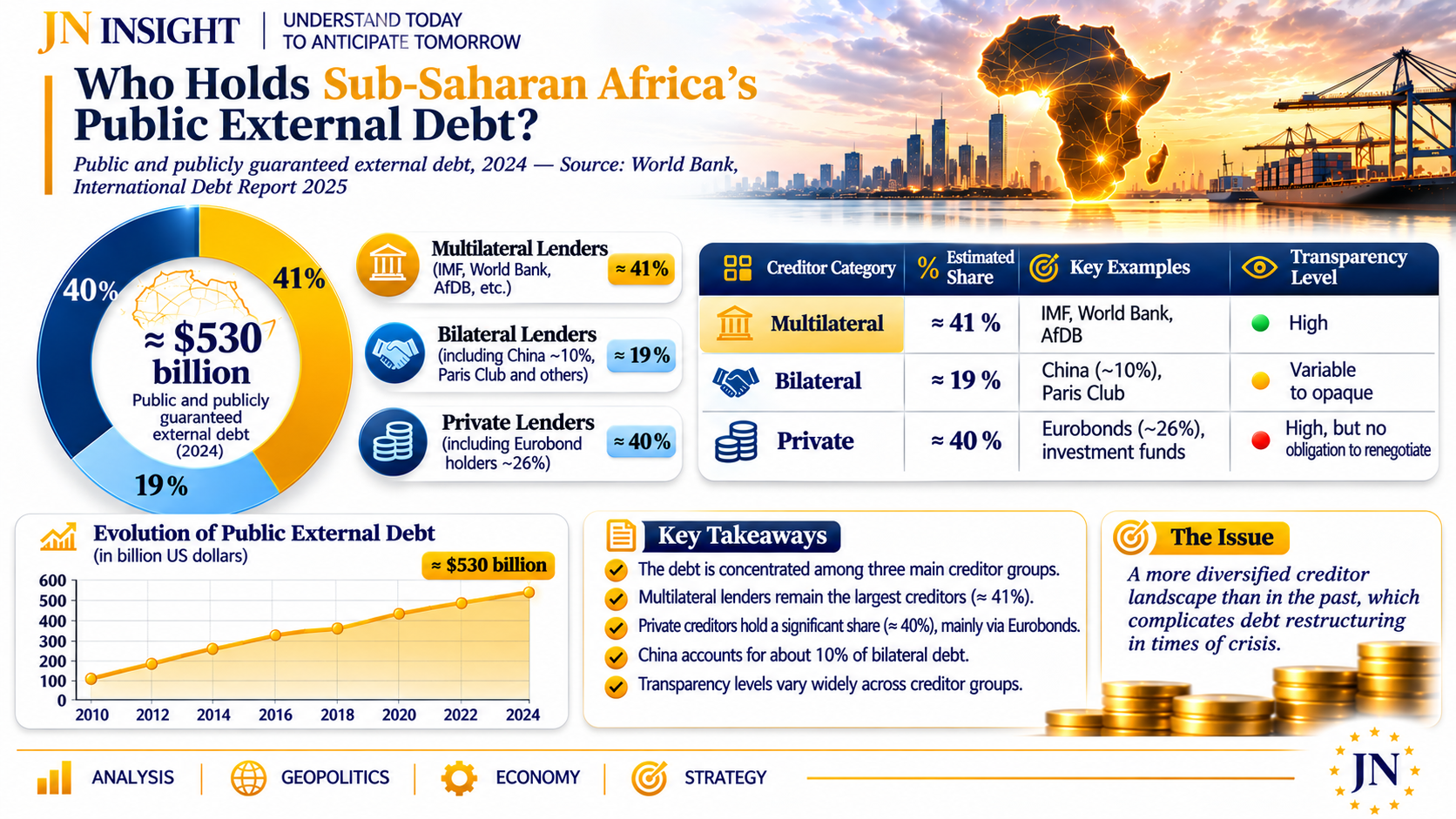
Let us examine the preceding table carefully. Contrary to the prevailing narrative, African public debt is neither mainly Chinese nor mainly multilateral.
It is private. Fragmented. And that fragmentation is precisely what makes crises impossible to resolve quickly. Four major creditors stand out, and each deserves closer scrutiny.
- First creditor: the multilaterals.
IMF, World Bank, AfDB. Around 41% of Africa’s external public debt.
The instruments differ profoundly: concessional IDA loans at near-zero rates over 25 to 40 years for the poorest countries, non-concessional IBRD loans and IMF programmes on terms closer to market rates.
These are structurally the least dangerous. But never unconditional.
The IMF does not sign a cheque without an adjustment programme: cut deficits, stabilise currencies, restore market confidence. The effects on people are documented in subsidy cuts, rising prices and public sector wage freezes. In Ghana in 2023, for example, implementation of the $3 billion programme was accompanied by the removal of fuel subsidies. Needless to say, public transport fares rose immediately.
This is not a conspiracy theory. It is the documented machinery of conditional lending: there is always a price to pay.
Second creditor: China.
Around 10% of Africa’s external public debt. On paper, a modest share. In practice, a structural presence marked by opaque contracts that make precise figures difficult to establish, with a number of Exim Bank loans containing excessive confidentiality clauses.
That opacity is itself information (let us read between the lines). The Chinese model has delivered real infrastructure. The Nairobi–Mombasa railway, for example, hydroelectric dams in Ethiopia, not to mention roads and ports across the continent.
But what it has not built is the capacity to repay independently. Indeed, the roads exist, and so do the stadiums, but export earnings have not kept pace. The infrastructure was delivered; the local value added needed to pay for it was not.
And since 2023–2024, Chinese financing has undergone a significant slowdown and a shift towards smaller projects. The era of the unlimited Chinese cheque is over, with no real equivalent alternative on that scale.
Third creditor: the bilaterals — including the Paris Club.
The Paris Club has coordinated official bilateral creditors since 1956. Its procedures are well established. Its problem is structural: it coordinates only those willing to play by the rules. China has long favoured direct bilateral negotiations, although it has taken part in some coordinated restructurings, including Zambia’s. When interests diverge and private funds demand preferential treatment, coordination becomes a dead letter.
Fourth creditor: private markets.
This is the creditor that public debate systematically forgets.
Yet it accounts for more than 40% of Africa’s external public debt, including around 26% held by Eurobond investors alone. Names such as BlackRock, Pimco, Ashmore. And unlike official creditors, they have no political obligation to come to the table.
They have a legal obligation: to maximise returns for their investors.
That is not the same thing.
In March 2022, the US Federal Reserve began a rate-hiking cycle that took it to 5.50% in July 2023. The dollar strengthened. Emerging markets were punished. African Eurobonds needing refinancing found buyers demanding prohibitive terms, or no buyers at all.
Let us return to Accra.
The cedi lost nearly 40% of its value against the dollar in 2022. A depreciation of that magnitude does not mean an equivalent increase in dollar-denominated debt; it implies a rise of around 67% in its cedi value. The illustration is mathematical: if one dollar used to buy 6 cedis, it now buys 10. Every dollar owed weighs 67% more heavily on the national accounts.
Arithmetic had made Ghana insolvent.
Zambia, meanwhile, had defaulted in November 2020. Its own fiscal fragility, falling copper prices, the pandemic… Ghana suspended external payments in late 2022, Ethiopia in late 2023.
Three crises, three distinct trajectories.
One shared vulnerability: foreign-currency-denominated debts in economies whose revenues are in local currency, in a world where markets close without warning.
These are not isolated accidents. They are three manifestations of the same design flaw.
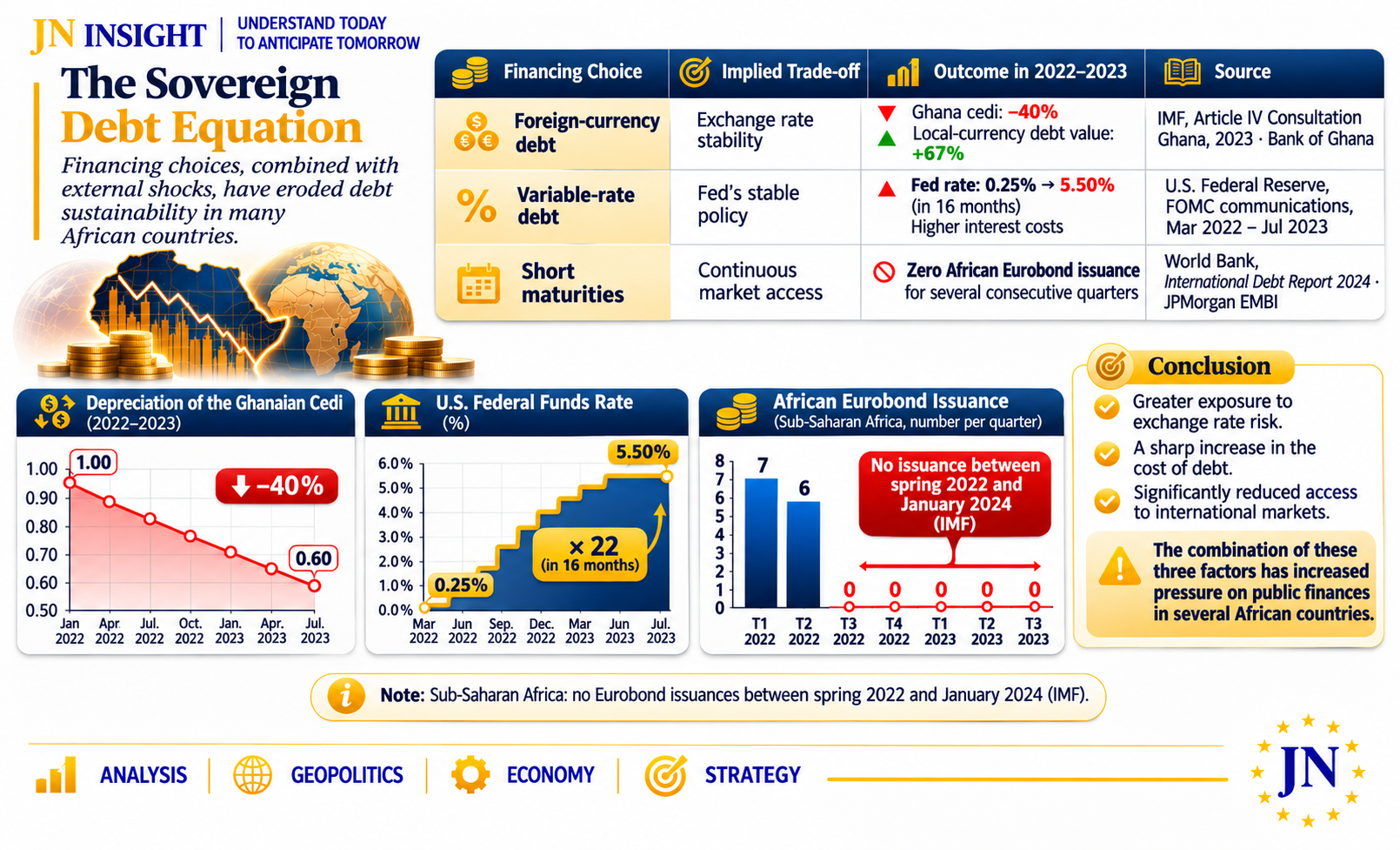
Every line represents a bet lost at the same time. It was that simultaneity that produced the disaster.
Part III – When Debt Worked
So far, we have dissected creditors, mechanisms and defaults. But an honest analysis demands something difficult.
Naming the successes.
Not for rhetorical balance. But because they reveal exactly why the failures are failures.
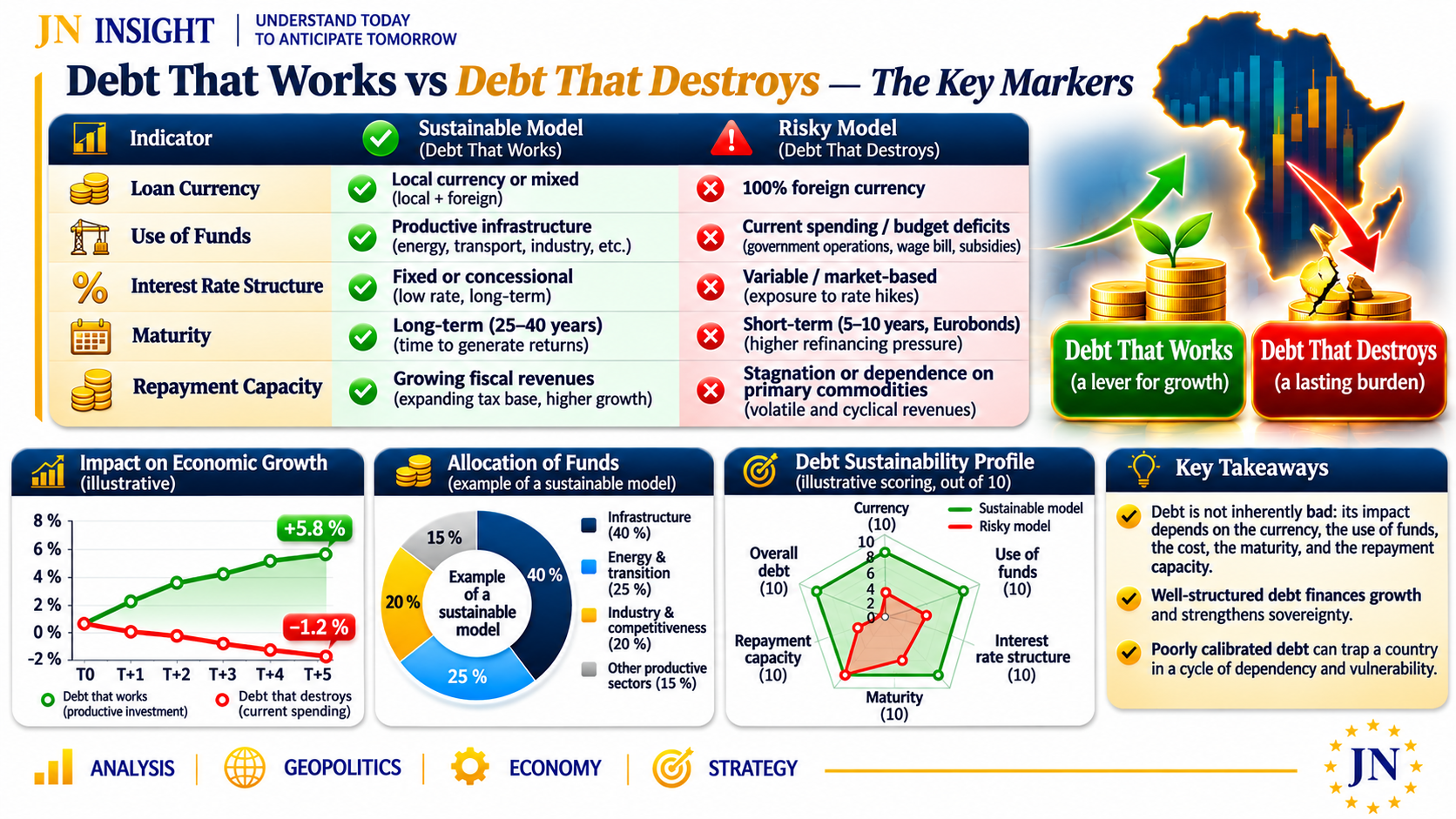
Debt sustainability is measured against four variables at once: repayment capacity, financing costs, the maturity profile and the economic return on the investments financed. Two countries with the same debt-to-GDP ratio can have radically different risk profiles depending on whether borrowing financed a productive motorway or current expenditure.
Côte d’Ivoire after 2011 illustrates what well-structured debt can deliver. Rebuilding infrastructure: roads, ports, energy. Debt financed what would generate future tax revenues.
Several consecutive years of 8–10% growth followed.
But if Côte d’Ivoire weathered the 2022 shock better than Ghana, it was not simply because of its productive investments. It was also because the CFA franc is pegged to the euro. As the cedi collapsed against an appreciating dollar, the CFA franc followed the euro in a much more moderate depreciation, mechanically limiting the increase in the local-currency burden of dollar-denominated debt. This does not mean the CFA peg is superior to other monetary regimes in every context. Debates over its implications for sovereignty and its structural constraints are legitimate. But in this particular shock, in 2022, that mechanism played a protective role.
Ghana itself had experienced a decade of sustained growth supported by well-calibrated borrowing, until 2015–2016, when fiscal deficits began to accumulate and the debt structure started to weaken.
That is where the fault line lies.
The 2022 crisis demonstrated one unforgiving truth: even the model pupils remain vulnerable when all three bets are lost at once.
The mechanism makes no distinction.
Part IV – The Political Price of Restructuring
We have seen how debt is incurred. We have seen who lends. We have seen when it works.
One question remains, the one nobody asks openly.
What happens when it all goes wrong and renegotiation becomes necessary?
There is a sequence that nobody really names.
A state in difficulty knocks on the door of the IMF. The Fund attaches conditions to its assistance. The state accepts because it has no choice. Reforms take effect. Prices rise, and, sure enough… people take to the streets.
This sequence is not universal. Each country has its own actors, its own trajectory. But it constitutes a documented systemic risk that recurs in recognisable forms. Conditionality has a sound economic rationale. Its application in fragile political contexts produces instability that macroeconomic models had not anticipated.
Zambia embodies something different, and just as brutal.
The first African country to default, in November 2020, it then endured four years of Kafkaesque negotiations. On one side, the IMF conditions its support on far-reaching fiscal reforms. On the other, Chinese creditors, Eurobond holders and Paris Club members struggle to agree on how to share the losses. Each party defends its own logic, in its own interest.
Meanwhile: fiscal paralysis. Cuts to public services. Inflation. The human cost of the impasse between creditors.
An agreement covering the main categories of creditors was reached in 2024, after years of fragmented negotiations.
Four years. For nineteen million people. And nobody has yet built an alternative.
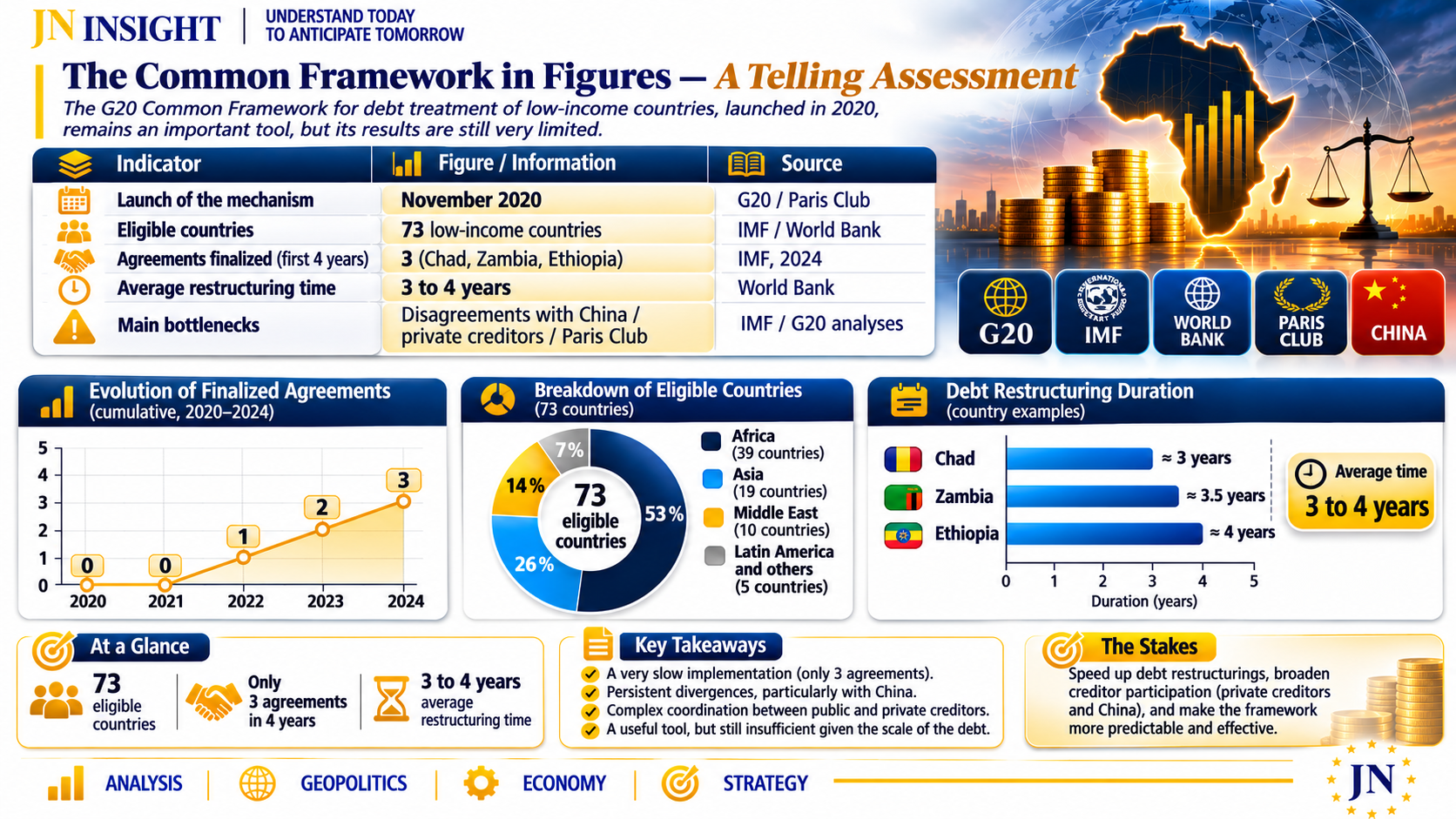
A mechanism designed to accelerate restructurings that has produced 3 agreements in 4 years for 73 eligible countries.
Conclusion – The Unresolved Tension
When a state repays before it governs, debt ceases to be a financial instrument. It is always a relationship of power.
And often a mirror of how states have chosen to govern themselves.
As of November 2026, painfully negotiated restructuring agreements have allowed a few countries to regain partial access to markets. But terms remain prohibitive for much of the continent. $900 billion in total external debt. Four categories of creditors with incompatible logics. A crisis-resolution mechanism that has produced three comprehensive agreements in four years.
The picture is there. But it is incomplete.
WHAT HAS BEEN DONE WITH THIS MONEY?
Creditors have lent on sometimes harsh terms, at sometimes prohibitive rates, under sometimes opaque clauses.
The money was indeed received.
And in some countries, the infrastructure is not there. Growth is not there. The tax revenues needed to repay are not there.
The question is not to choose a culprit. The question is to understand how two failures — that of the international system and that of those who benefited from it — fed each other, covered for each other and silently legitimised each other.
While people paid the price for both.
Debt is never merely a balance sheet.
That is the subject of Volume II.
Intellectually yours,
Jean-Noël Niamké
JN INSIGHT
Sources: IMF, Article IV Consultation — Ghana, 2023 · World Bank, International Debt Report, 2025 · World Bank, Africa’s Pulse, April 2023 · UNCTAD, A World of Debt, 2023 · Joseph Stiglitz, La Grande Désillusion, Fayard, 2002 · Dambisa Moyo, Dead Aid, Allen Lane, 2009 · AidData, Banking on the Belt and Road, 2021 · G20/Paris Club Common Framework, 2020