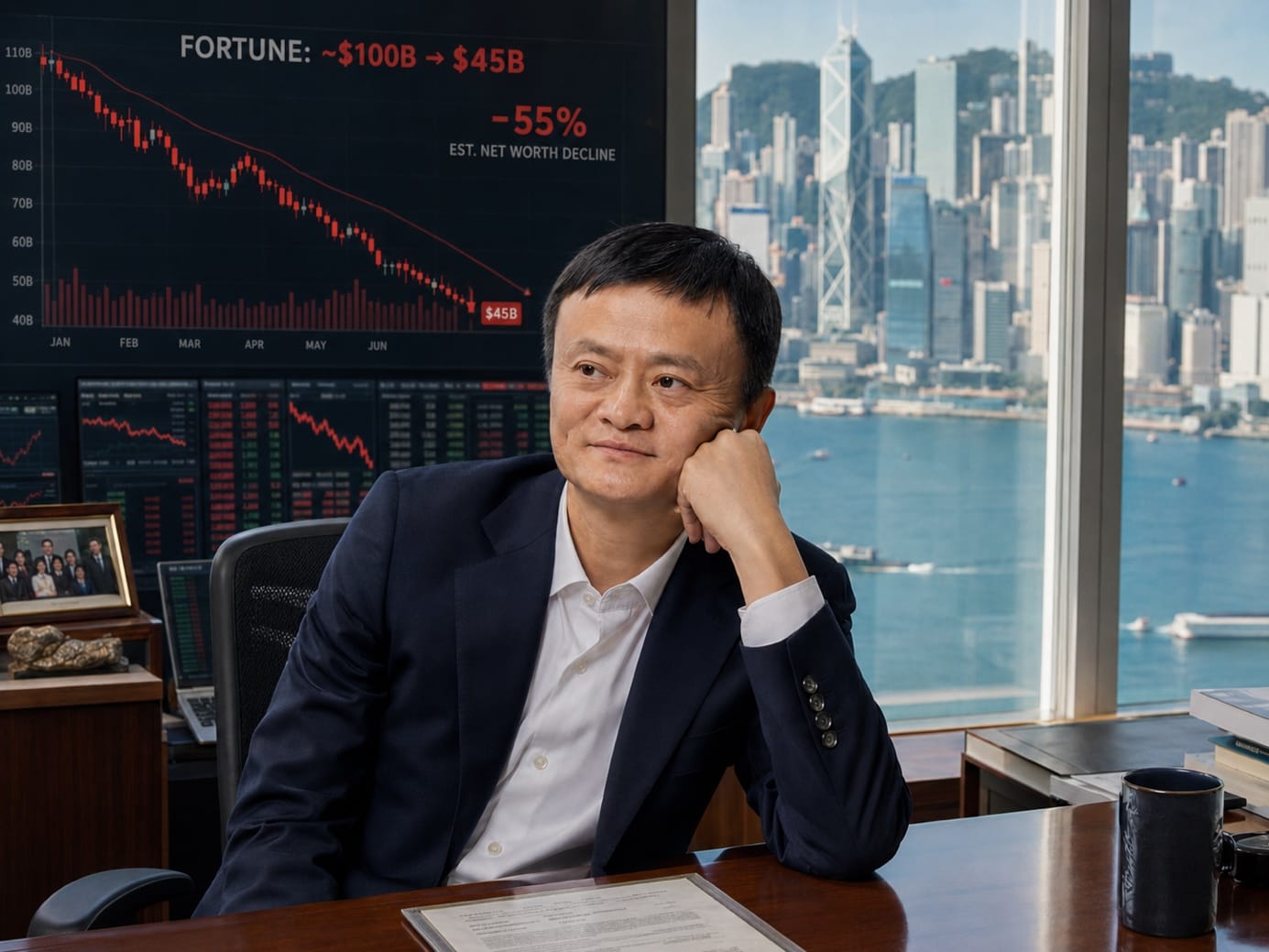
Bonus • Jack Ma: the billionaire whom Beijing has reined in
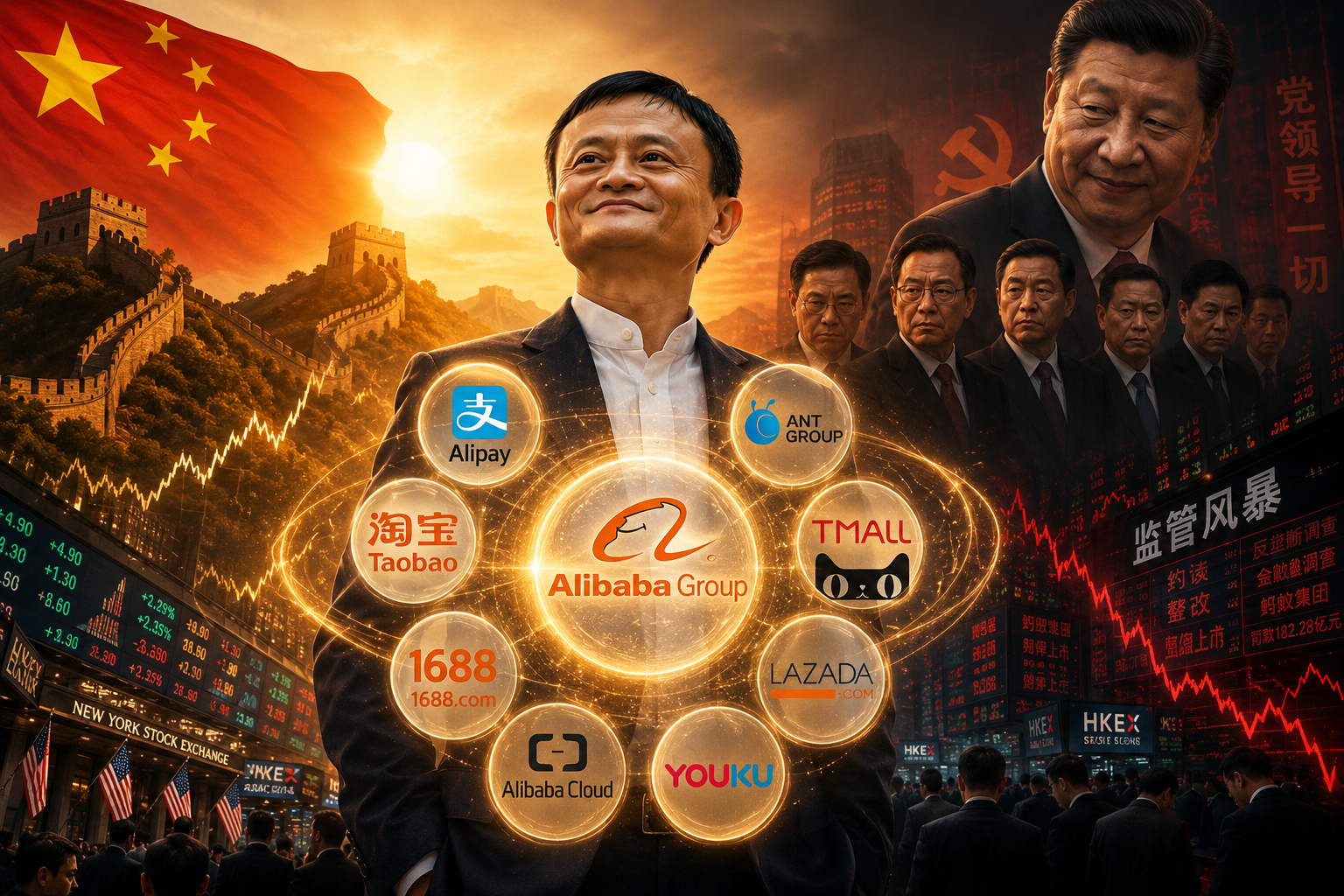
When the State reminds its elites that in China, capitalism is a privilege — not a right
October 2020. Jack Ma stood on the verge of completing the largest IPO in financial history.
Three days later, the offering was suspended by decree. Jack Ma vanished from public view.
On October 24, 2020, the most famous man in Chinese capitalism delivered a speech at the Bund financial summit in Shanghai. Three days later, Ant Group's IPO— $37 billion , the largest IPO ever planned—was abruptly halted. The message was unambiguous: in China, an
entrepreneur may rise to extraordinary heights. Yet none may forget who holds sovereign authority. Whilst the GAFAM companies have become near-indispensable private infrastructure undergirding the American system, China serves a starkly different reminder:
In China, the State remains the one true infrastructure.
Having examined the American system, the GAFAM companies , and the sovereign entrepreneur Musk, here stands the absolute antithesis of that model: the Chinese entrepreneur brought to heel by the very State that made him a king.
PART I — The Ma Empire: From English Teacher to Global Titan
A former English teacher from Hangzhou, Jack Ma founded Alibaba in 1999 in his apartment, alongside seventeen friends and a seed capital of $60,000 . Two decades later,
the empire he had built commanded hundreds of billions of dollars in value. Alibaba dominated Chinese e-commerce through Taobao and Tmall , counting over 900 millionactive users , whilst its logistics subsidiary Cainiao dispatched billions of parcels annually.
Alibaba Cloud led the Chinese cloud market and ranked among the foremost global players, trailing only AWS, Azure, and Google Cloud.
Yet it was Ant Group that fundamentally altered the landscape. Through Alipay (China’s pre-eminent mobile payment platform, analogous to Apple Pay and Google Pay), Ma constructed one of the world’s most extensive mobile payment systems. Ant’s ambitions extended far beyond mere payments — encompassing microcredit, insurance, wealth management, and investment. The group had become a systemic actor within Chinese digital finance. And it was precisely here that Beijing discerned a threat: a private financial infrastructure of sufficient scale to slip beyond the State’s direct authority. Ant Group’s flotation, scheduled for November 2020, was set to value the company at approximately $313 billion . It was too large, too systemic, and altogether too political.
Jack Ma — Key Figures
The Ma Empire in 2026
$45.1 billion — Fortune estimated by Bloomberg as of 7 May 2026. Jack Ma remains among the wealthiest individuals in China, though he is no longer the untouchable symbol he once appeared to be.
$29.1 billion – Forbes’ estimated fortune in its 2026 ranking of Chinese billionaires, placing him approximately eighth. The divergence between Bloomberg and Forbes reflects the opaque assumptions surrounding Ant Group’s valuation and Ma’s private holdings.
~4% — Estimated stake in Alibaba Group. A modest yet strategically meaningful position in one of China’s most consequential technology enterprises.
~9.9% — Economic interest in Ant Group, the former fintech jewel whose historic flotation was abruptly suspended by Beijing.
996 billion RMB — Alibaba’s revenue for the fiscal year ending March 2025, equivalent to approximately $138 billion. The industrial empire endures at scale, even as its founder has been politically chastened.
$150 billion → $50–78.5 billion — The symbolic arc of Ant Group: a valuation of approximately $150 billion in 2018, reduced to a fraction of that figure following regulatory intervention. The true significance lies not merely in a suspended flotation, but in the deliberate dismantling of an ambition.
$25 billion — The sum raised by Alibaba during its 2014 IPO, then the largest such offering in history. At that moment, Jack Ma embodied the triumphant emergence of digital China. Within a few years, he had come to embody something altogether different: the absolute limits of private capital when confronted with the Party.
PART II —
The Bund Speech: Thirty-Six Hours That Changed Everything
On October 24, 2020, Ma took to the podium at the Bund financial summit, addressing Chinese regulators and the country's financial elite. Instead of the expected diplomatic speech, he launched a frontal attack on the Chinese banking system: "The Chinese financial system operates with a pawnbroker mentality." He criticized state-owned banks, accused regulators of stifling innovation, and touted fintech as the future. In Beijing, the message was interpreted differently: a private billionaire was publicly challenging the authority of the Party-state, at a time when Ant Group was poised to become a financial player potentially more powerful than state-owned banks. Unacceptable.
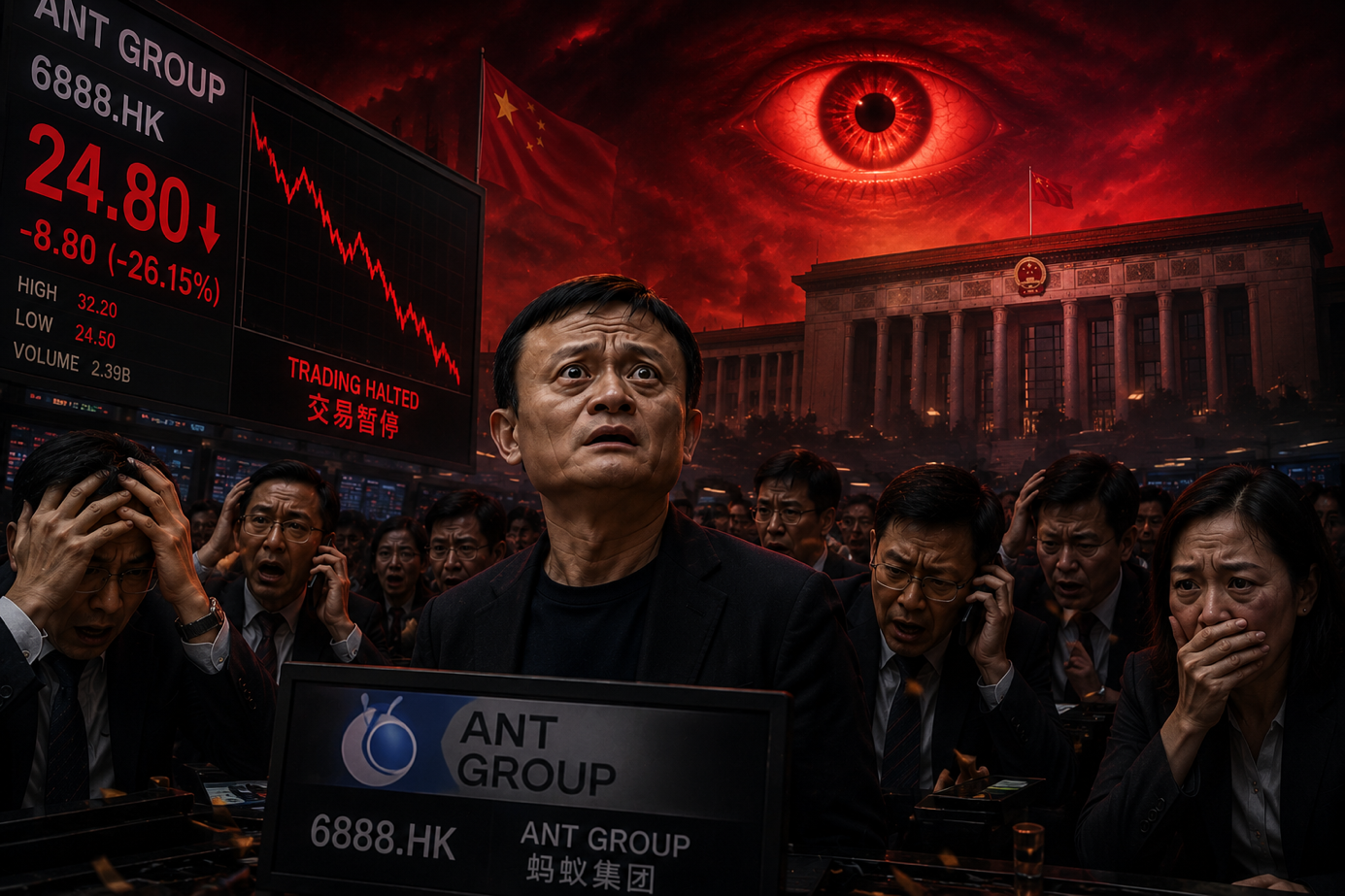
Thirty-six hours later, Ma was summoned to Beijing by four regulatory bodies. On 3 November, Ant Group’s flotation was suspended by decree. The largest financial transaction in history was annulled at a stroke. Ma disappeared from public life.
PART III —
Brought to Heel: Three Years of Methodical Dismantlement
For nearly three months, Jack Ma made no public appearances whatsoever. In January 2021, he resurfaced briefly during a video conference with rural schoolteachers. The message was unambiguous: he was alive, but he had been firmly reminded of his place. In April 2021, China’s antitrust authority imposed upon Alibaba a record fine of $2.8 billion for abuse of its dominant market position. The group accepted the penalty without demur.
Ant Group was compelled to restructure as a regulated financial holding company under central bank supervision. Its lending operations were curtailed, its model brought into conformity with that of a conventional financial institution, and its valuation substantially reduced. In January 2023, Ma formally relinquished control of Ant Group, retaining only approximately 6.2% of the voting rights , against a former majority stake exceeding 50%. His personal fortune had been reduced by half within two years. Today it is estimated at between $28 billion and $45 billion, depending upon the methodology employed: Forbes placed it at $28.8 billion in its 2026 ranking , whilst Bloomberg estimated it at around $45 billion . Jack Ma remains a man of considerable means, yet he is no longer the untouchable figure he appeared to be in 2020.
In 2025 and 2026, Jack Ma continues to embody the enforced discretion demanded of China’s technology billionaires: present on occasion, yet politically
neutralised. He conducts a life of deliberate obscurity, occupying himself with sustainable agriculture, education, and carefully calibrated public appearances. The lesson could not be plainer: even the most celebrated figure in Chinese capitalism may lose everything the moment he forgets where the boundary lies.
PART IV —
The Lesson: Chinese Capitalism is a Concession
The Ma affair reveals the true nature of the Chinese model. Ma was punished not only for what he had done, but for what he could become. AntGroup threatened to capture the Chinese financial system—a domain the Party considers sovereign, on par with the military or diplomacy. The unspoken agreement is crystal clear: in China, you can get rich as long as you serve the Party's objectives. The day you threaten its political monopoly, you fall from grace. The lesson has been learned by the entire Chinese elite. Several executives from Tencent, Didi, Meituan, Pinduoduo, and ByteDance lowered their public profiles, issued fulsome
declarations of allegiance, relinquished executive responsibilities, or announced lavish philanthropic initiatives. The message has been thoroughly absorbed: in China, one does not become a Musk.
PART V —
What Ma Reveals About the Chinese Model — Strengths and Constraints
The strength of the system . In the United States, Musk may attack the SEC, defy regulators, shape public discourse, and bring pressure to bear upon the State. In China, the reverse
is inconceivable. Where Musk acquires X and transforms his platform into an instrument of sovereign influence, Ma surrenders control of Ant Group and retreats into a life of sustainable farming, education, and carefully managed appearances. In one model, the entrepreneur may approximate sovereignty. In the other, he remains a permitted variable, tolerated by power. There is no capture of the State by billionaires. The Party retains its grip upon the economic elite. This discipline is the source of the Chinese model’s strategic coherence.
The system’s constraints . Disruptive innovation does not flourish readily in an environment where entrepreneurs understand that everything may be forfeit without notice. Since 2021, there has been a quiet exodus of Chinese entrepreneurs to Singapore, Dubai, and Japan. Among the younger generation, tang ping —the rejection of the exhausting social race—signals a deeper unease. This is the Chinese paradox: the country excels in execution, scale, industrial discipline, and incremental improvement. But disruptive innovation often requires a form of creative disobedience. Yet the Party demands obedience.
Can one genuinely innovate when the cardinal rule is never to surpass political authority? This is, in all likelihood, the
glass ceiling of the Chinese model.
China produces impressive champions— Huawei, BYD, ByteDance, DeepSeek —but it still struggles to impose global disruptive standards
of the order achieved by Apple, Nvidia, or OpenAI in the global technological imagination. DeepSeek demonstrates that China remains capable of genuine disruption, yet operates within a framework in which innovation must remain consonant with the Party’s political constraints. It is authentic innovation. But it is innovation under surveillance.
Conclusions
Jack Ma’s story is not that of a fallen billionaire. It is the story of a system that reminds its elites of their proper station. In China, one may accumulate wealth exceeding the GDP of most nations. But one shall never surpass the Party in power. In the United States, the entrepreneur challenges the State and propels the nation forward. In China, the entrepreneur serves the State and preserves the system. Two models. Two trajectories. Two very different ceilings.
→ In your opinion, which of the two models is more sustainable: the one where the entrepreneur challenges the state, or the one where the state disciplines the entrepreneur?
Jean-Noël Niamké,
Financial Expert |
Strategic Analysis, Macroeconomics & Geopolitics