US–China: Who Really Dominates the Global AI War?
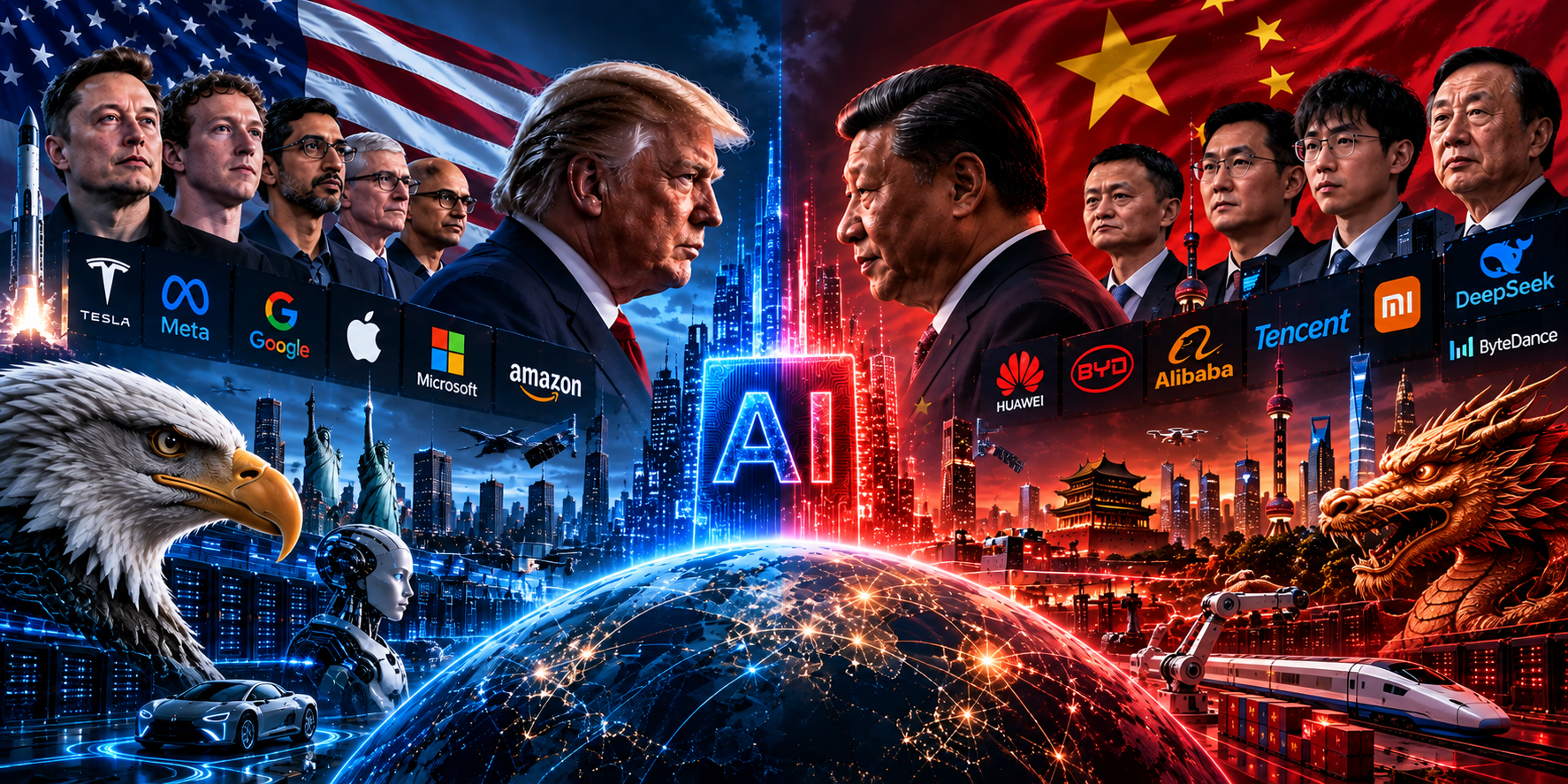
In artificial intelligence, the United States still commands the most powerful giants, the deepest pools of capital and the strongest infrastructure. But something has changed: China has almost erased its technological lag and is advancing with a different weapon — efficiency, industrial scale and diffusion. Behind ChatGPT, Claude, Gemini, DeepSeek and Qwen, a far deeper battle is therefore unfolding: who will control the infrastructure without which no artificial intelligence can exist?
PROLOGUE — THE WAR NO ONE SEES
A Chinese start-up releases a new artificial-intelligence model, open-source and accessible to everyone. More importantly, it is presented as far less costly than the most powerful American models.
Its name: DeepSeek-R1.
One week later, Wall Street is hit by a shock. Nvidia plunges by nearly 17% in a single trading session.
Nearly $600 billion in market capitalisation disappears. Never before had a company lost so much value in a single day of trading. Why? Because a Chinese start-up had suddenly introduced doubt where, until then, there had been almost complete certainty:
what if dominating artificial intelligence did not necessarily require ever-increasing levels of spending?
At that moment, DeepSeek had not won the AI war. But it had just changed the nature of the conflict.
This is not a war fought with tanks. No missiles over a capital city. No soldiers massed at a border. Its weapons have less spectacular names.
Chips. Data centres. Semiconductors. Computing power.
Its generals do not wear uniforms. They run artificial-intelligence laboratories, chipmakers, cloud giants and some of the most powerful companies on the planet.
Behind them stand two states: the United States. And China.
The word “war” is a metaphor. The balance of power, however, is entirely real: hundreds of billions committed, trade restrictions, control over technology, industrial sovereignty and global standards.
A war without soldiers.
Certainly not a war without consequences.
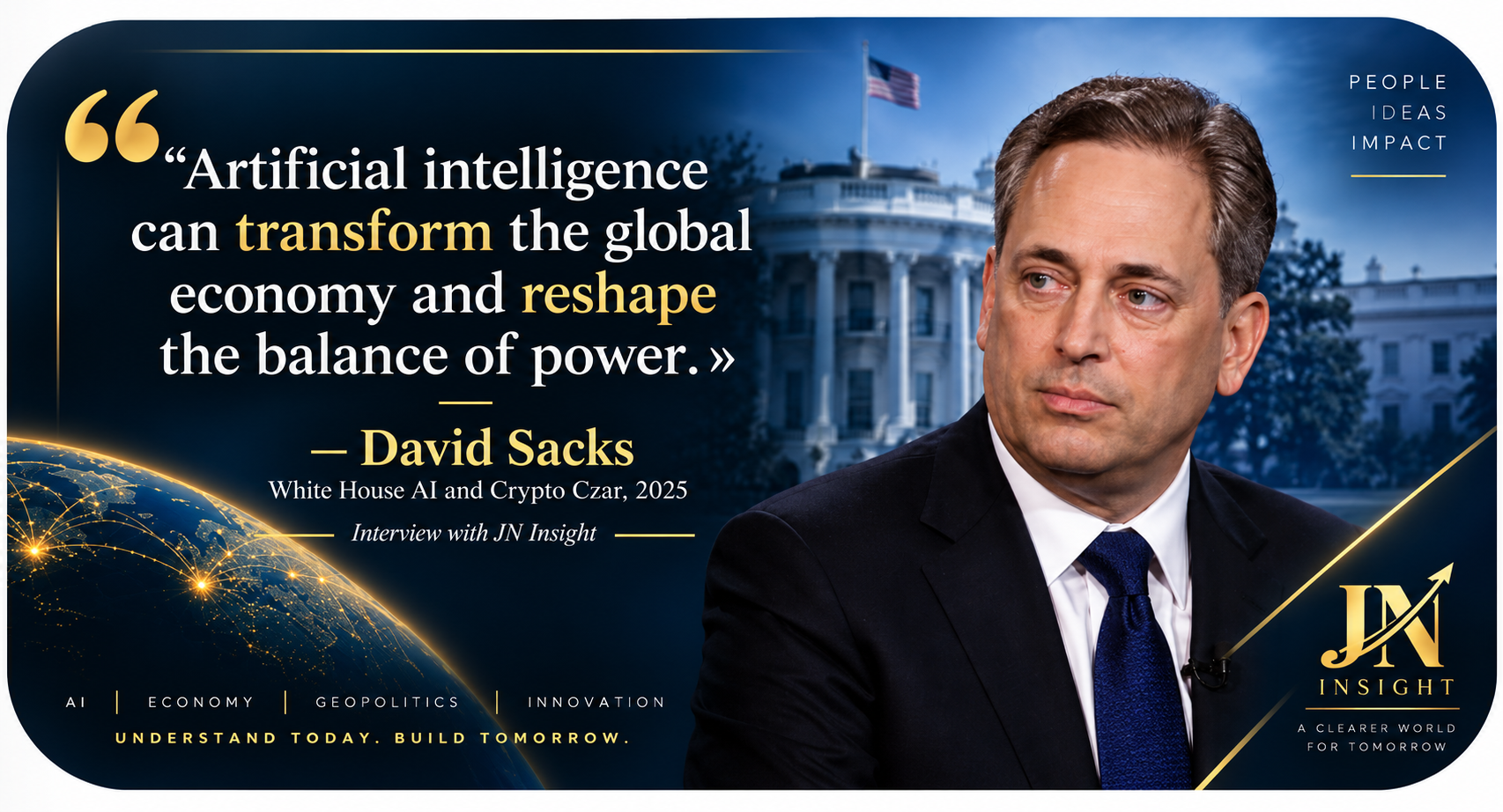
For a long time, however, the balance of power appeared obvious.
America had the models. America had the chips. America had the money. America had the data centres.
Then one name disrupted that script: DeepSeek. DeepSeek did not overthrow America’s AI empire. It did something more troubling for Washington.
It showed that the fortress walls could be bypassed.
In February 2025, DeepSeek-R1 briefly rose to the level of the best American model in rankings tracked by Stanford.
Then, in March 2026, the gap between the best American model and its Chinese rival had narrowed to just:
Behind this seemingly modest figure lies a far more consequential shift. The question is no longer merely:
“Can China catch up with the United States?”
It is becoming:
“What if the catch-up is already well under way?”
But first, we need to understand what “dominating AI” actually means.
Owning the best chatbot? Controlling the chips? Having the largest number of data centres? Attracting the best researchers? Securing the necessary electricity? Imposing one’s standards on the rest of the world?
Because this may be precisely where we are all looking in the wrong direction.
The artificial-intelligence war is not primarily a war of intelligence. It is a war of infrastructure.
To understand who is truly ahead, we must stop staring for a moment at the shop window — the chatbots — and descend into the engine room: chips, data centres, energy, software and capital. That is where the real balance of power is being decided.
PART I 🇺🇸 THE AMERICAN EMPIRE: THE FORTRESS
To understand American power, forget ChatGPT for a moment.
The true strength of the United States is not that it has a single champion. It is that it has built almost the entire ecosystem around that champion.
The companies that design the models, manufacture the chips, host the computing workloads, develop the software and finance the infrastructure. America does not merely own the racing cars. It also owns a large part of the track.
1. The Brains
And with good reason: in March 2026, the leading models from Anthropic, xAI, Google and OpenAI occupied the top four positions in the Arena ranking reported by Stanford. Alibaba and DeepSeek followed close behind. America remained ahead. But for the first time, the rear-view mirror was beginning to matter.
In 2025, U.S. institutions produced 59 AI models deemed notable, compared with 35 for China. Stanford describes “notable models” as systems that have materially shaped the field through their performance, novelty or significance. More than 90% now came from industry rather than academia.
Frontier AI is therefore no longer merely a matter for researchers. It has become an industry. And whenever a technology becomes an industry, one question inevitably emerges:
Who can finance its deployment at truly massive scale?
2. The Billions
In 2025, private investment in AI reached $285.9 billion in the United States, compared with $12.4 billion in China.
A ratio of 23 to 1.
Yet this comparison largely reflects private capital. Beijing also finances AI through public funds, state-owned enterprises and national infrastructure programmes. The two countries are therefore not playing by exactly the same accounting rules.
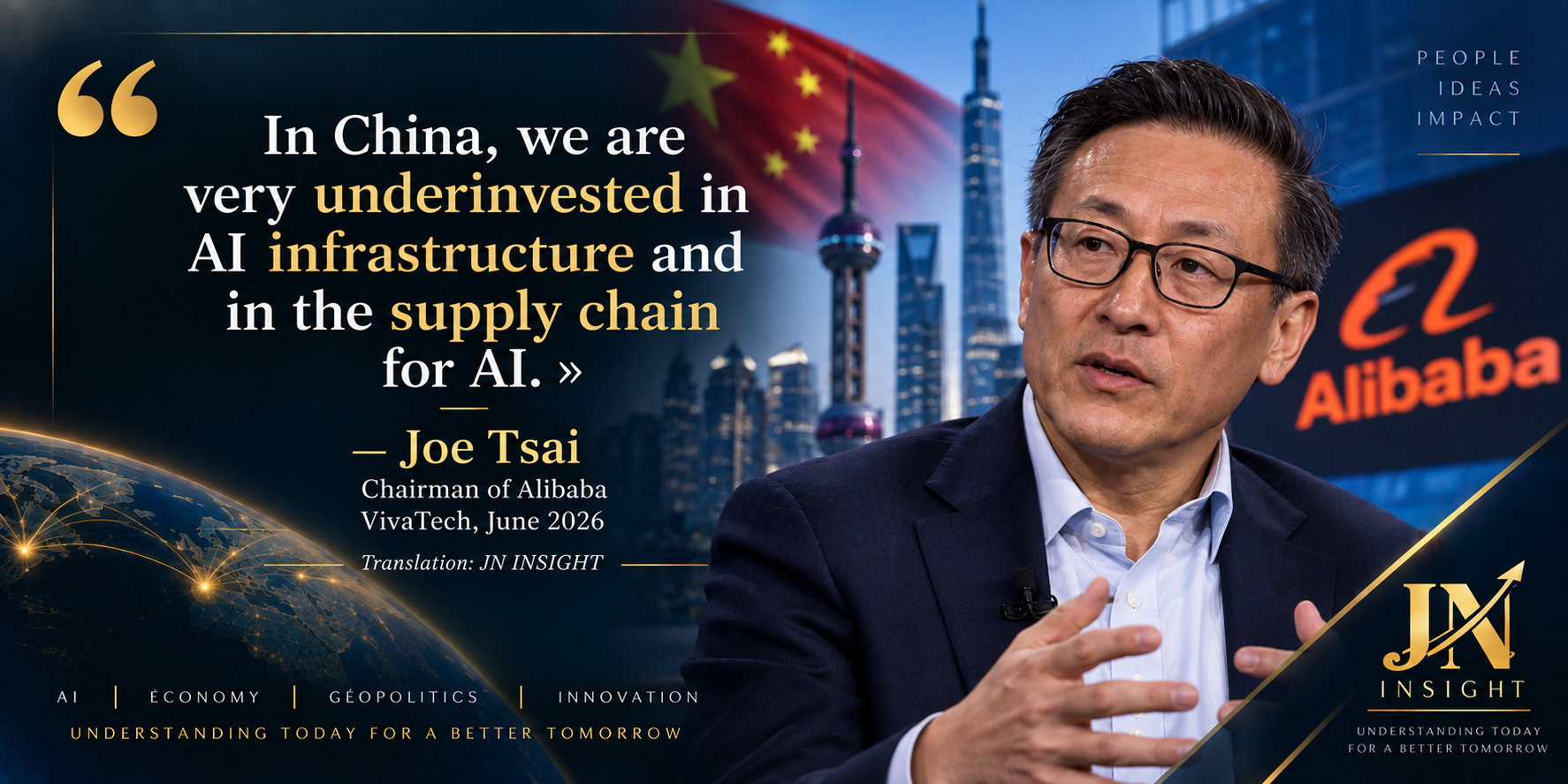
Looking only at the billions invested would therefore be misleading. In finance, spending heavily is never a victory in itself. The real question comes next:
what returns will those hundreds of billions ultimately generate?
And this is precisely where American strength reveals its first paradox.
3. The investment trap: what if America’s strength became a vulnerability?
For twenty years, U.S. technology giants captivated markets with a formidable model: software. Platforms. Billions of users. Almost no factories.
AI has shattered that equation.
To increase computing power, one now needs concrete, thousands of chips, networks, cooling systems — and above all, enormous amounts of electricity.
These expenditures are known as Capex: investments in long-lived assets — buildings, servers, chips, power networks and data centres.
According to Reuters, expected 2026 investment by Microsoft, Alphabet, Amazon, Meta and Oracle rose from roughly $485 billion in January to nearly $730 billion by July.
As these investments surge, an increasing share of the cash generated by these groups is immediately being reinvested in infrastructure.
And this is where financial analysis must briefly interrupt the technological narrative. Investing $730 billion is not, in itself, evidence of profitability.
It is an enormous wager: that future AI revenues will eventually justify the data centres, chips and electricity being purchased today.
That does not, of course, prove the existence of a bubble. Revenues are already real — Microsoft’s AI business had exceeded $37 billion in annualised revenue.
But the question remains: will AI revenues grow quickly enough to justify investment on such a massive scale?
If the answer is yes, the United States will have built one of the most powerful economic infrastructures of the twenty-first century.
If the answer is no, part of what looks like strength today could become a vast profitability problem tomorrow.
America has won the battle for capital. It still has to win the battle for returns.
4. Nvidia: the arms dealer of the revolution
Artificial intelligence gives the impression of floating in the cloud, somewhere above our heads. It does not.
Every answer, every image, every video is computed by machines installed somewhere, powered continuously and cooled at considerable expense.
According to Stanford, Nvidia technologies account for more than 60% of recorded global AI computing capacity. Google and Amazon provide much of the remainder. Huawei is gaining ground in China.
Sam Altman, CEO of OpenAI, captures almost the entire battle in a single sentence:
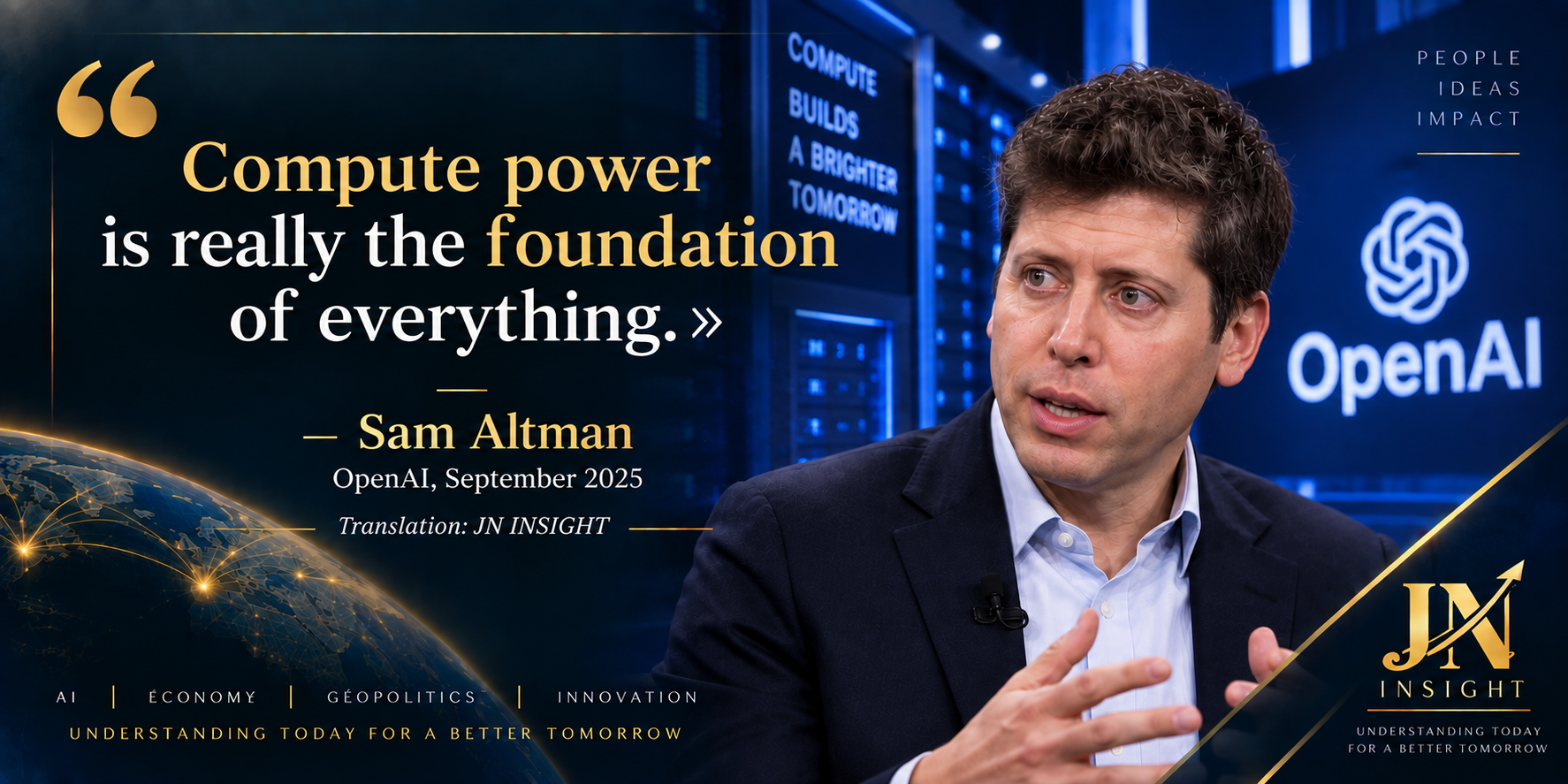
And today, that computing power has an indispensable supplier: Nvidia. Nvidia is no longer simply a graphics-card manufacturer.
In this new gold rush, Nvidia is not prospecting for gold. It is selling the picks and shovels.
But its lead does not rest on chips alone. For nearly twenty years, the company has been developing CUDA — a complete software environment used by millions of developers. The term may sound technical. The idea is very simple.
Imagine an exceptionally high-performance car. Now imagine that the same company also built the roads, garages and tools around it — and trained the mechanics.
It must still persuade millions of developers to change their tools, their habits and, in some cases, part of their software stack.
Building a good chip is an industrial battle. Persuading people to abandon twenty years of habits is a cultural battle.
That is why dislodging Nvidia is far more difficult than it appears. Yet none of this would be possible without our famous cathedrals.
5. The Cathedrals of Intelligence
They have neither stained-glass windows nor spires. From the outside, they are vast industrial buildings. Inside are kilometres of cables, thousands of servers, cooling systems and entire rows of processors running day and night. These are data centres: the cathedrals of the twenty-first century.
Stanford counts 5,427 of them in the United States — more than ten times the number recorded in any other country. 5,427 cathedrals devoted to computation.
There is only one problem: a digital cathedral does not pray. It consumes — prodigiously. Electricity, land, water, cooling systems and networks capable of powering thousands of servers without interruption.
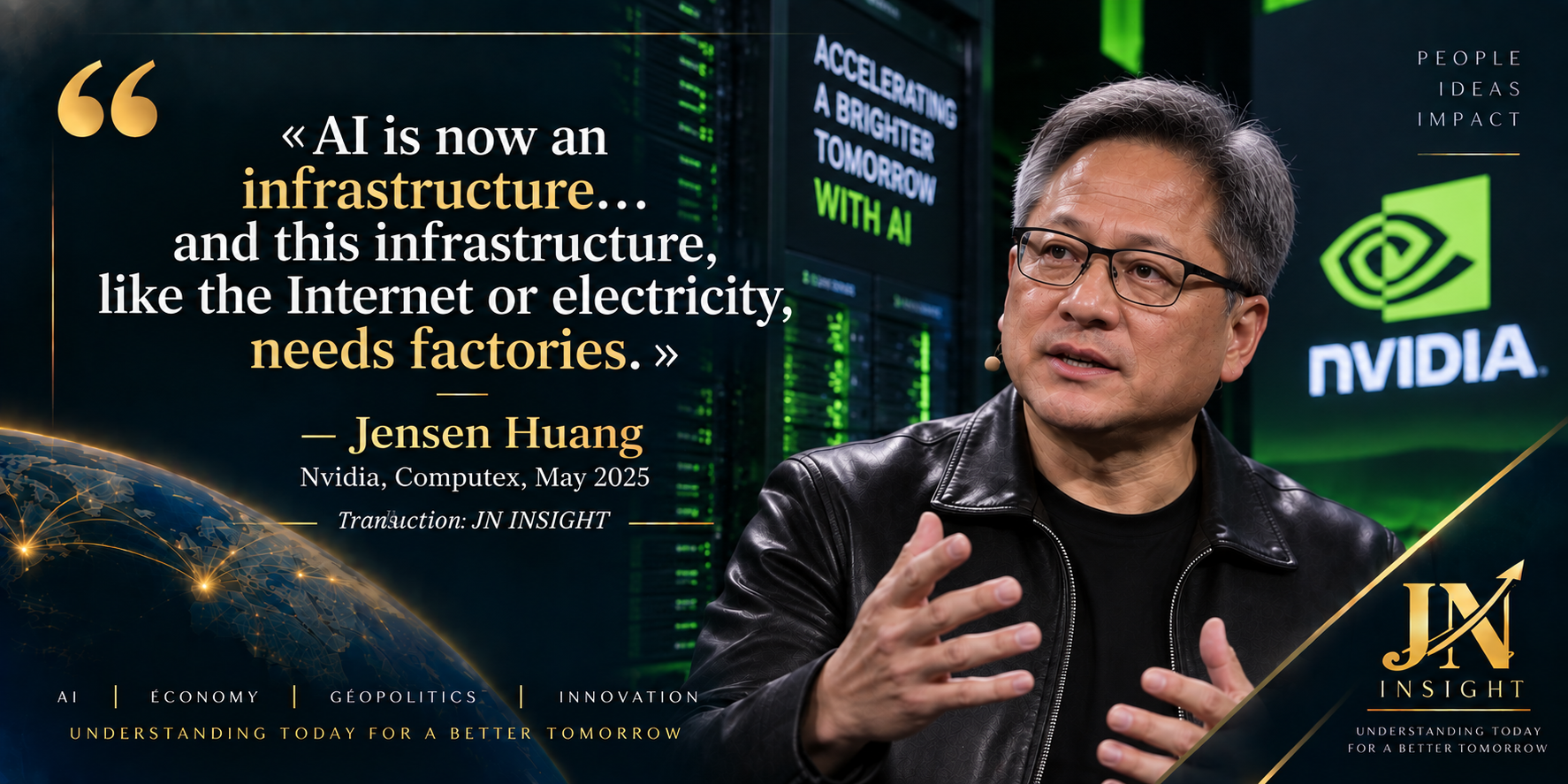
Jensen Huang, CEO of Nvidia, sums up this transformation perfectly:
And these digital factories are already beginning to encounter a very physical constraint.
In other words: you can have the chips, the land and the money — and still have to wait for the electricity.

The next major bottleneck for AI may therefore no longer be the chip. It may be the power socket.
Models, capital, chips, software, data centres, energy.
And yet, at this point in the story, the American fortress appears almost impregnable. Almost. Because fortresses have one weakness: they are built to withstand an enemy attacking head-on.
Beijing, however, has understood something.
Why try to reproduce the American system exactly when you can learn to operate differently?
Fewer cutting-edge chips, less private capital. More optimisation, more industry, more integration into the real economy.
America had built the fortress. China would look for the passage around it.
And this is where DeepSeek ceases to be merely a chatbot story. It becomes the symptom of a strategy.
PART II — 🇨🇳 CHINA, OR THE ART OF BYPASSING THE FORTRESS
And yes — Washington did not see this catch-up coming.
For a long time, Chinese artificial intelligence was viewed in the West with a mixture of curiosity and condescension.
China published extensively. Filed vast numbers of patents. Trained enormous numbers of engineers.
But when one looked at the very top of the rankings, America seemed to be competing alone in a different league.
That world no longer exists.
1. DeepSeek: AI’s “Sputnik moment”
To understand what some have called AI’s “Sputnik moment”, we need to go back to 1957.
At the time, the United States believed itself to be in a position of strength in the technological race. Then the Soviet Union launched Sputnik, the first artificial satellite in history. A small metallic sphere, just 58 centimetres across, crossed the sky. But in Washington, a much larger certainty collapsed.
The rival believed to be behind had just demonstrated that it could seize the initiative. Surprise. Even move ahead.
DeepSeek triggered a comparable shock.
Not because China had suddenly taken the lead in global artificial intelligence, but because it had demonstrated something far more unsettling for Washington.
Restricting access to the best technologies can slow Chinese innovation. It does not necessarily stop it.
In February 2025, DeepSeek-R1 briefly matched the best American model in rankings tracked by Stanford. Then Qwen, Kimi, GLM, MiniMax, ByteDance and Huawei showed that DeepSeek was not an isolated accident.
China no longer had merely one champion. It was beginning to have an ecosystem — and all of this without computing power comparable to that of Uncle Sam.
DeepSeek did not prove that China had won. It proved something far more important: the race was still open.
2. The Vanishing Gap
Let us return to the figure that changes the perception of this contest.
That is the gap measured by Stanford in March 2026 between the best American model and its strongest Chinese competitor.
An immediate caveat is necessary: the result varies depending on the tests, models and versions being compared. The 2.7% figure is not a universal measure of the U.S. lead. The trend, however, is much harder to dispute.
The best Chinese systems now compete in the same league as the best American models.
Only a few years ago, the gap was substantial. In 2026, on some indicators, it is measured in just a handful of points. And China does not even need to rank first across the board to alter the balance of power.
It simply needs to be close enough.
Because once two technologies deliver comparable performance, another battle begins: price, accessibility, diffusion — and ultimately adoption.
3 — Doing Almost as Well… Differently
When access to the best chips becomes more difficult, there are two options.
Give up. Or learn to operate differently. Beijing chose the second path.
Do more with less. Reduce the cost of using models. Improve the software. Conserve computing power. Optimise every available resource. Turn constraint into method. And this may be where the contest becomes most interesting, because the most powerful model is not necessarily the one that will ultimately be used the most.
For a company, a government or a ministry, a few additional points in a ranking do not decide everything. Price matters. Speed matters. The ability to deploy a model on one’s own infrastructure matters. Ease of access matters. Control over data matters.
And sometimes, being almost as capable for far less money is a more decisive advantage than simply being number one.
America advances under conditions of abundance. China is learning to advance under constraint.
And the history of technology teaches us something: it is full of brilliant technologies that nevertheless failed to become the standard.
Because invention is not enough. Diffusion matters. Creating the best technology is one form of power. Giving millions of companies, governments and individuals a reason to use it is another.
You can lose the benchmark and win the standard.
And this is precisely where China’s immense industrial machine enters the equation.
4 — When the World’s Factory Meets Artificial Intelligence
AI will not remain forever confined to a chat window. It will enter robots, cars, drones, warehouses, ports, smartphones, machine tools and factories. And on that terrain, China possesses something no chatbot can replicate: industrial scale.
In 2024, China accounted for 54% of all industrial-robot installations worldwide. It also leads by volume on several AI-related research and intellectual-property indicators, while the United States retains the advantage in producing the most consequential models. Two strategies are therefore beginning to emerge. America seeks to push the frontier of intelligence ever further. China also seeks to bring that intelligence down into factories, machines and the real economy.
One side seeks to build the most powerful brain. The other wants to connect that brain to the factory of the world.
And if artificial intelligence becomes as fundamental to industry tomorrow as electricity was in the twentieth century, that manufacturing advantage could carry enormous weight.
But there is a paradox. An immense paradox. Catching up does not mean achieving autonomy.
China can now develop artificial-intelligence models of the highest order. But it still depends on foreign technologies to manufacture some of the most advanced chips those models require.
Behind the technical terms — EUV lithography, HBM memory, design software — the underlying idea is actually very simple.
China knows how to build part of the brain. It still does not independently control all the machines required to manufacture that brain at scale.
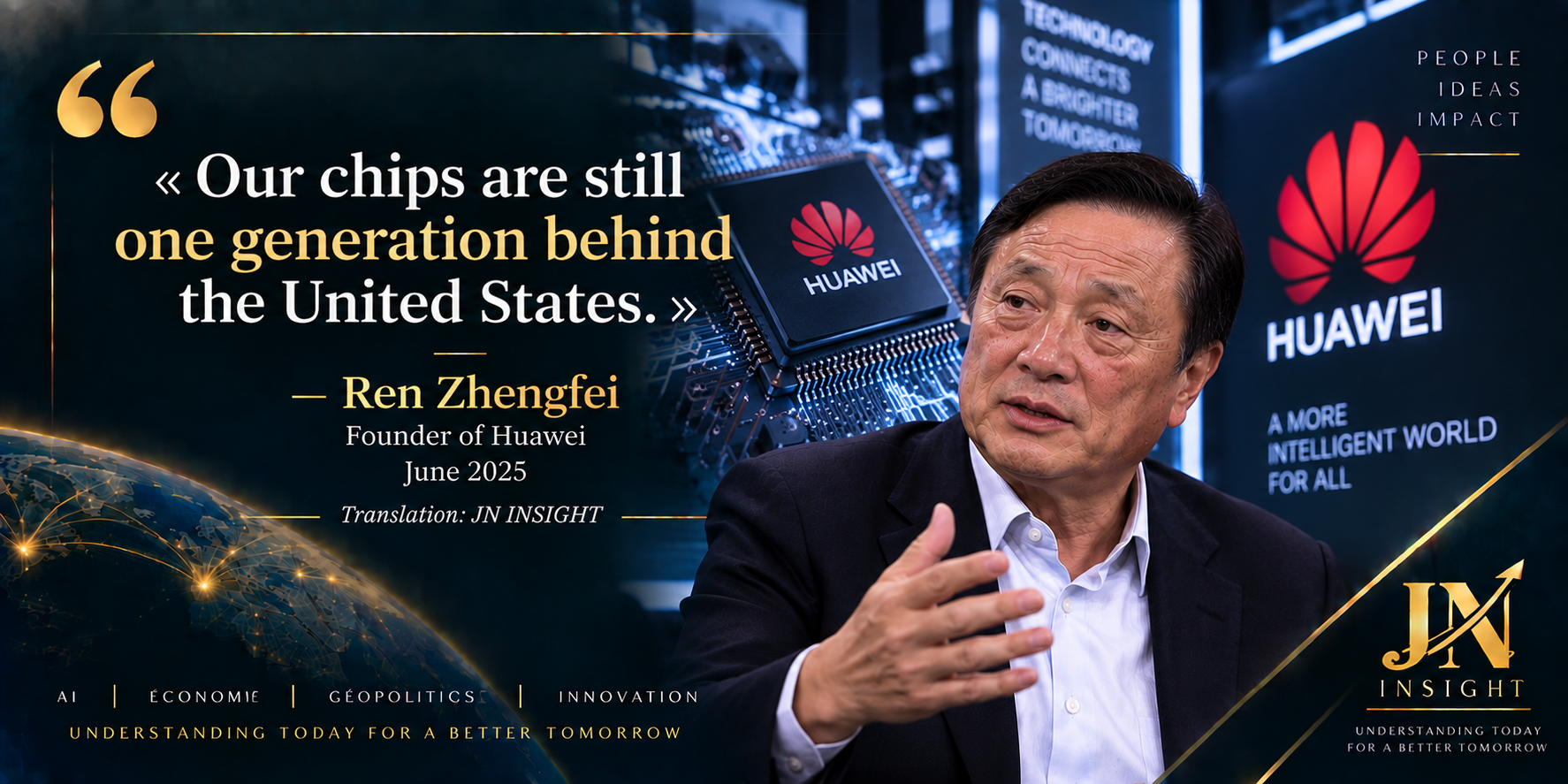
That is the full Chinese contradiction. Beijing can now produce AI systems capable of competing with the best. But to operate them at massive scale, it still depends on certain technologies controlled by its rivals. And suddenly, the real question changes. It is no longer: “Can China build artificial intelligence?”
The answer is now obvious. The real question becomes:
“Can it build the entire industrial machine required to depend on no one else?”
Because if the answer one day becomes yes, Washington will lose far more than a technological lead. It will lose one of its principal sources of leverage.
And it is precisely to prevent that scenario that the United States has begun closing the doors.
PART III 🥊 US–CHINA: A DOMAIN-BY-DOMAIN COMPARISON OF THE TWO AI SYSTEMS
So, who dominates?
The question appears simple. The answer is not. Rather than search for one absolute winner, let us examine the contest domain by domain. That is where the balance of power becomes truly legible.
Each side has its fortresses. Its weaknesses. Its dependencies.
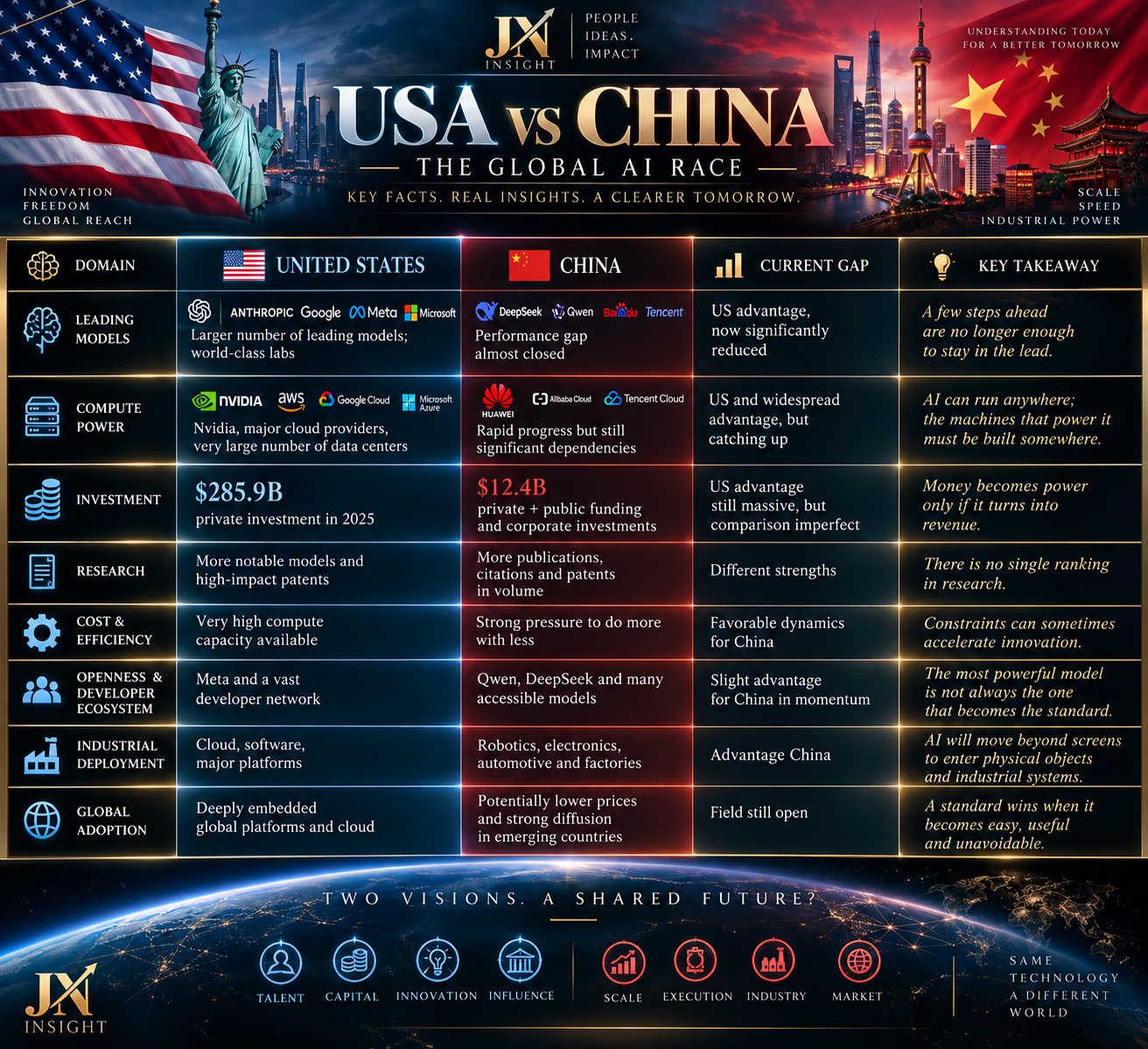
The table already tells most of the story.
The United States retains the most decisive advantages: chips, financing and data centres.
But China is now close enough on models, strong enough in research and powerful enough in industry to prevent Washington from treating its lead as permanent.
The United States remains ahead. But it is no longer beyond reach.
China is no longer watching the race from the back. It is now running with the leaders. And once the balance of power is laid out, one question becomes unavoidable.
If China continues to advance despite technological restrictions, what can Washington still do?
The answer can be captured in a single image: tighten the tap.
PART IV 🧠 WASHINGTON’S WEAPON: CONTROLLING THE TECHNOLOGY TAP
When you cannot stop your rival from improving its algorithms, another option remains: restrict access to the machines that bring those algorithms to life.
Since 2022, Washington has restricted Chinese access to the most advanced chips and to the equipment used to manufacture them. But the regime is not a total ban. In January 2026, the Bureau of Industry and Security indicated that certain highly capable Nvidia or AMD chips could still be exported to China on a case-by-case basis, subject to conditions.
Washington is therefore not simply trying to close a door. It is trying to control the flow through the technology tap.
The tighter the tap is turned, the stronger Beijing’s incentive to build its own plumbing. The equation is delicate: slow China enough to preserve the American lead, without pushing it so rapidly towards self-sufficiency that it ultimately dispenses with U.S. technology altogether.
1. A Chip Is the Product of Several Countries
Before understanding America’s weapon, one must understand a reality that many people overlook: no country can manufacture a cutting-edge chip entirely on its own. Not even the United States.
🇺🇸 United States — AI-chip design, software, cloud and specialised equipment.
🇳🇱 Netherlands — ASML, which makes the only machines in the world capable of producing the most advanced chips.
🇯🇵 Japan — critical materials and equipment that are difficult to bypass.
🇰🇷 South Korea — Samsung and SK Hynix, notably for the ultra-fast memory used by AI.
🇹🇼 Taiwan — TSMC and advanced manufacturing.
None of these actors is sufficient on its own.
And once the chip has been manufactured, another dependency begins: the energy required to run millions of them in data centres.
The most fragile link in this chain is located on an island.
2. TSMC: the Achilles’ Heel of Global Intelligence
Stanford highlights a staggering fact.
A single Taiwanese company — TSMC — plays a strategically central role in manufacturing the chips that power the world’s most advanced AI systems.
One company. On an island of 36,000 square kilometres. Claimed by Beijing.
One glance at a map is enough to understand the vertigo. Part of the world’s digital future rests on an industrial chain whose most sensitive links sit at the heart of the U.S.–China rivalry.
Two superpowers, thousands of data centres, millions of accelerators.
And at the centre of this global architecture: one island.
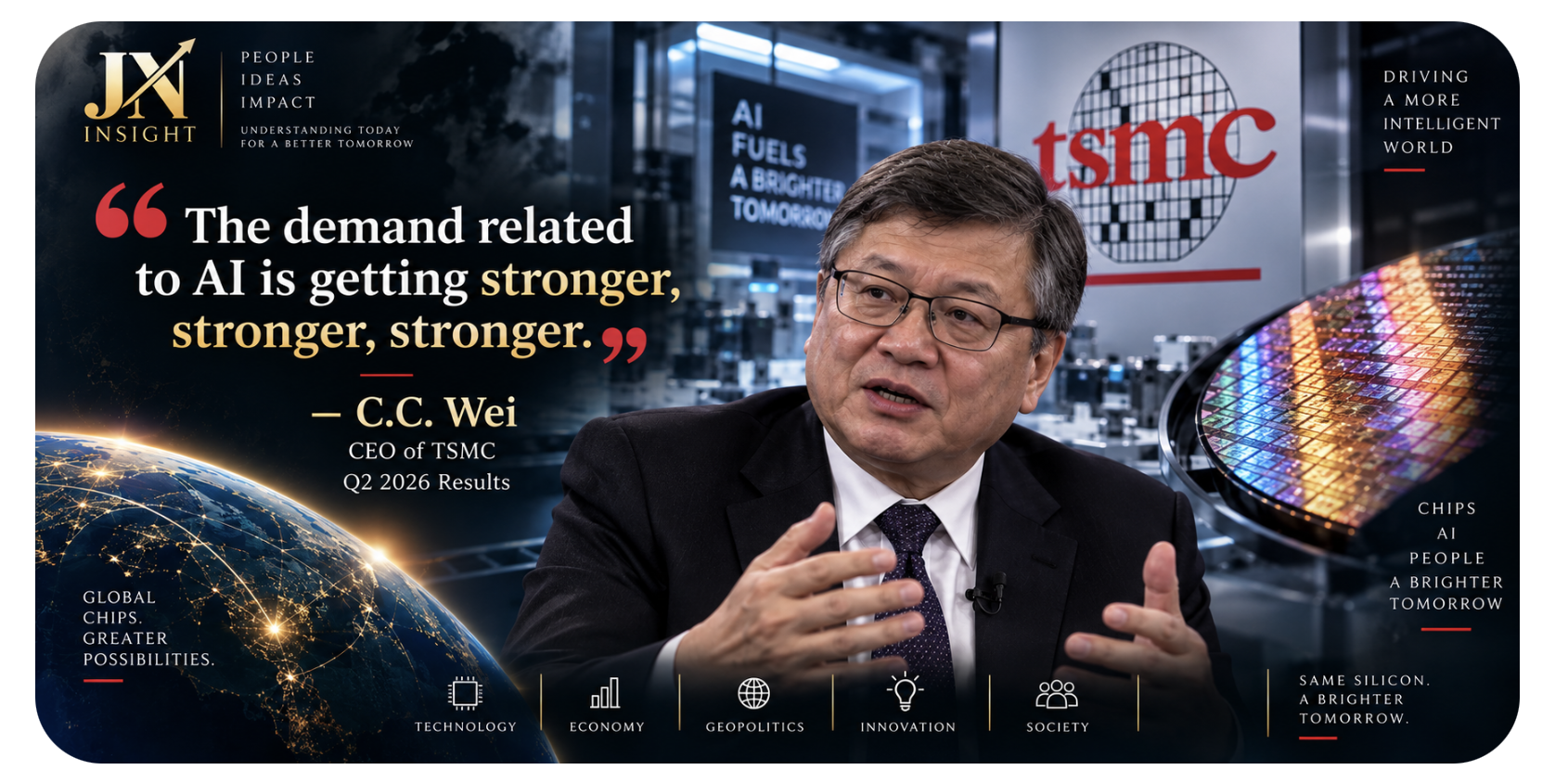
TSMC is gradually diversifying its production, notably towards the United States. But the core of the most advanced manufacturing remains deeply tied to Taiwan. That is why the Taiwan question now reaches far beyond Taiwan itself. It directly touches the infrastructure of the global digital economy.
3. The Sanctions Paradox
Washington protects its lead today while giving Beijing an additional reason to free itself from that dependence tomorrow.
That is the paradox. Sanctions can slow China.
They can also strengthen its determination to no longer depend on those technologies.
Even the U.S.–China contest is incomplete, because neither giant controls the entire chain on its own. Between Washington and Beijing stand countries and companies that neither can do without.
They may not dominate the race. But they control some of its essential chokepoints.
PART V 🌍 THE ESSENTIAL CHOKEPOINTS: THE ACTORS NEITHER GIANT CAN IGNORE
Between Washington and Beijing are countries and companies that neither giant can easily ignore or replace. They do not dominate the rankings. They control the passages.
🇪🇺 Europe — A Key No One Can Easily Replace
Europe has not yet built a system as complete as that of the United States or China.
No European Nvidia. No European OpenAI. No European TSMC.
But it holds a key that no one can easily replace: ASML.
The Dutch company manufactures the machines essential to producing the most advanced chips. Without its technology, manufacturing future generations of chips becomes considerably more difficult.
One company. One technology. Considerable bargaining power. Europe also has Mistral AI, valued at €11.7 billion after raising €1.7 billion in September 2025. And in February 2026, the acquisition of French cloud provider Koyeb sent a clear signal: Mistral no longer wants merely to design models. It also wants to control the infrastructure that allows them to run.
Although Europe trails its principal rivals, it still holds several keys to the fortress.
🇹🇼🇰🇷🇯🇵 Technological Asia — Impossible to Bypass
Taiwan manufactures a large share of advanced chips. South Korea supplies the ultra-fast memory essential to AI. Japan remains indispensable for several precision materials and pieces of equipment. None of these countries dominates the chatbot race. Yet without them, the world’s best chatbots would struggle to exist.
You do not need to own the best AI to be indispensable to the one who does.
🇦🇪🇸🇦 The Gulf — Turning Petrodollars into Computing Power
For decades, the Gulf built its power by exporting a resource the world could not do without: energy.
Today, a new strategic resource is emerging: computing power.
Capital, energy, land and political will.
The Gulf possesses a rare combination.
With Stargate UAE, that combination is beginning to turn into data centres and computing capacity. Some 200 MW of the project are expected to come online in 2026.
OpenAI itself describes Stargate UAE as infrastructure designed to develop sovereign AI capacity.
The choice of words is not accidental. AI is no longer viewed merely as a service. It is beginning to be treated like energy, telecommunications or defence: as strategic infrastructure.
An attribute of sovereignty. And perhaps, tomorrow, a new instrument of power. Yesterday, the Gulf exported barrels. Tomorrow, it may also export compute.
Europe. Taiwan. South Korea. Japan. The Gulf. None dominates artificial intelligence alone. But each controls a piece that the giants need.
And in an economy this interdependent, being indispensable at one precise point in the chain can sometimes confer as much power as owning the most visible champion.
The question is therefore not only: who wins the race? It is also: who controls the roads on which the race is run?
PART VI 🌍 THE NEXT WAR: WINNING OVER THE REST OF THE WORLD
Now suppose the United States retains the most capable models for several more years.
Has it won?
Not necessarily.
Because a technology only truly dominates the world when the world ultimately adopts it.
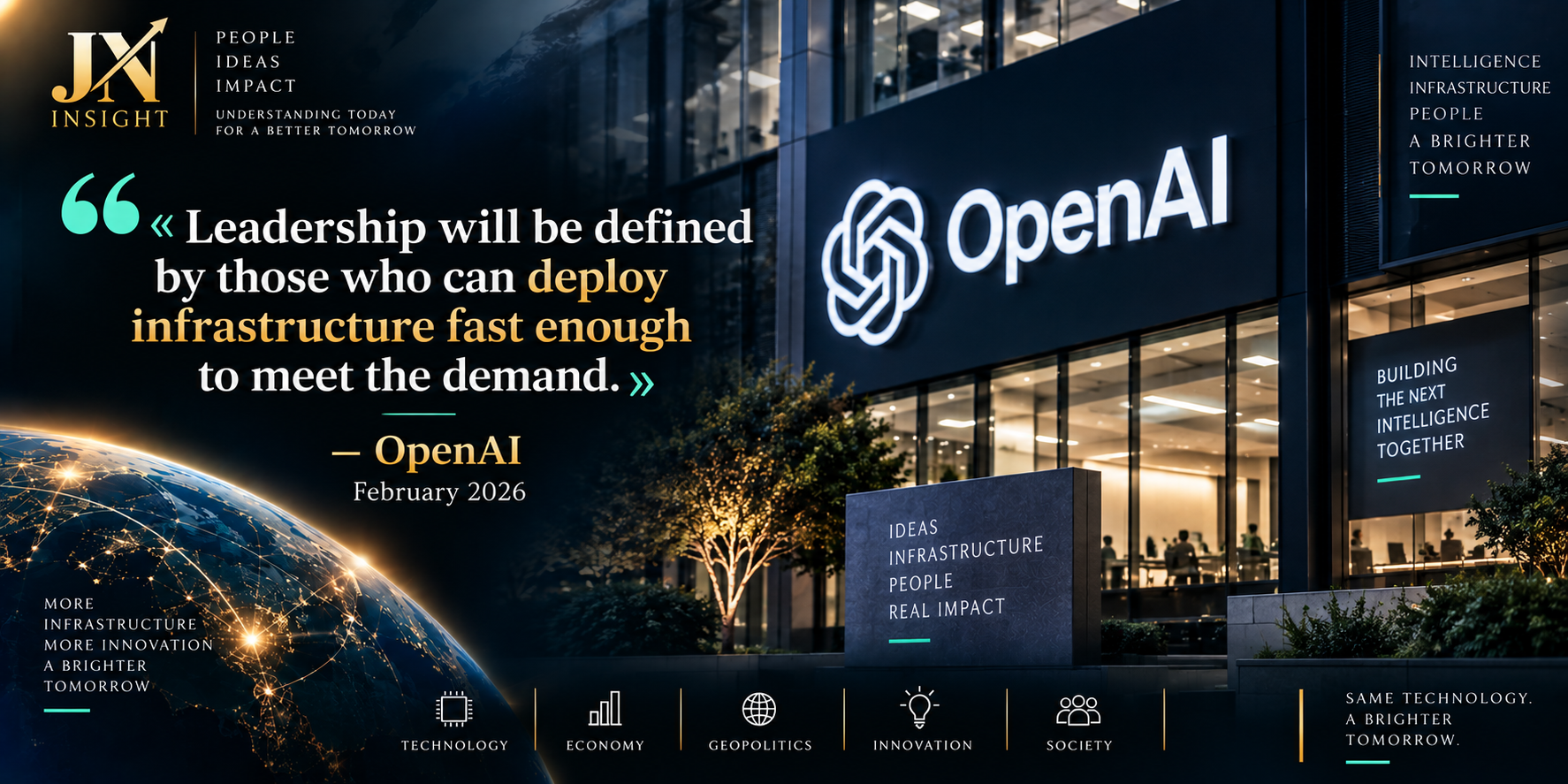
The winner will therefore not necessarily be the country that invents the most impressive AI.
It may be the one whose AI becomes the hardest to avoid.
Africa, India, the Middle East, Southeast Asia and Latin America. Billions of users. Millions of companies. All will have to choose their models, their cloud services and their standards.
The next battle will not be fought only in laboratories. It will be fought over the ability to win over the rest of the world.
Imagine two technologies. The first is slightly better, but expensive and dependent on foreign infrastructure. The second is almost as capable, less costly and deployable locally.
For many countries, the choice will very quickly cease to be ideological.
It will become economic.
Because adopting an AI system never means adopting software alone.
It also means choosing the tools around it. The cloud that hosts it. The skills that must be developed. The standards that become entrenched. And sometimes the legal rules governing the data.
Windows. Android. The cloud. 5G.
History has already shown this: a technology becomes powerful when it creates habits that are costly to abandon.
And where does Africa fit into all of this?
JN Insight has already asked this question in other forms.
In Is Africa Really Poor? — owning resources does not mean controlling the value they generate.
In From the CFA Franc to the ECO — the question was one of monetary sovereignty.
In Hormuz — it was the control of routes and flows.
AI extends exactly the same problem. After resources, currency and trade routes, a new question emerges.
Who will control the digital tools on which our companies, governments, schools and hospitals will depend tomorrow?
Consider a very concrete example.
If, tomorrow, a Ministry of Education chooses Qwen rather than an American model, it is not merely choosing a chatbot. It is also choosing hosting. Tools. Languages that may be more or less well supported. Skills to be developed. And sometimes the country whose rules will apply to its data.
This is precisely where open or lower-cost Chinese models can become powerful instruments of influence. Not because they will always be the best, but because they may be good enough, accessible enough and easy enough to integrate to become unavoidable.
Africa’s next dependency may not be only mineral, monetary or energy-related. It could be algorithmic.
Yesterday, dependency was measured in tonnes of raw materials or in foreign-exchange reserves. Tomorrow, it may also be measured in the model that advises a doctor, assists a teacher or helps a public administration make decisions.
PART VII 🏆 SO… WHO REALLY DOMINATES?
In September 2026, the verdict remains clear.
The United States is still ahead.
Washington has the most complete system: more private capital, Nvidia, the major cloud providers and an unrivalled network of data centres.
But China has dramatically narrowed the gap at the frontier. And it possesses other weapons: research, robotics, industrial power and the ability to drive costs down.
Beijing is no longer trying to enter the race. It is already in it.
The convergence in performance does not mean that China dominates. It means something subtler: the old technological gulf is closing at precisely the moment when the real contest is shifting towards chips, energy, data centres and industry.
America is therefore trying to preserve its lead. China, meanwhile, is trying to change the rules of the race.
That may be the entire story of this rivalry in a single sentence.
Washington is defending a dominant position. Beijing is trying to make that position less decisive.
2030 — Three Scenarios
Scenario 1 — America’s wager pays off. Washington preserves its technological and financial lead. AI revenues eventually catch up with the colossal investments made. America bet correctly.
Scenario 2 — The contest stabilises. Beijing reduces its dependencies enough to build an almost complete AI system and reaches a level of chip production that is sufficiently autonomous and competitive with Nvidia and the existing ecosystem. Two major technological spheres then face one another — each with its own models, infrastructure and zones of influence.
The world will have to choose a side.
Scenario 3 — No one wins alone. Models gradually become easier to replace. Value shifts towards what remains scarce: electricity, computing power, data, distribution and standards. In this scenario, the American risk becomes straightforward.
Ever-increasing investment in infrastructure whose profitability grows more slowly.
The real question for 2030 may therefore not be:
“Who will have the best chatbot?”
But rather: “Who will control the infrastructure that others can no longer do without?”
The scenarios are set. It is for each of us to decide which answer is most plausible.
One thing is certain: America has won the battle for capital. The battle for returns is only beginning.
PART VIII — 🎯 THE JN INSIGHT LESSON
For two centuries, global power was measured through things that could be seen. Touched. Counted.
Territories, armies, factories, oil wells, aircraft carriers.
Then part of that power shifted towards digital networks, semiconductors, the cloud… and now, artificial intelligence.
At first glance, nothing has ever seemed more intangible. Yet behind the screen lies an extraordinarily physical reality.
Mines are needed to supply the materials; machines to manufacture semiconductors; specialised factories to produce chips; data centres to host them; power plants to provide electricity; and billions in capital to finance the whole system. Only then — at the very top of this immense chain — do algorithms transform infrastructure into intelligence.
That is why this battle extends far beyond ChatGPT, DeepSeek, Gemini or Claude.
AI is no longer merely a technology. It is becoming an infrastructure of power.
And infrastructure is never neutral. It creates dependencies. It sets standards. It often ends up distributing power.
Intelligence appears intangible. Yet its power rests on concrete, copper, silicon, electricity, code and capital.
America still possesses the most complete system. China is building its own at a speed Washington can no longer ignore.
Europe, although well behind in this clash of titans, still retains several strategic technologies.
Taiwan, South Korea and Japan control indispensable components.
The Gulf is gradually converting its energy and capital into computing power.
No one rules alone.
But everyone is trying to control what others will need.
The next AI superpower may therefore not simply be the country that creates the most intelligent model.
It may be the country that controls the roads, factories and energy that enable the rest of the world to use it.
Because the next great AI power may not merely determine which models we use.
It may also control part of the infrastructure through which our children learn, our companies work and our states govern. The AI war is only beginning.
But the real question may already no longer be whether tomorrow’s artificial intelligence will be American or Chinese.
Because whoever controls the infrastructure does not merely control a technology. They control a dependency.
The real question is more unsettling.
When these infrastructures have become indispensable —
will we still genuinely have a choice?
→ And you? Ten years from now, will the artificial intelligence you use every day be American, Chinese… or will it come from a player no one yet expects?
Yours intellectually,
Jean-Noël Niamké Financial Expert | Geo-economic and Strategic Analysis The Mechanisms of Power | The truth beyond appearances.
Our sources: here