October 17, 2026: What if the problem was elsewhere?
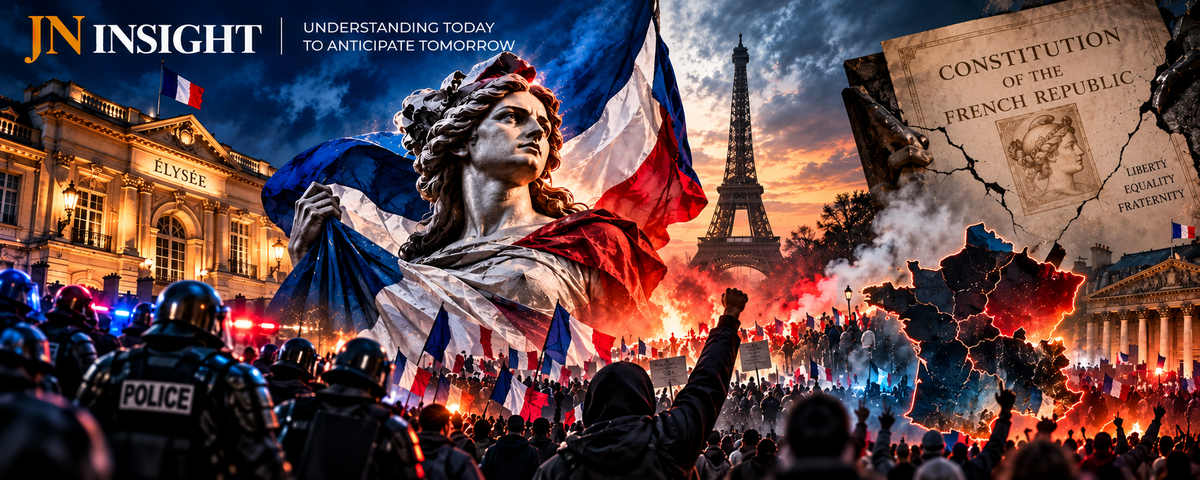
When a country accumulates ten years of consultations without follow-up, the street ends up taking over from the institutions.

On October 17, 2026, between 550,000 and 800,000 people marched in the streets of France. The figures speak for themselves: two visions, two assessments, the same fractured country.
2,397 arrests. 997 police and gendarmes injured. A man died on Boulevard de Magenta. A 17-year-old teenager with his hand torn off in Saint-Étienne, IGPN investigation opened. Two others lost an eye. The town hall of Limoges, a historical monument, burned down. More than 2,000 shops damaged or looted according to CCI France, at least 3,000 according to the government. Curfews in several major cities.
The next evening, Macron described the troublemakers as "factious". Retailleau called for a state of emergency. The Paris prosecutor noted that of the 557 people in police custody in the capital, none had claimed a political motive.
This bulletin does not tell the whole story. It says what happened. It does not say why.
JN INSIGHT condemns the violence, without confusing its perpetrators with all the demonstrators. But condemnation does not exempt us from understanding. Because beyond the damage and clashes, one question remains: why was so much anger expressed simultaneously?
Part I - The Decade of Missed Opportunities
Explaining October 17 is like going back a long way, as far back as the beginning of Emmanuel Macron's first five-year term. And you will see that the origins are not so trivial. It all began in 2018.
In the autumn of that same year, diesel had just exceeded €1.50. For millions of French people who live far from the big cities, with no other choice than their car to go to work, this is the last straw. The Yellow Vests movement broke out. On November 17, 2018, 282,000 people occupied roundabouts and toll booths throughout the country. This is not a movement of left or right. It is a movement of exhausted people.
The government is trying to provide some solutions: revaluation of the activity bonus, tax exemption for overtime. .. And above all, it is opening grievance books in every town hall in France, a space where citizens can write down what is wrong. Thousands of pages are filled. The street empties. But what they contain will never really be dealt with.
The anger was thus absorbed, but not yet processed.
Emmanuel Macron, President of the Republic, nevertheless draws a lesson from this: the French want to be heard. In 2019, he launched the Citizens' Convention for the Climate: 150 citizens drawn at random, representative of the country's diversity, gathered for 9 months to work on the ecological transition. This is the direct follow-up to 2018: a president who creates a space for direct participation to prove that he listens.
At the end of these nine months of work, the 150 submitted 149 proposals. On June 29, 2020, Macron received them at the Élysée Palace. He had promised to transmit their proposals "without filter". The country is watching.
And then, he comes up with a group of words: "thethree jokers".
Quite rightly, three of the 149 proposals are thus discarded, the most symbolic in the eyes of the citizens: the 4% tax on dividends, the limit to 110 km/h on motorways, the inclusion of the fight against climate change in the preamble to the Constitution. It must be said: 146 of the 149 proposals have been formally retained. But their actual implementation is another question, and it is precisely this gap between the announcement and the effect that counted in the collective perception. Unfortunately, something broke that day: there is confidence in the idea that participation is useful.
It was not a one-time failure. It was a systemic signal.
Then came 2023, Prime Minister Élisabeth Borne presented the bill on a new pension reform: raising the legal retirement age from 62 to 64. The measure was presented as a budgetary necessity. The unions, for their part, saw it as a red line. Nine days of national mobilization. 1.28 million demonstrators according to the government. 3.5 million according to the CGT. The mobilization is massive, long-lasting, transversal.
Despite popular discontent, the government decided to engage its responsibility via article 49.3 and forced the text through on March 16, 2023, without a vote in the National Assembly. The Constitution allows it, but the rage of the demonstrators is ferocious, although contained in the stomach.
The message received that day was not "reform is good or bad". It was indirectly: it doesn't matter what you think. The text passes.
Subsequently, in July 2025, the Duplomb law was adopted. An agricultural law that aims to reintroduce acetamiprid, a neonicotinoid banned since 2018 in French agriculture. These insecticides are accused of decimating bees. A petition launched against this project collected 2 million signatures. But, to everyone's surprise, it was the referral by left-wing parliamentarians, and not the petition, that triggered the constitutional examination. On August 7, 2025, decision no. 2025-891 DC led to the censorship of the article reintroducing acetamiprid. The procedure worked. The safeguard held.
And yet.
In July 2026, an agricultural emergency law reintroduced neonicotinoids , including acetamipride, through another legislative vector, with a different framework mechanism. The Constitutional Council validated this text this time on August 14, 2026. Same substance, different scope.
So the procedure didn't just absorb the anger. It absorbed its own victory.
The observation is therefore as glaring as it is surprising and leads indirectly to a silent accumulation without action that would break the camel's back in the long term.
Part II - When tensions become systemic
October 17 was not born of a single cause. It was born of the accumulation of several crises that converged at the same time, on the same people.
The first: fuel. At the end of February 2026, diesel cost €1.72. In October of the same year: €2.34 to €2.40. A historical record. SP95 was close to €2.02. Behind these figures: the Strait of Hormuz, closed at the end of February following the conflict involving Iran, and 400 million barrels released via the IEA, which were not enough to contain the rise. For millions of French people without an alternative to their car, filling up had become an insoluble equation.
The second: caregivers. They were there in 2019, when the hospital inter-union launched the first major movement on medical deserts and bed closures. Also in 2020, clapping from their windows before realizing that the Ségur de la Santé would not compensate for the years of wage freeze. And in 2026, they were still marching, not because nothing had been done, but because what had been done had not changed what they were experiencing: understaffed services, long on-call duty, the feeling of being a variable of budgetary adjustment.
They are still present in the procession, but unfortunately the subscribers are absent from the real budgetary arbitrations.
A third: Municipal employees as well. Indeed, the 2026 finance law had frozen the DGF at the 2025 level: in real volume, about 300 million euros lost for local authorities, nearly 2 billion in total drain. Behind all this: fewer services, fewer agents, fewer responses.
A fourth: Transporters, who were suffering the full force of the rise in fuel prices. According to the FNTV, diesel represents between 25 and 30% of a road haulier's operating costs. At €2.40 per litre, margins had melted before contracts could even be renegotiated. Several federations had alerted the government in the spring. Without a binding response.
And finally the high school and university students who marched on their own, or rather, side by side, without really recognizing each other. The most visible reason: Parcoursup, this platform launched in 2018 in which each high school student waits, sometimes for weeks, for an algorithmic response that will determine his or her orientation. But behind Parcoursup, there was also something else. High schools where the toilets no longer work, leaky roofs, overheated classrooms in June and freezing in November. A 2023 report by the Court of Auditors estimated the delay in the maintenance of school assets at 12 billion euros. It was not just anger at an algorithm. It was anger at buildings that are falling apart while they are being asked to project themselves into the future. And in the face of all this, an official response from the government in October: improvements "by the end of October". This is not an answer. It is a postponement.
What the street said that day was not "down with the government". It was: words no longer coincided with actions.
Part III - October 17: The Atomization

What surprised observers was not that people took to the streets. It was that they did not recognize themselves in the same street.
The CGT and Solidaires had called for demonstrations on specific demands: purchasing power, public service, fuel. The former Yellow Vests, on the other hand, were there with something else: a presence, a diffuse rage, without a single object. To this must be added high school students, transporters, caregivers, isolated citizens without union membership or partisan labels.
Several processions in a single street, several readings of the same anger.
What commentators called "convergence of struggles" was in reality quite the opposite. It was atomization. Not a mobilization organized around a common project, but parallel anger that happened to find itself in the same public space. According to Le Monde, a TikTok video published on September 8, 2026 had helped propel the date of October 17, before being relayed by various organizations. Territorial intelligence described TikTok as an "unprecedented accelerator": the scenes of looting filmed and broadcast live had fueled the conflagration as much as the union calls. No unified leadership had coordinated this, and this is precisely what made it ungovernable.
It must be said clearly: the decentralization of this mobilization does not alone explain the violence. Diffuse anger does not automatically produce violent acts. But it prevents any structured negotiation, because there is no one to talk to.
An organized anger negotiates. An atomized anger has no interlocutor, and some of those who make it up end up looking for one in violence.
Part IV - 2024: The Ballot Boxes Without

We cannot talk about the origins of this crisis without specifically addressing the European elections of June 2024. On the evening of June 9: the RN came out on top with about 32% of the votes cast, and the Renaissance list (presidential part) followed with only 14%.
The next day, as surprising as it is innocuous, Emmanuel Macron announced the dissolution of parliament.
The French are therefore invited to an early election to which they lend themselves. The New Popular Front came out ahead in terms of seats at the end of it, the RN stumbled in the majority vote. The presidential camp finished second. No absolute majority for anyone.
And yet, the president appointed Michel Barnier as Prime Minister on September 5, 2024 , leader of a party that arrived in a bad position at the polls. This is legally possible: legally, Article 8 of the Constitution does not impose any obligation to choose the leader of the bloc that came out on top. But this is not the custom. The precedents of cohabitation have indeed demonstrated the opposite with Chirac under Mitterrand in 1986, Balladur in 1993, then Lionnel Jospin under Chirac in 1997 who had established the opposite standard. It should also be remembered that no bloc had an absolute majority, which made the situation constitutionally unprecedented.
A decision that is therefore legally indisputable in principle, but whose political legitimacy remains contested in the face of custom in a context of jurisprudence.
The ballot boxes had produced a result. The institutional reading had produced a completely different one.
Part V - Why the Way Works

The 1958 Constitution was designed to put an end to the chronic instability of the Fourth Republic: governments that fell on average every six months. The remedy: a strong executive, a supervised Parliament, a Prime Minister appointed by the President. In 1962, direct universal suffrage further strengthened the legitimacy of the head of state.
This system has its defenders. They argue that it has produced sixty years of relative stability, gone through May 68, the oil shocks, three cohabitations without collapsing.
That's right. And that's precisely the question.
Because other democracies function differently. In Germany, the Bundesrat gives the regions a structural right of scrutiny over the laws that affect them. In Switzerland, the referendum by popular initiative is constitutional. In the United Kingdom, citizens' petitions can give rise to a parliamentary debate, without being automatically followed by action, but the discussion takes place.
In France, consultation exists. The petition exists. The Convention exists. Parliament votes on laws and can overthrow the government, as it has demonstrated. But the weight of the executive in the final decision, and the limits of participatory mechanisms, mean that the result of a consultation is not imposed on the person who initiated it. The question raised by the events of 17 October is not whether this system is legitimate, it is constitutionally. It is whether the participation mechanisms it proposes are sufficient to absorb expectations that have profoundly changed.
It's not a failure. It's an architecture. Designed in 1958 for a country that no longer quite exists.
What to remember?
What burned on October 17 was not just buildings. It's a question asked.
The procedure absorbed the anger. It did not absorb the cause.
The Yellow Vests got money, not structural reform. The Convention made 149 proposals, 146 formally retained, the most symbolic discarded or not applied. The mobilization of pensions was bypassed by 49.3. The Duplomb law was censored and neonicotinoids came back through another door. The 2024 elections produced a result that the institutions interpreted differently.
Each time, the legality has been respected. Each time, the distance between procedure and concrete effect has widened a little more.
This is not a crisis of government. It is a crisis of confidence in the forms of representation themselves.
So the question arises: Does France need new consultations, or new rules so that they can really change decisions?
And you, what do you think?
Intellectually yours,
Jean-Noël Niamké
FINANCIAL EXPERT
Strategic & geopolitical analyses
Sources: Find the full references here 👉