Hormuz, Bab El-Mandeb, Damietta: when 33 kilometres of water reshape the world order
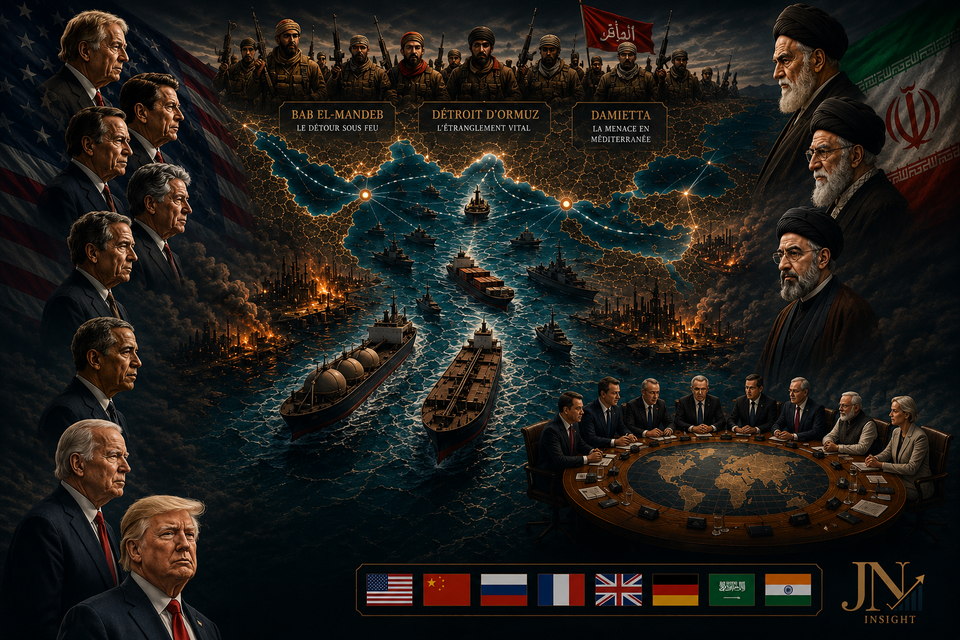
From Jimmy Carter (President of the United States, 1977-1981) to Donald Trump (2016-2020 and since 2024), an unspeakable rivalry between the American leaders and the ayatollahs of the Islamic Republic against a backdrop of oil control.
Five months of war. Four ceasefires broken. An American ship on fire in Egypt yesterday. TotalEnergies doubling its profits. Trump trapped. And the world that understands that wars are no longer won with bombs.
The wars of the twenty-first century are no longer won on the battlefield. They are won on the sea routes.
February 28, 2026. Midnight. Something closes. And the world is holding its breath.
July 29, 2026. Last night. Something is burning. In a port. In the Mediterranean. Where no one expected war.
Between these two dates: five months. Four ceasefires. Zero agreement. And a silent recomposition of the world order.
What has happened since February 28, 2026 is not a war like any other. Nor is it a simple oil crisis. It is something rarer: a conflict that reveals the fault lines of the international system in real time.
Who really holds the power? Who absorbs the costs?
And who, in silence, repositions his pieces on the chessboard?
This is what JN Insight has been deciphering since the beginning, and what you are about to discover may surprise you.
ACT I — The Geography of Absolute Power
There are places on Earth where geography is a weapon. The Strait of Hormuz is the most brutal example of this.
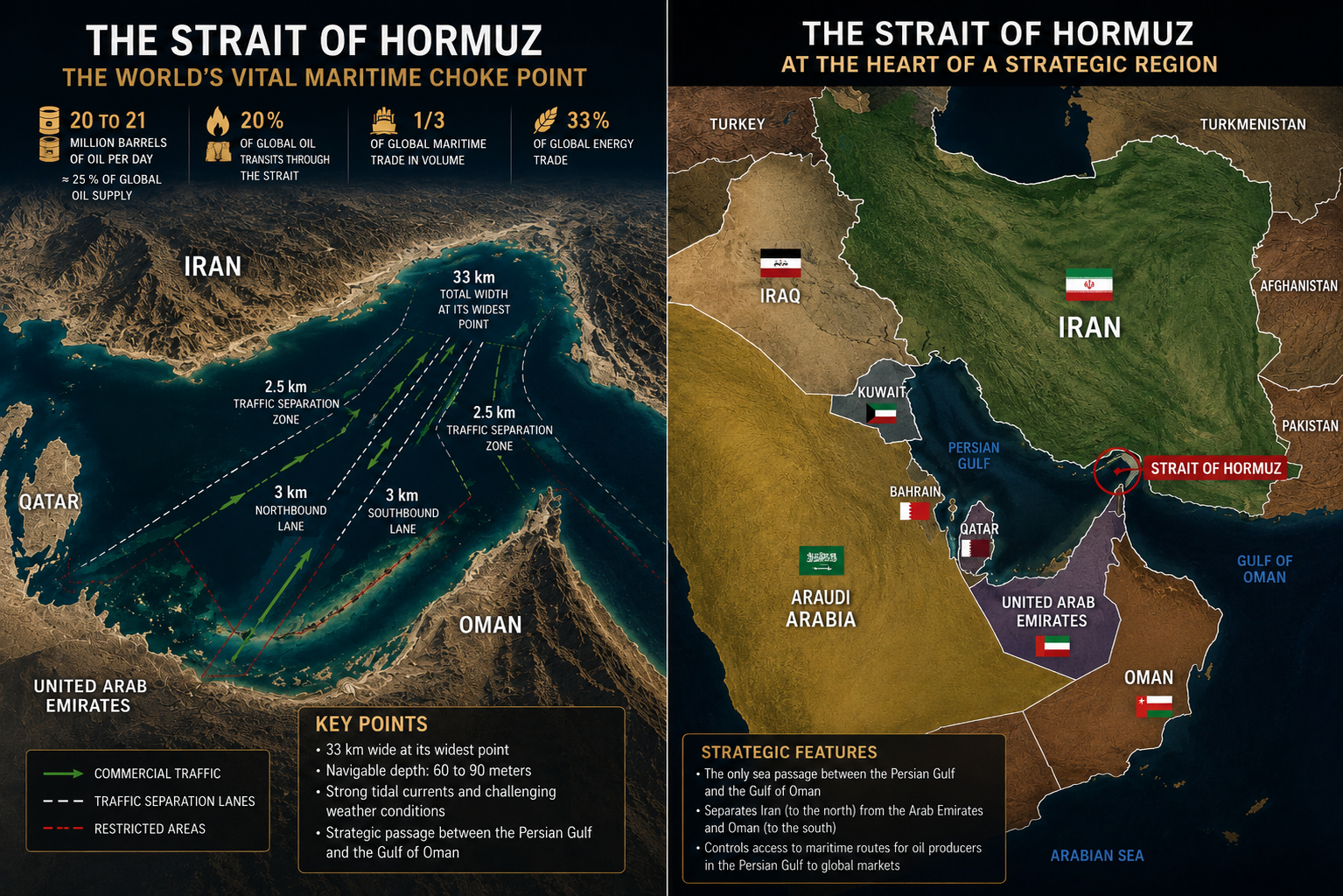
At its narrowest point, theStrait of Hormuz is only about 33 kilometres wide. Yet the giant ships use shipping lanes that are barely 3.7 kilometres wide each. Before the war, nearly 20 million barrels of oil passed through it every day, about a quarter of the world's maritime oil trade and a fifth of the world's consumption.
Whoever closes this passage, holds the world.
But here's what few analysts were saying before February 28: there is no single strategic passage. There are two.
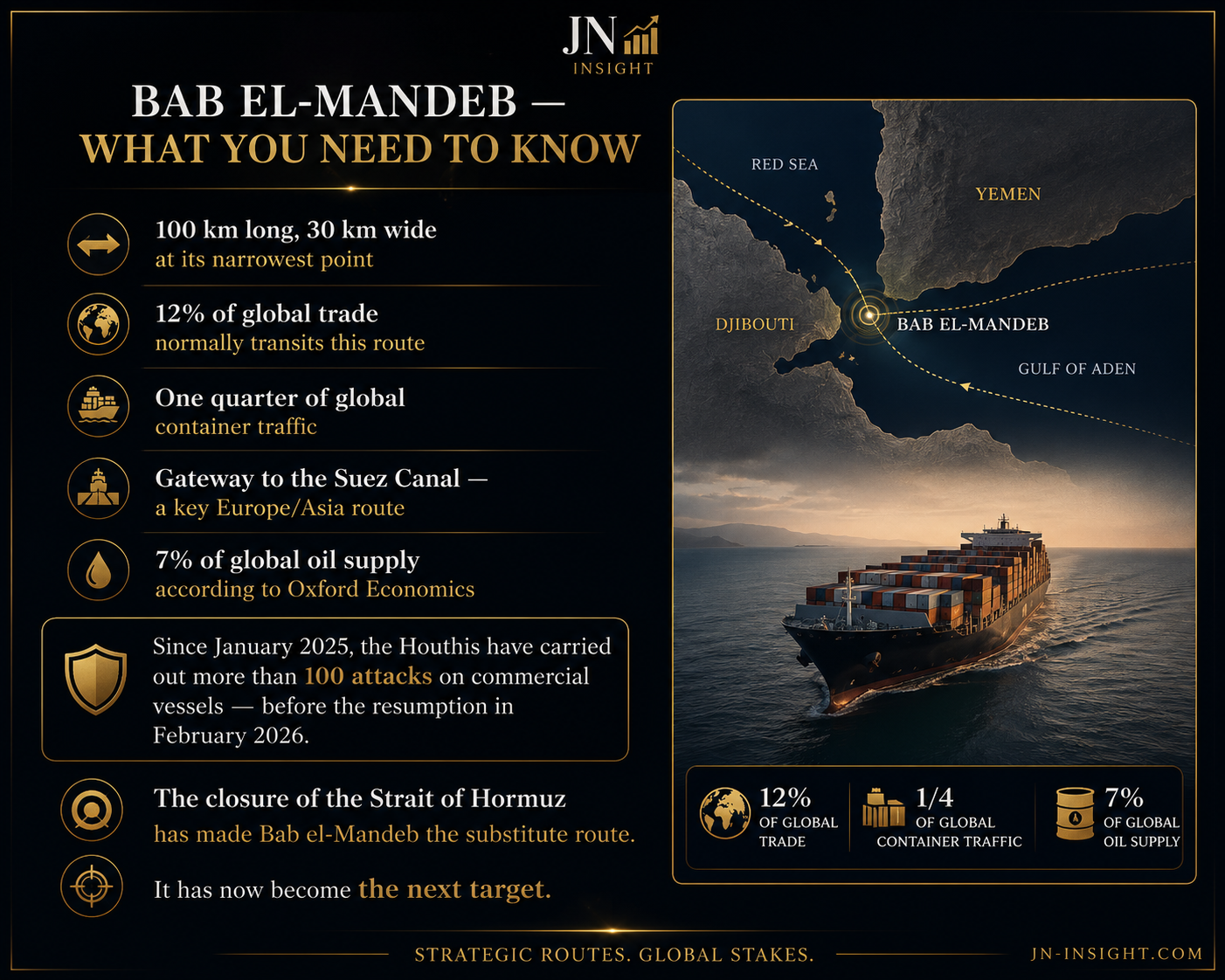
Bab el-Mandeb — the second lock.
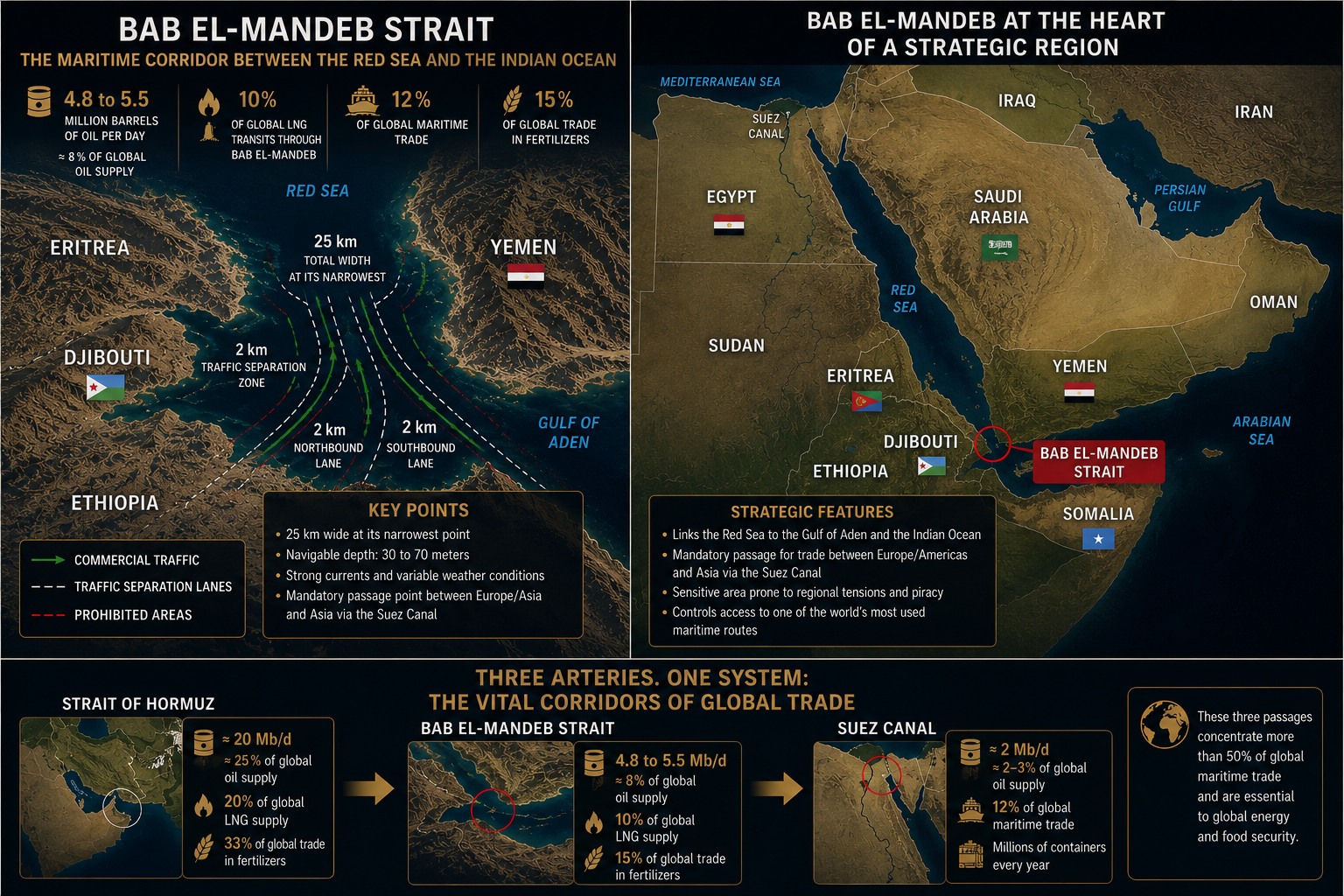
This strait commands the southern access from the Red Sea to the Gulf of Aden. About 100 km long, 1.2% of world trade and a quarter of world container traffic normally use this route. It is the gateway to the Suez Canal. This is the route that the shippers had taken to bypass Hormuz.
Hormuz in the north, Bab el-Mandeb in the south; Two locks, a single world caught in a vice.
But there is also—The port of Damietta. A drone was launched in this Egyptian port in the Mediterranean. The facts: a US regasification unit based in Egypt was hit by a drone in this port. Perpetrated on Wednesday, July 29, 2026, this attack caused a fire on board two production and storage gas ships at the quayside. The origins have not yet been established, as no one wants to take responsibility for this strike, but everything suggests that it would be retaliation for American involvement in the conflict in Iran, rather than simple isolated facts.
The war is therefore spreading. It no longer seeks to block a passage. It seeks to impact the very notion of maritime security.
But understanding what these straits really represent would not be enough. We also need to understand how we got to this point. Date after date, decision after decision. Because if the current conflict broke out in a few months, its roots go back much further. It is therefore necessary to distinguish the recent escalation from its root causes.
ACT II — Before the five months, forty-seven years of tensions
To understand why the Strait of Hormuz was closed on February 28, 2026, we have to go back forty-seven years.
Because this war did not start in 2026. She was born in 1979.
I. The origins of the conflict
A chronological analysis allows us to better understand its origins.
1979 — The Break
The Islamic Revolution overthrew the Shah of Iran, Washington's main ally in the Gulf. Ayatollah Ruhollah Khomeini took power. A few months later, the American embassy in Tehran was occupied and 52 American diplomats were held hostage for 444 days. Since that day, the United States and Iran have not maintained any diplomatic relations. The economic sanctions begin. A real cold war is taking place between Washington and Tehran.
It will never really end.
2015 — Hope
After years of negotiations, Barack Obama signs the Joint Comprehensive Plan of Action (JCPOA) with Iran and five other major powers.
Iran agrees to limit its nuclear program. In return, international sanctions are gradually being lifted. For a few years, the confrontation slowed down.
One agreement. And even that agreement will be broken.
2018 — The turning point
Donald Trump unilaterally withdraws the United States from the JCPOA.
The so-called "maximum pressure" sanctions have been reinstated. Iran is gradually resuming uranium enrichment beyond the limits set by the agreement and trust is disappearing.
The logic of cooperation gives way to a logic of confrontation. With it, what appeared to be the last real chance for a lasting diplomatic settlement vanished.
2020 — Military escalation
General Qassem Soleimani, commander of the Quds Force and the main architect of Iran's regional influence, waskilled in a US strike near Baghdad. Tehran promises "severe revenge".
From that moment on, military logic definitively took precedence over diplomatic logic.
2023–2025 — The regionalization of conflict
The Houthis are increasing attacks on commercial ships in the Red Sea. Hezbollah is intensifying its operations from Lebanon.
Pro-Iranian militias are increasingly striking US bases in Iraq and Syria.
In June 2025, Israel directly struck Iranian territory in the Twelve Day War. The United States then destroyed three of Iran's main nuclear sites.
The conflict then ceased to be solely Iranian-American.
It becomes regional. Then gradually global.
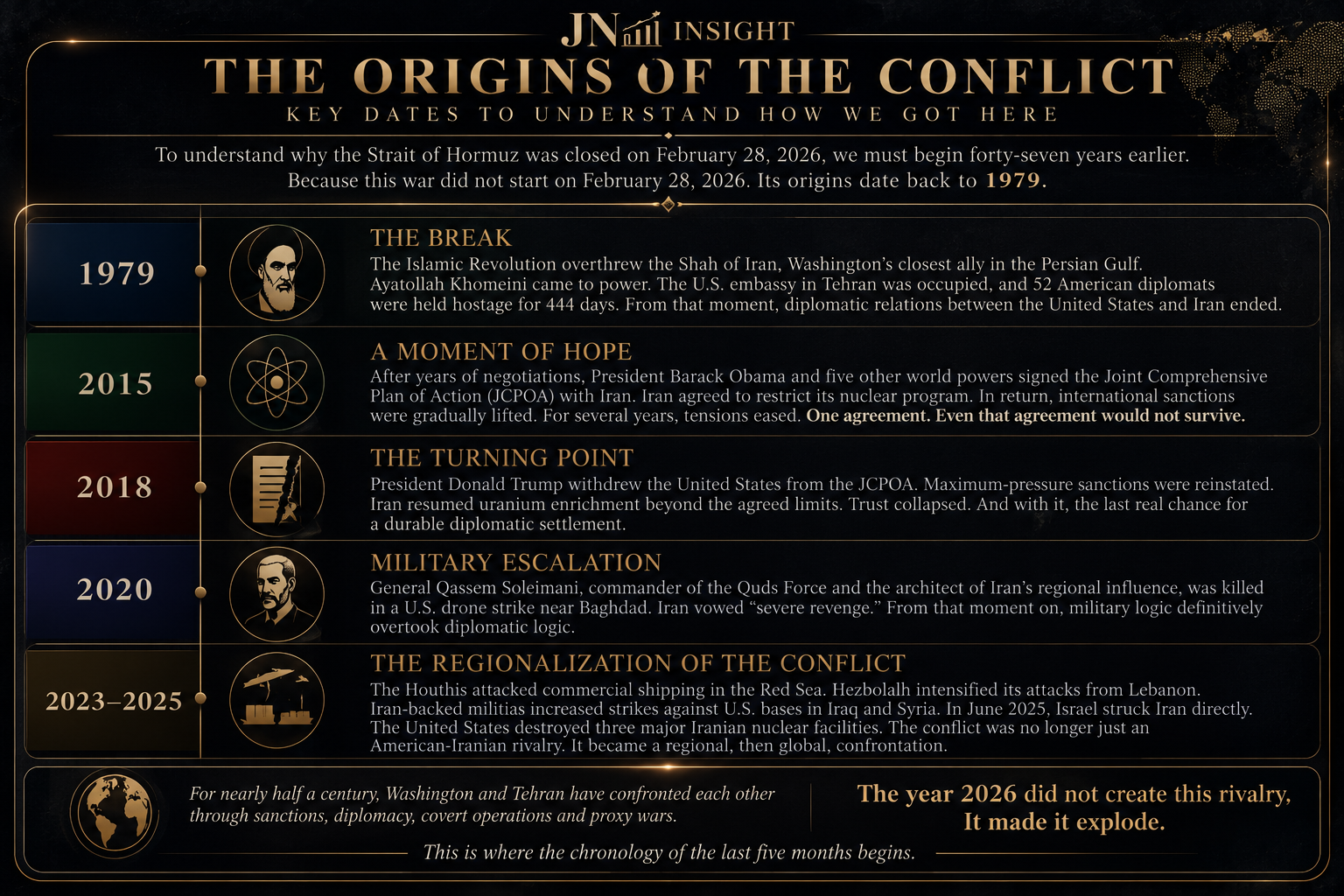
For nearly half a century, Washington and Tehran have clashed through economic sanctions, negotiations, clandestine operations and proxy wars.
Year after year, the red lines have shifted. Each crisis has prepared the next, to the point of making escalation almost inevitable.
The year 2026 does not create this rivalry. It makes it explode in the eyes of the world.
This is where the chronology of the last five months begins.
II. Five months that changed global geopolitics (2026)
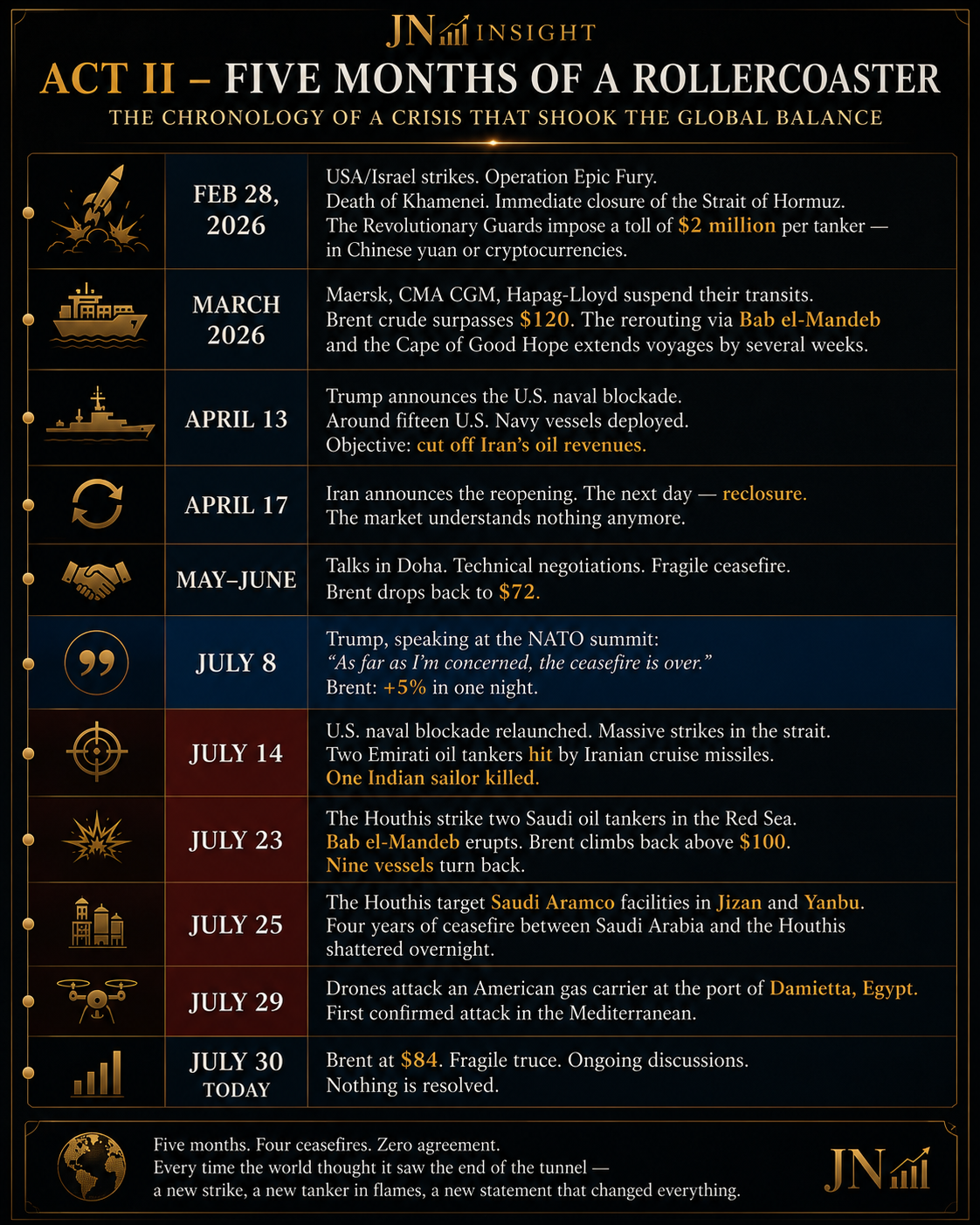
Here is the timeline that the media has not shown continuously. The real story of this crisis, as it unfolded.
A first signal of normalization nevertheless appears. On July 30, a QatarEnergy-controlled LNG carrier became the first LNG vessel to leave the Strait of Hormuz in nearly three weeks. Traffic is not yet resuming normally, but market participants are cautiously testing the limits of the risk.
In this war, even a single ship became a strategic indicator.
Five months. Four ceasefires. Zero agreement.
And every time the world thought it was at the end of the tunnel — a new strike, a new tanker on fire, a new statement that rocks everything.
The world had a plan B. His name was Bab el-Mandeb. Then the Houthis struck there.
ACT III — Bab el-Mandeb: the second front that we didn't see coming
There was a logic in the bypass of Hormuz. If the Gulf is dangerous, we go through the Red Sea, we cross Bab el-Mandeb, we go up through the Suez Canal. It takes longer. It's more expensive. But it is possible.
The Houthis broke this logic overnight.
On 23 July, they struck two Saudi oil tankers — the Encelia and the Layla — in the middle of the Red Sea. These ships loaded crude oil transported by the East-West pipeline, precisely the bypass road that allowed Riyadh to supply Asia without passing through Hormuz, at Yanbu (an ultra-strategic port on the Red Sea, located more than 2,500 kilometres from Tehran, on the west bank of Saudi Arabia, opposite Egypt). At least nine ships turned back.
The bypass road is now as dangerous as the main road. The maritime world no longer has a plan B.
The invisible weapon: marine insurers.
Closing a strait is no longer the only way to block global trade. Sometimes it is enough to make the insurance prohibitive.
Since the Houthi attacks, insurance premiums for ships transiting the Red Sea have skyrocketed. The costs of coverage can multiply the bill for a single trip by ten. As a result, even when a route is physically open on the map, it can become economically unusable on the shipowners' accounts.
An open route on the map may be closed on the shipowners' accounts.
Then on July 25, the Houthis directly targeted Saudi Aramco in Jizan and Yanbu. Black clouds rise above the refinery. Four years of ceasefire between Saudi Arabia and the Houthis — broken in a week.
And yesterday — Damietta. Drones attack a US gas freighter in an Egyptian port in the Mediterranean. It is no longer the Gulf or the Red Sea. Now it's the Mediterranean.
The logic of this war is now clear. It is not a question of blocking a strait. It is a question of making the seas of the world entirely impassable.
Ormuz, Bab el-Mandeb, Damietta.
So far, we are talking about a regional conflict. But there is a fourth player that no one names out loud. An actor who doesn't fire a single shot. And yet it has everything to lose.
ACT IV — The Chinese Signal — The Real War Behind the War
This is the blind spot of the public debate. Because the blockade of Hormuz is not limited to an Iranian-American standoff.
By blocking this passage, the United States is indirectly, but significantly, hampering China's energy supply. Beijing alone receives nearly 38% of all oil transiting through the strait. More than half of China's oil imports come from the Middle East, and some 45% of its imported crude physically travels through the Middle East. China depends on foreign countries for 70% of its crude oil consumption.
Hormuz is the energy Achilles' heel of the world's second largest economy.
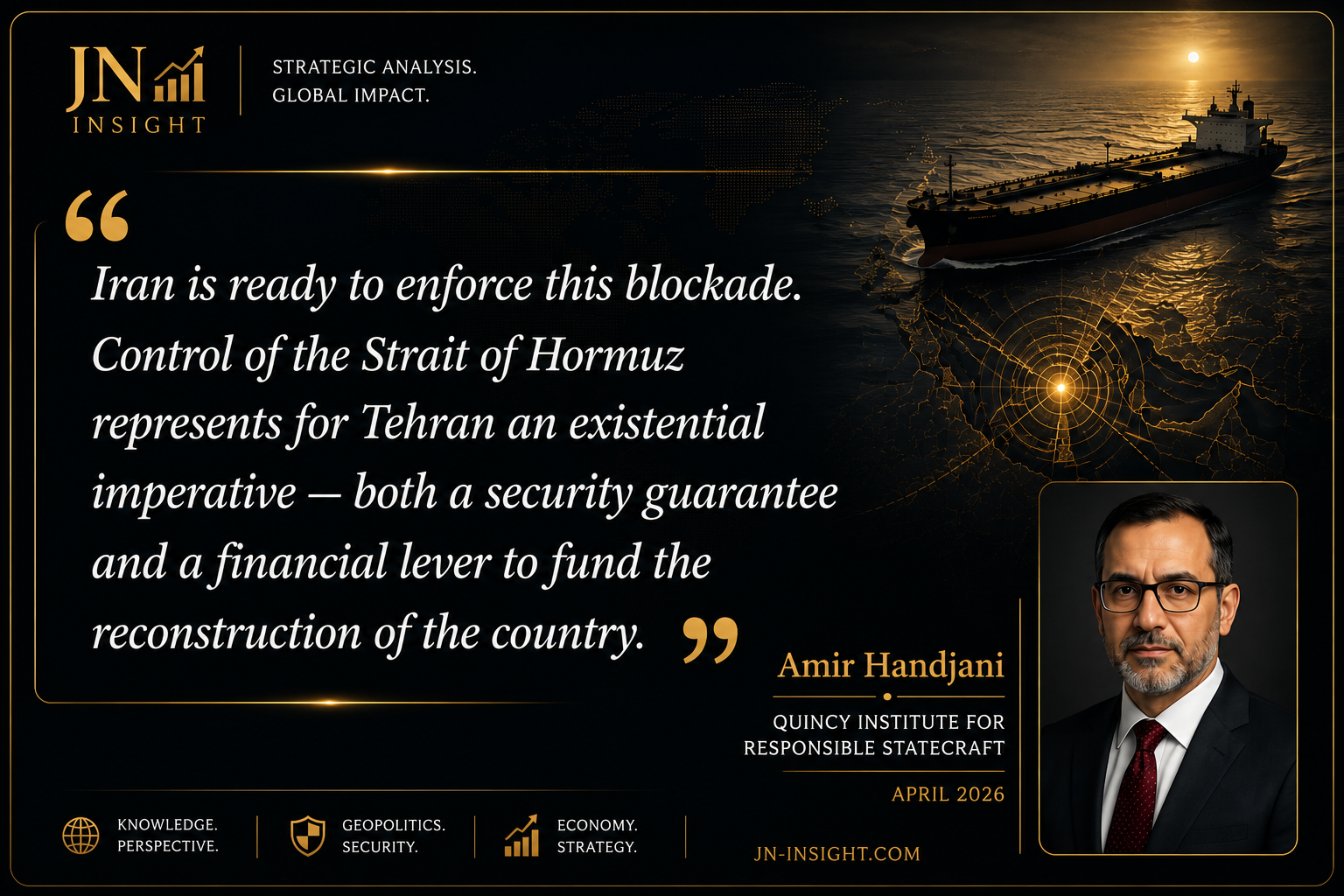
The message to Beijing, for those who know how to read it, is unequivocal: "We have the capacity to disrupt your supply." Here we leave the register of regional conflict to enter fully into that of rivalry between superpowers.
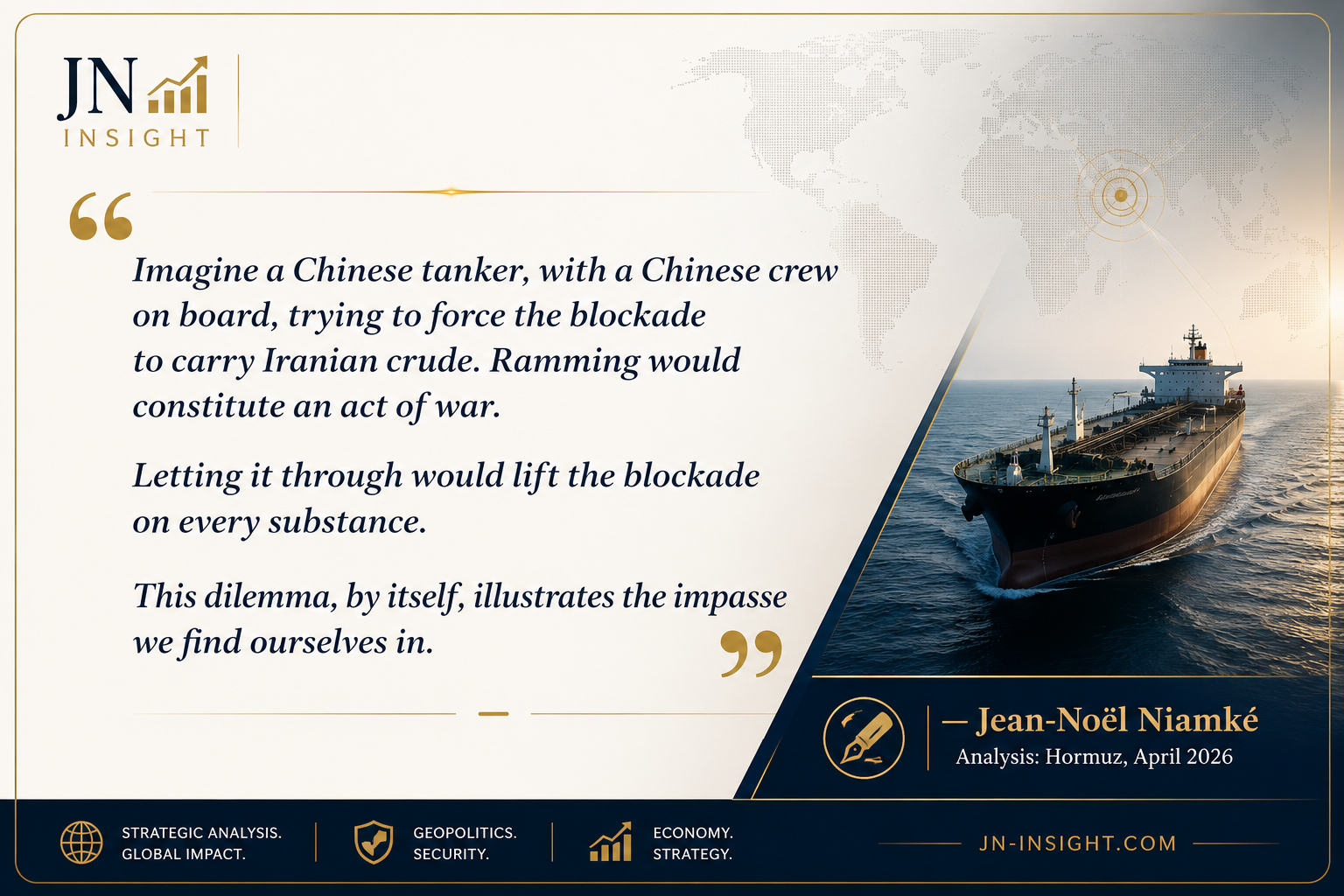
China absorbed more than 80% of Iran's oil exported by sea. Chinese authorities have called the blockade "dangerous and irresponsible behavior" — a formulation that, in Beijing's diplomatic language, betrays an anger rarely expressed so openly.
Its strategic reserves exceed 1.3 billion barrels, or more than 100 days of autonomy. Its transition to electric vehicles is more advanced than is generally perceived in the West. Beijing is certainly not immune to this crisis. But it is not helpless to deal with it either.
This war is not Iranian-American. It is a message written on fire for Beijing.
While diplomats negotiate and the military positions themselves, someone, somewhere, counts his profits. And the figures are impressive.
ACT V — France and its oil powers: the scandal within the scandal
While the French are queuing at the pump... Here's what the oil companies are doing.
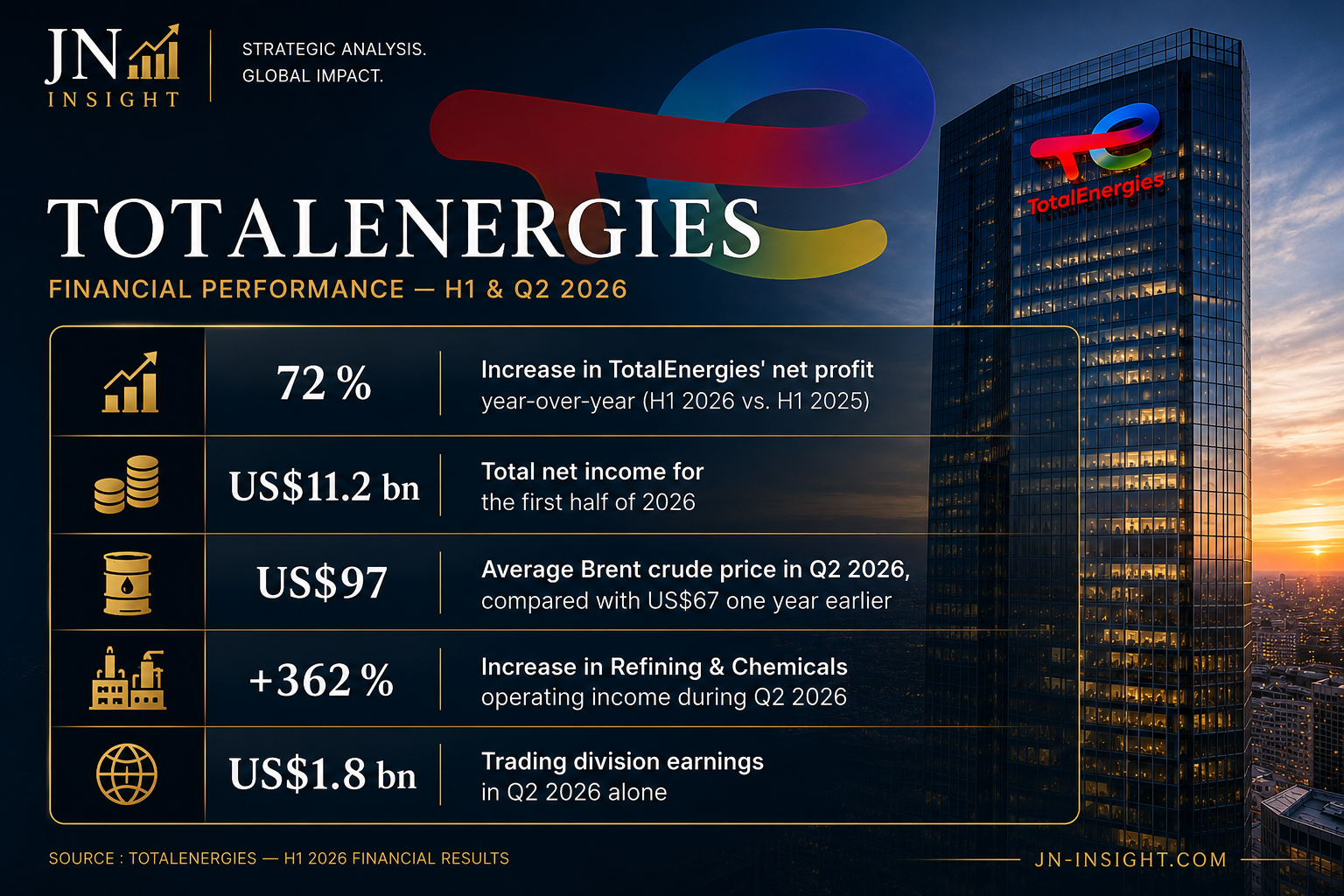
Oil companies, including TotalEnergies, raked in more than $11.2 billion in profits in the first half of 2026. That is 9.8 billion euros. This is a 72% increase compared to last year. Net income for the second quarter: $5.4 billion. Exactly double the number of Q2 2025.
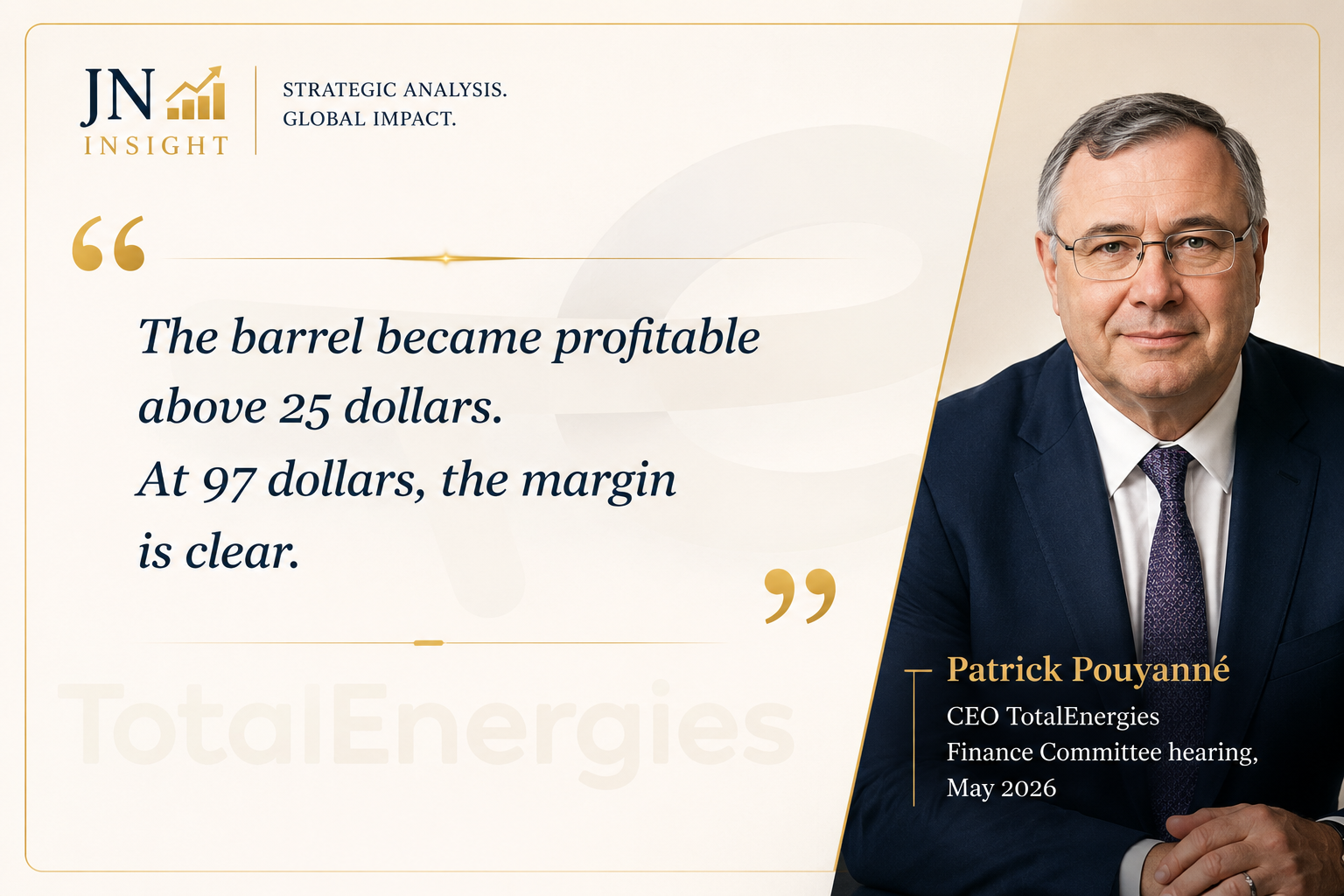
CEO Patrick Pouyané had indicated it himself during his hearing before the Finance Committee in May 2026: the barrel becomes profitable above $25. At $97, the math is quickly done.
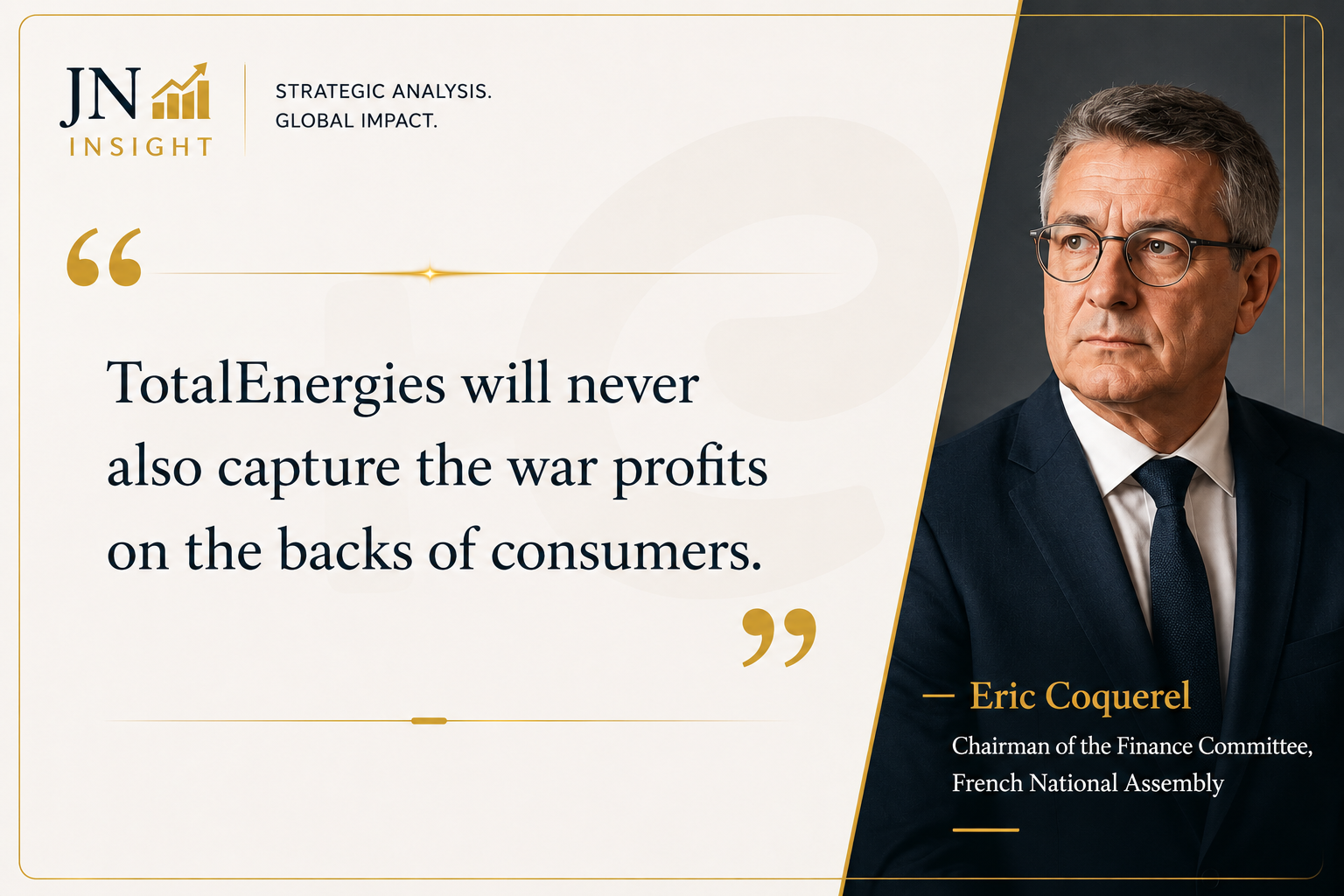
La France Insoumise is calling for a 50% tax on superprofits. The government plans to regulate distributors' margins by decree. DGCCRF inspections have been carried out at service stations. But for the moment — diesel has exceeded 2 euros since March 2026. And Total's profits continue to rise.
The war enriches those who sell oil. It impoverishes those who consume it. And it is the same people who pay taxes.
This paradox is not an economic surprise. This is a historical constant. We had already seen this after Ukraine in 2022. We see him again today. The longer the crisis lasts, the wider the margins become.
There remains a question that all analysts are asking in a low voice.
How does Donald Trump get out of this vice? Short answer: he doesn't know yet.
ACT VI — Trump trapped in his own vice
Donald Trump had started this war with the conviction, expressed several times by his entourage, that the matter would be settled in four to six weeks. We are in the fifth month.
The blockade was to be the final blow to an already weakened adversary. It has turned into a strategic quagmire. Oil prices are soaring, inflation is resurgence, and the midterm elections are looming in November.
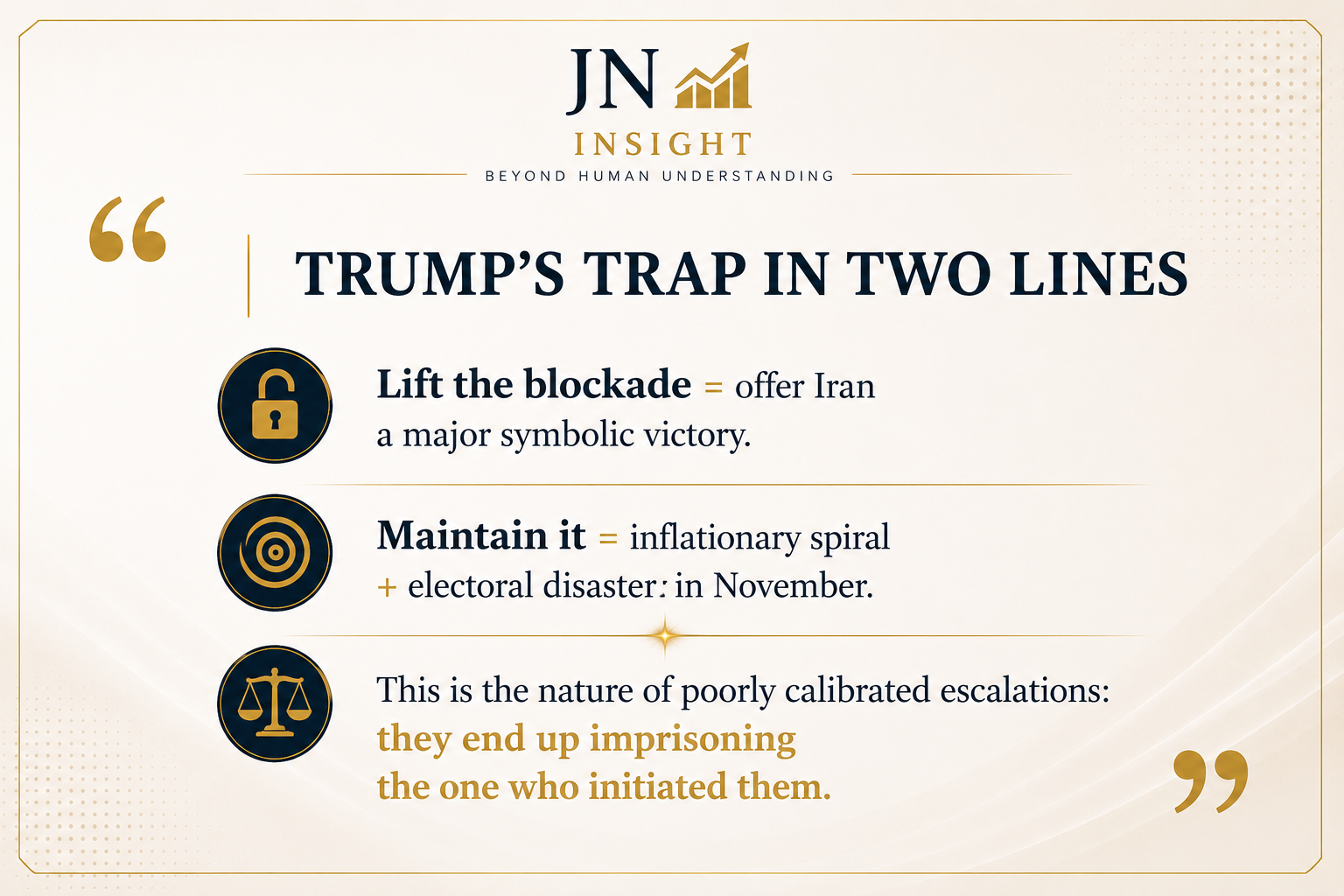
Yesterday — Damietta. Drones strike a US gas cargo ship in an Egyptian port on the Mediterranean. Trump said he received a report of the incident. Without retaliating. Without hitting. Without responding militarily.
Threaten. And not to hit. Unfortunately, this is the definition of impotence.
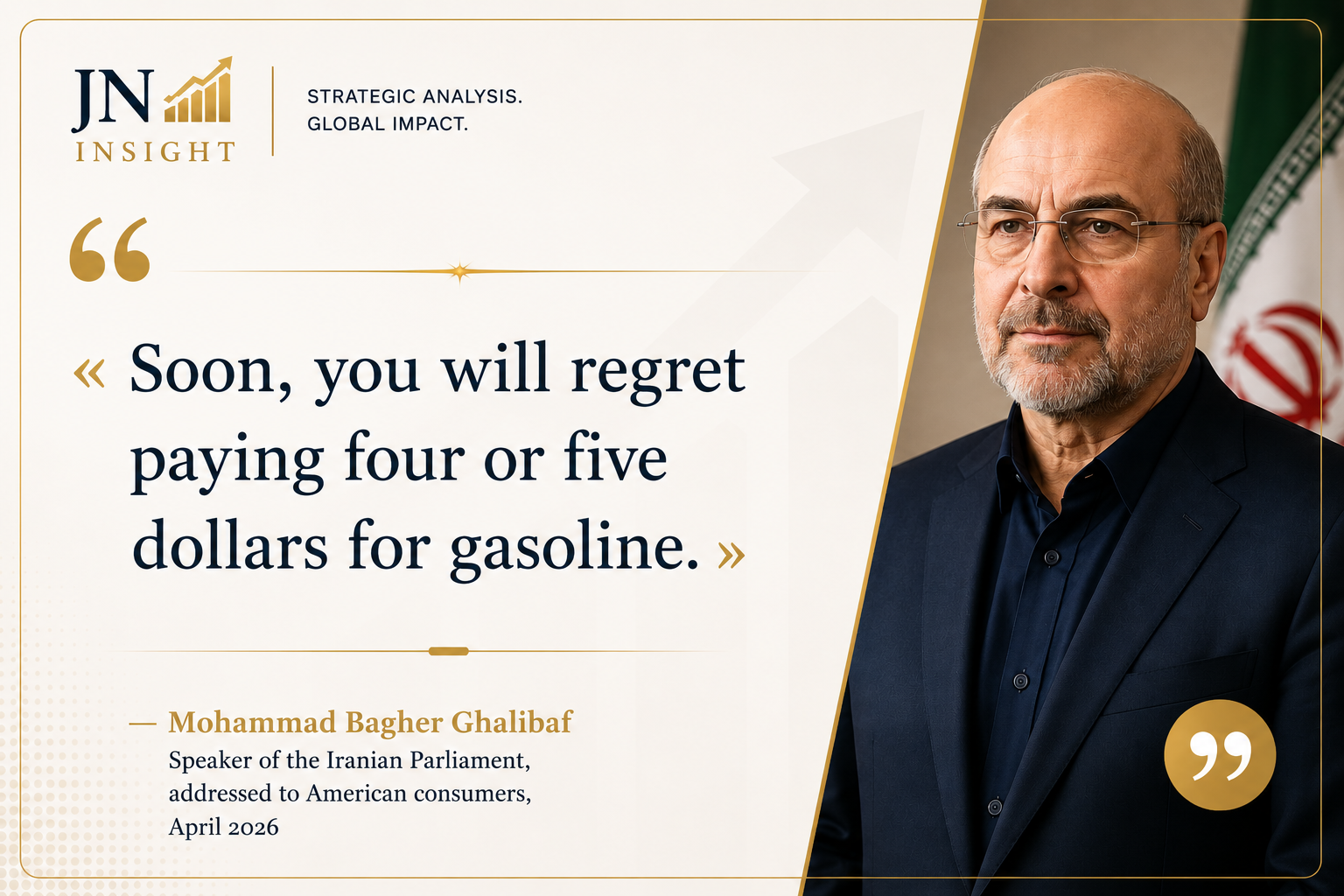
According to Axios, Trump ordered not to strike Iran again on Friday to allow more room for diplomacy. The United States and Iran held technical discussions in Doha. Trump said the U.S. got along "very well" with Iran and that the recent meetings in Qatar had gone "well." Iranian response: an AI-generated video showing Trump facing empty chairs.
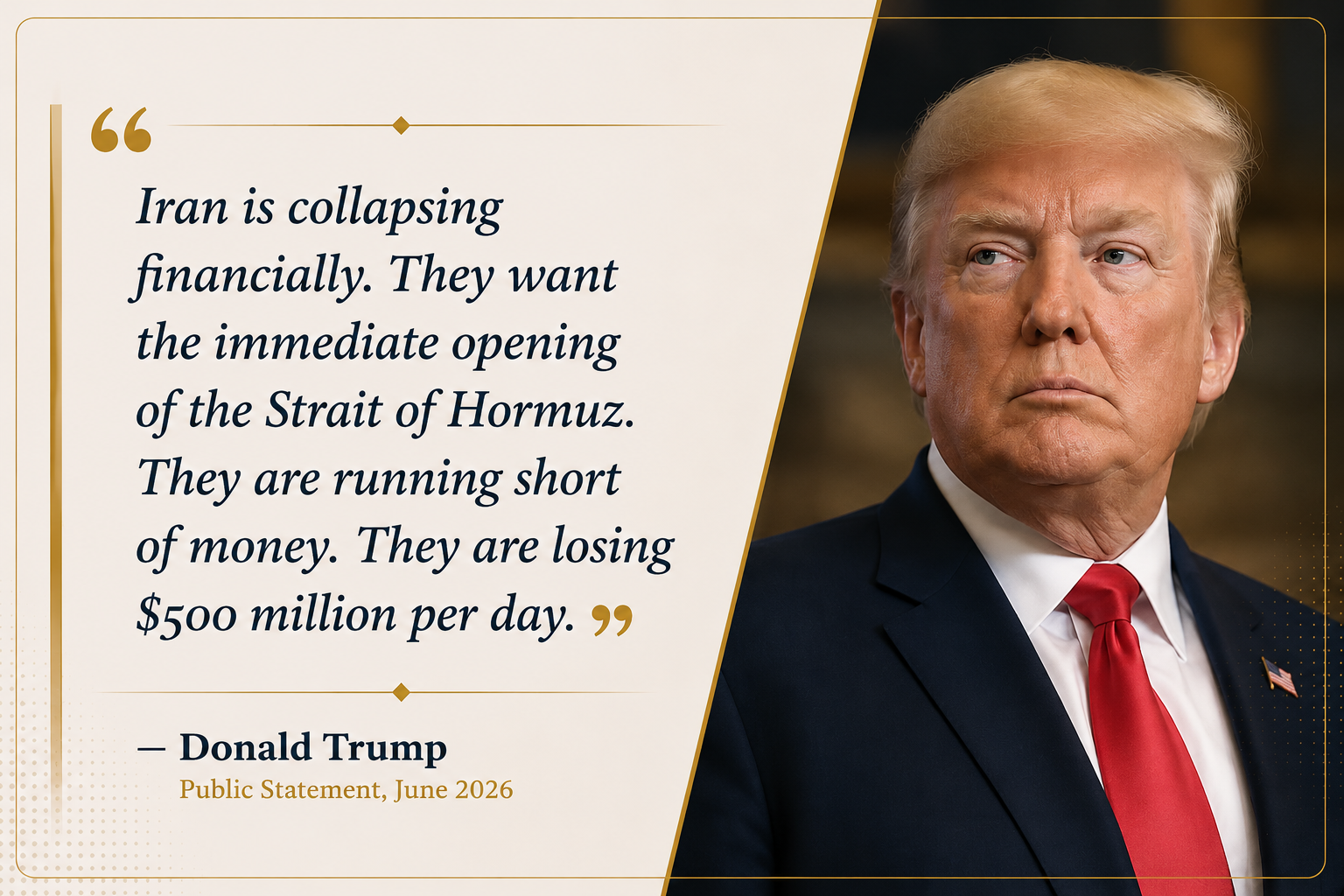
A country under sanctions for forty years. With a new supreme leader for five months. With a diminished navy. Who allows himself to publicly mock the president of the United States. This is not arrogance. It's a calculation.
While Trump is looking for his way out, while Iran is holding on, while TotalEnergies is counting, a silent transformation is underway.
It is played in the palaces of Riyadh, Abu Dhabi and Doha. And it will change the world order far more permanently than any ceasefire.
ACT VII — What the Gulf States Have Understood — and What No One Says
Saudi Arabia. The Emirates. Le Qatar. These countries are watching.
And what they see is changing their calculations for the next twenty years. Only one state — Iran — with a degraded navy, without a world-class army, with sanctions for forty years — has managed in five months to:
• Paralysing 20% of the world's energy
• To make the barrel soar to $120
• Resist U.S. strikes
• Survive the death of its Supreme Leader
• Forcing Trump to the negotiating table
• Extend the conflict to three maritime theatres simultaneously
The Gulf states say nothing publicly. But they are opening diplomatic lines with Tehran. They are diversifying their alliances. They are looking at China and Russia with renewed interest.
When the protector stumbles, his protégés look for other insurance. The real power is no longer closure. It's uncertainty.
This is perhaps the most important policy lesson of these five months — and the least worded. The objective is no longer to close a strait permanently. It is to maintain permanent uncertainty. To make sure that no one knows if tomorrow it will pass. That shipowners hesitate. That the markets panic. That the insurers refuse.
A sea route whose safety no one can guarantee produces almost the same economic effects as a completely closed route. Without even firing a single missile.
This is perhaps the most lasting consequence of this crisis. Not the price of a barrel. Not the ceasefire. Not the US elections in November. But the silent reorganization of the Gulf alliances — which is now being done, in real time, while the media is watching the Brent numbers.
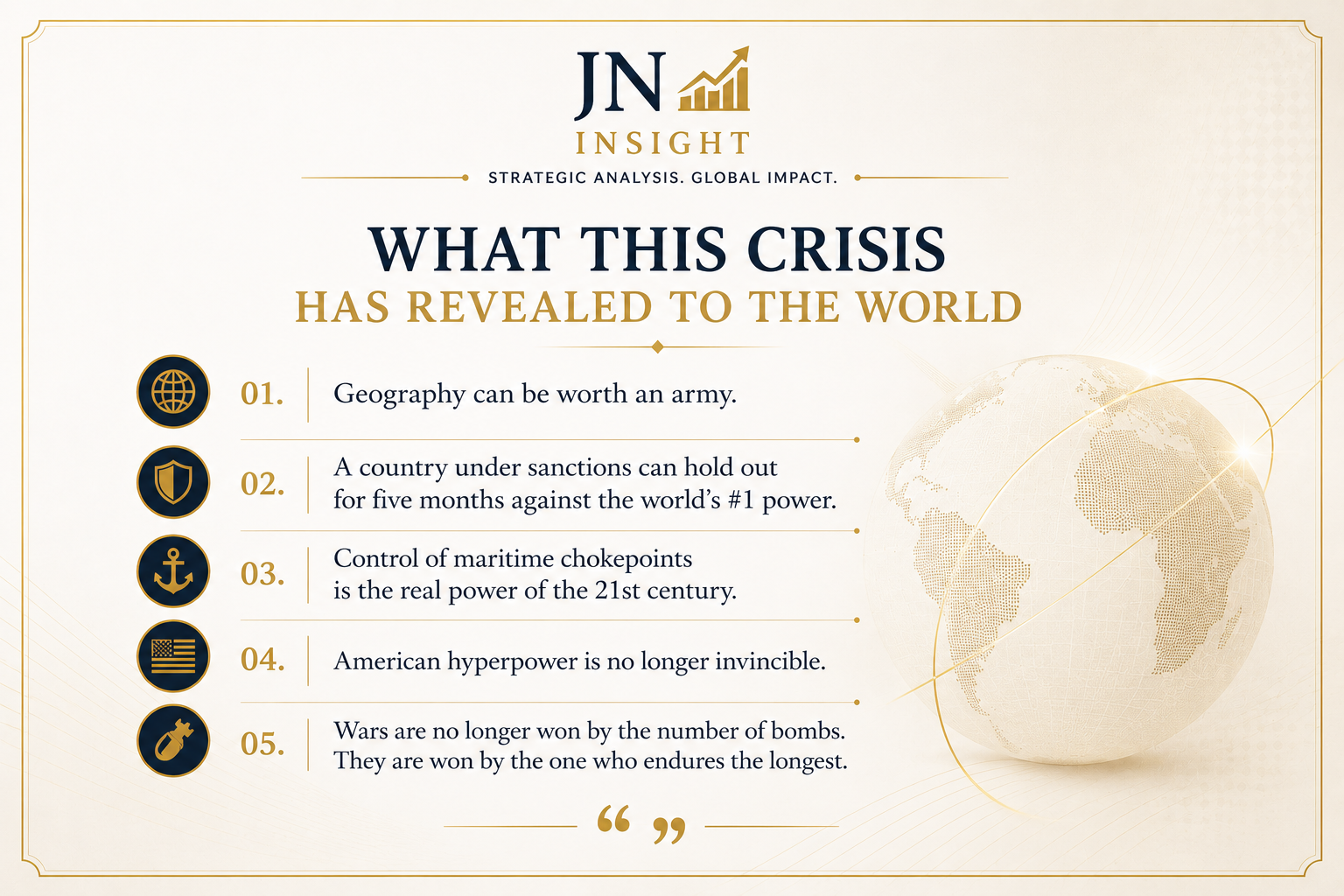
What if the real lesson of these five months was not military?
What if it were that the world order drawn after 1945 — with a single hyperpower capable of dictating its rules from a naval base in the Gulf — is cracking? Not because America lost.
But because she didn't win. And not winning, when you're the hyperpower, is already a form of defeat. Five months. Four ceasefires. Six theatres of operations. It is time to take stock. Not of the conflict but of the system.
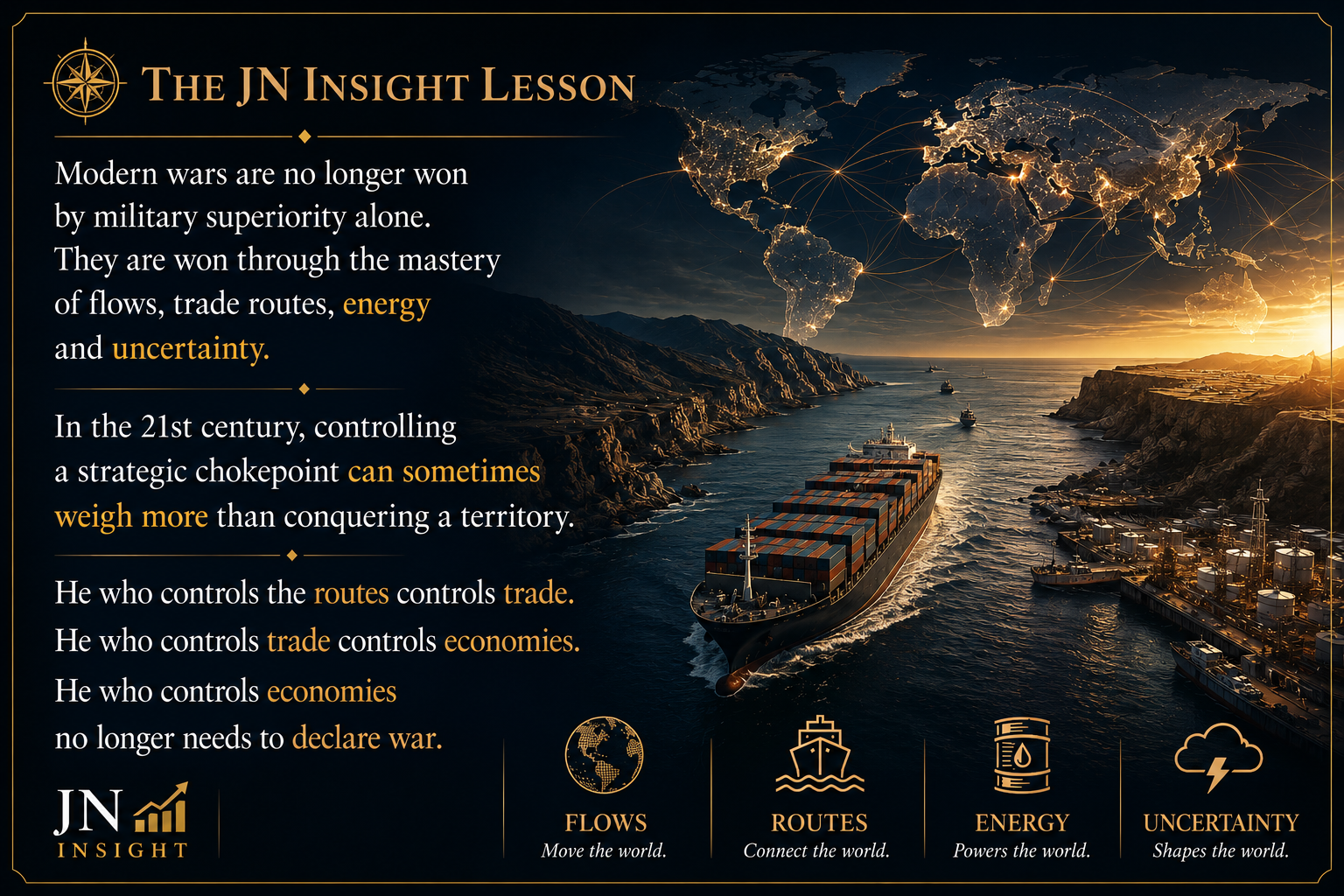
What to remember? — The Strait Trap
Trump will probably end up negotiating. Not because he wants to. Because he has no choice. The midterm elections are coming up in November. Inflation is eating away at American purchasing power. Beijing is biding its time. And Damietta — last night — has just shown that war can strike anywhere.
Ormuz. Bab el-Mandeb. Damietta. Three theatres. A single message. He who holds the passages holds the world.
The world no longer has a single guardian. He now has to deal with several power centers.
This conflict is not only redrawing maritime routes. He redraws the map of world power. It shows that brute force is no longer enough. That a well-chosen geography is better than an aircraft carrier. That the determination of a regime to hold can prevail over technological superiority.
A war is no longer won with the number of bombs. It is earned with the ability to hold on. And sometimes — with the wisdom of knowing when to speak.
The twenty-first century may not be the century of the territories. It will be the one of passages. The states that control the straits, canals, submarine cables, LNG terminals and critical infrastructure will have a leverage of power that is sometimes greater than that of a conventional army. Ormuz, Bab el-Mandeb, Damietta — these are not three separate incidents. It is the announcement of a world where chokepoints have become the new frontiers of power.
Whoever holds the passages holds the economy. Whoever holds the economy holds the world.
Five months after the first launch, neither Iran nor the United States has won. Oil companies do. Energy markets, yes. The negotiators, perhaps soon.
The empires of tomorrow will not necessarily control more land. They will control more roads.
The real winner of this crisis will be the one who has been able to transform a passage into a lever. And a lever for lasting peace.
→What about you? Do you think Trump can still get out of this vice without losing face? Or is this war doomed to last until the November elections?
Intellectually yours,
Jean-Noël Niamké
FINANCIAL EXPERT
JN Insight — Geostrategic & Economic Analysis | July 2026