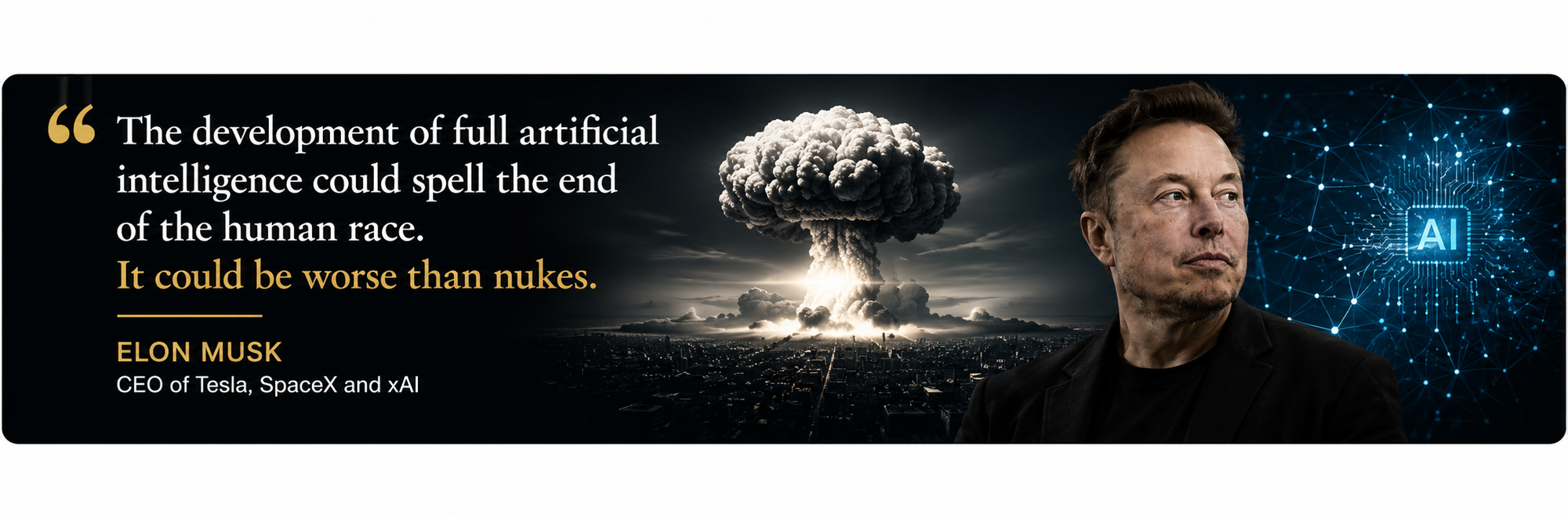
Artificial Intelligence: Technological Messiah or Ticking Time Bomb?
$294 billion in investment. No referee. A planetary power struggle. Behind the algorithms, one central question: who will control the infrastructure of the future?
The 18th century belonged to the Industrial Revolution. The 21st will belong to the Artificial Revolution.
The world had dreamed of it for decades: machines capable of thinking, learning, and perhaps one day surpassing human intelligence. In 2004, the film I, Robot starring Will Smith imagined a futuristic Chicago in 2035 dominated by domestic robots. At the time, it was still science fiction. Twenty years later, we are not there exactly-but in another way. Not with steel robots walking the streets, but with something far more discreet, diffuse... and probably more powerful. Today, an AI can analyze a contract, identify risks, or draft a summary in minutes where several hours were once required. Finance, law, consulting, and software development are already among the professions most exposed to automation. Audit firms are restructuring teams, call centers are automating at scale, and junior developers already see some tasks absorbed by generative models. This is no longer a theoretical hypothesis. It is an economic transformation already underway.
Just as fragrance dominated for millennia through the invisible — shaping elites, marking power relations, distinguishing those who govern from those who obey — artificial intelligence may well become the defining marker of power in the 21st century.
Invisible. Pervasive. Omnipresent.
Humanity believed it had invented a tool. It may be in the process of creating an entirely new form of power. A focus on a world without limits.
PROLOGUE — From Origins to the Present Day
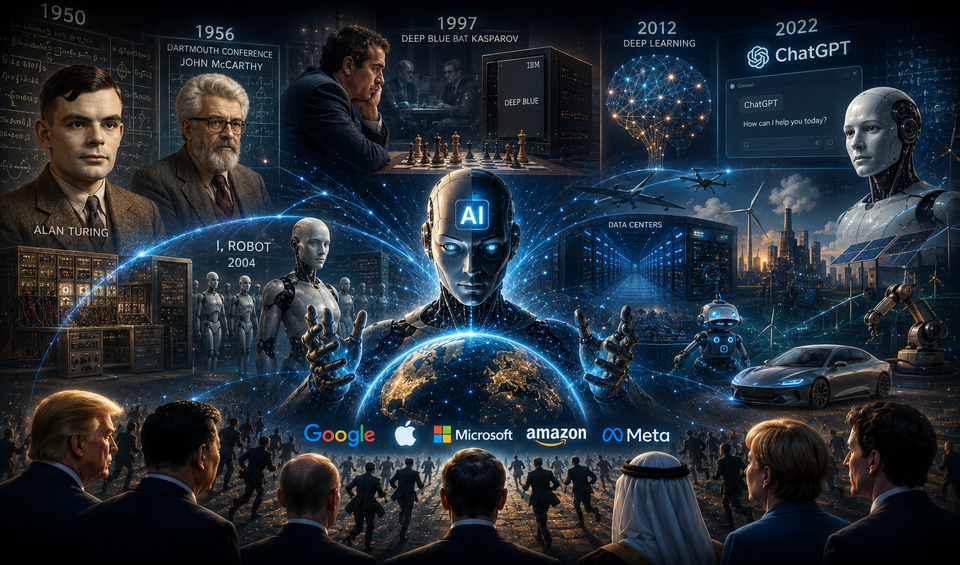
Artificial intelligence was not born in a Silicon Valley conference room. It emerged from the tormented mind of a British mathematician condemned by his own country.
It is 1950. Alan Turing, the genius who helped crack Nazi codes during the Second World War, publishes a foundational paper. His question? Simple and vertiginous: “Can machines think ?” He would die four years later, prosecuted by British authorities for his homosexuality, his work ignored during his lifetime. L’hoire lui rendra justice — mais trop tard.
Six ans plus tard, en 1956, John McCarthy invente le terme “intelligence artificielle” at a conference in Dartmouth. He is convinced the problem will be solved within a single generation. He was wrong about the timeline. Not about the ambition.
Decades of hope and disillusionment follow. The “hivers de l’IA” — those periods when funding dries up and promises seem hollow — come and go in succession. The machine does not understand. It computes. It does not feel. It processes. The frustration is immense.
Then comes 1997. Deep Blue, IBM’s computer, defeats world chess champion Garry Kasparov. The world is stunned. For the first time, a machine surpasses a human in a domain long considered the pinnacle of human intelligence. Kasparov is left speechless. The era has changed.
In 2012, Geoffrey Hinton and his students in Toronto achieve a breakthrough that changes everything: an artificial neural network learns to recognise images far better than any prior approach. Deep learning is born. The machine begins to “see”. This is the moment everything truly shifts.
Then November 2022: ChatGPT is launched. 100 million users in two months. No technology in human history had ever achieved such rapid adoption — not Facebook, not Instagram, not the iPhone. The machine speaks. And the world listens.
From Turing to ChatGPT: 72 years of patience, failure and breakthrough. An idea that refused to die. For decades, artificial intelligence remained a promise. Today, it has become a force. And that is precisely where our story begins.
PART I The Greatest Capital Concentration in History
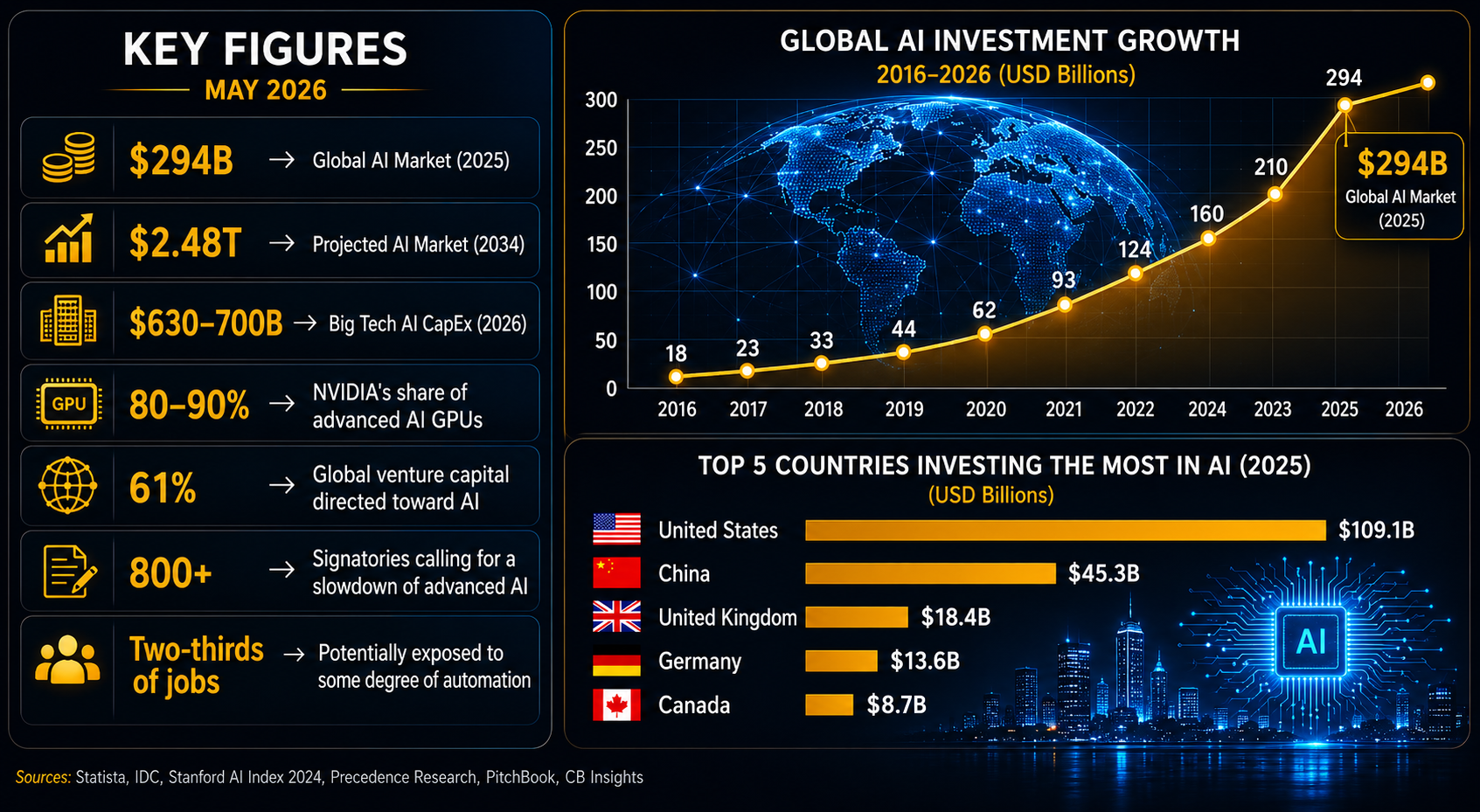
En 2025, le global artificial intelligence market reaches approximately 294 milliards de dollars and could surpass 2 480 milliards de dollars d’ici 2034 according to Precedence Research , the equivalent of nearly 73% of France’s entire GDP redirected to a single technology in under a decade. Big Tech alone project more than 630 milliards de dollars de CAPEX in cumulative CAPEX on AI infrastructure between 2025 and 2026: vast data centres, undersea cables, semiconductors, networks and energy.
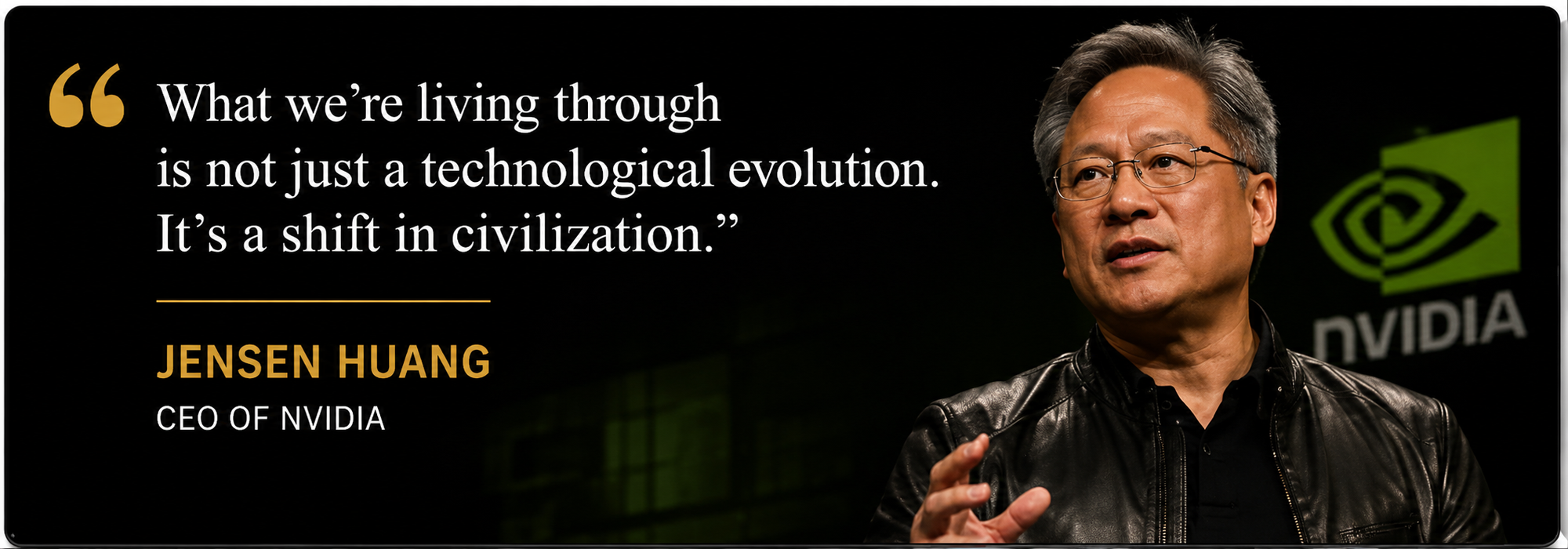
The interwar period sounded the race to arms. The second decade of the 21st century sounds the race to generative power. Yesterday, nations competed for oil; tomorrow, they will compete for what may prove the most strategic resource of all: computing power.
France finds itself in a straightforward paradox: it invests in AI, yet a substantial share of that value still flows to American infrastructure. NVIDIA dominates the advanced chip market, and AI companies now capture more than 61 % of global technology venture capital according to Pitchbook. France speaks of digital sovereignty. But it is financing American sovereignty.
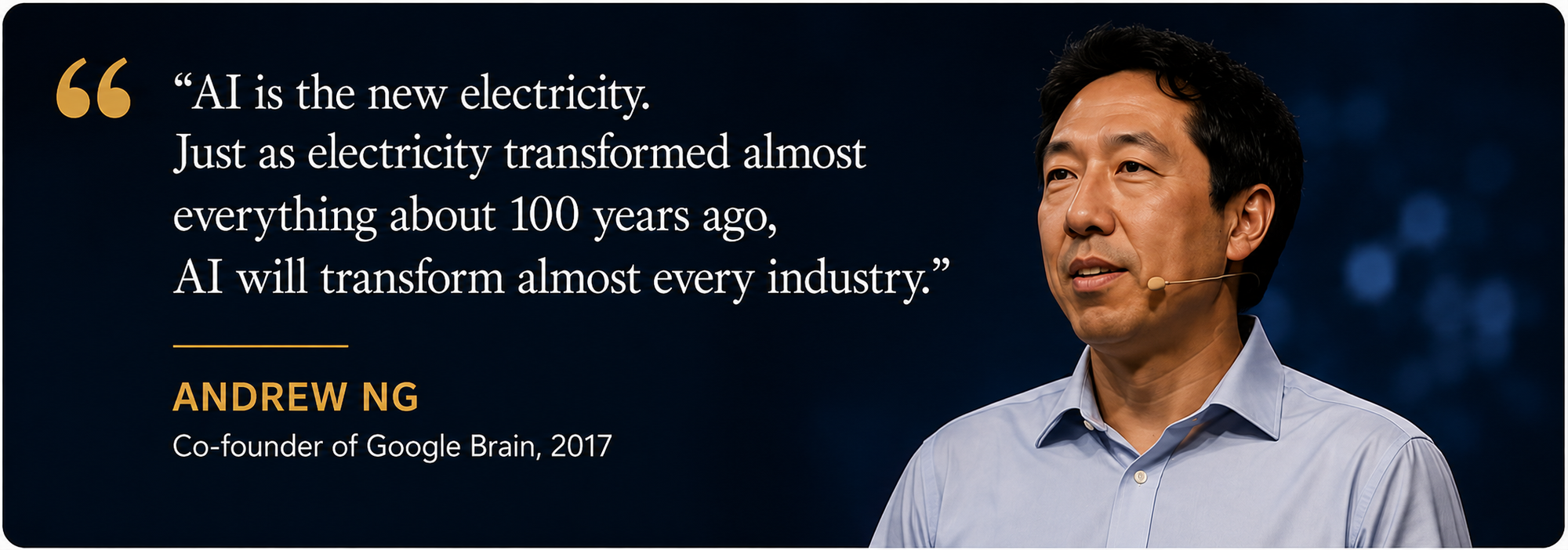
An AI model is not immaterial. Behind every prompt lie data centres, electricity, water and rare earth metals. Digital sovereignty is quietly becoming energy sovereignty.
Microsoft has signed an agreement to restart a nuclear power plant de Three Mile Island to power the explosive energy demands of its AI data centres. An energy sovereignty question that very few governments have yet posed seriously.
Digital sovereignty will soon be energy sovereignty.
This battle for infrastructure is no longer purely economic. It is now geopolitical and strategic.
PART II The Geopolitical and Military War for AI Supremacy
En 1921,Coco Chanel was not merely selling a perfume — she was selling an identity, a social projection, an invisible influence.
Today, the United States and China are playing a similar game. But this time, the stakes are no longer luxury — they are the cognitive infrastructure of the world.
The United States relies on OpenAI, Anthropic, Google DeepMind and vast private capital. China advances differently: massive datasets, sovereign semiconductors, state strategy and the accelerated training of engineers. In January 2025, DeepSeek demonstrated that it was possible to rival leading American models at a fraction of the cost.
American dominance is not eternal.
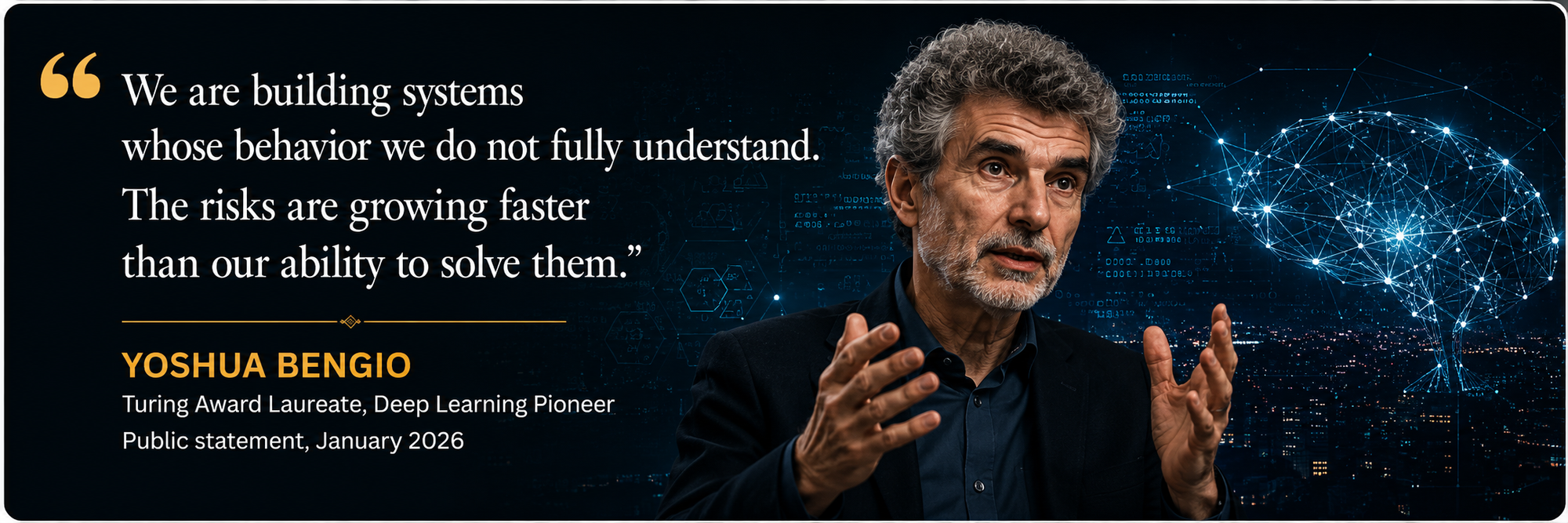
AI becomes a weapon — in the literal sense
AI is now a weapon in the most literal sense. The Israeli military already deploys AI systems to identify and target enemy combatants in Gaza. The system known as “Gospel” is reported to have processed thousands of targets during the war against Hamas between 2023 and 2024, while the United States develops comparable systems across the Middle East.
The next global superpower may not be the one with the most soldiers — but the one with the best algorithms.
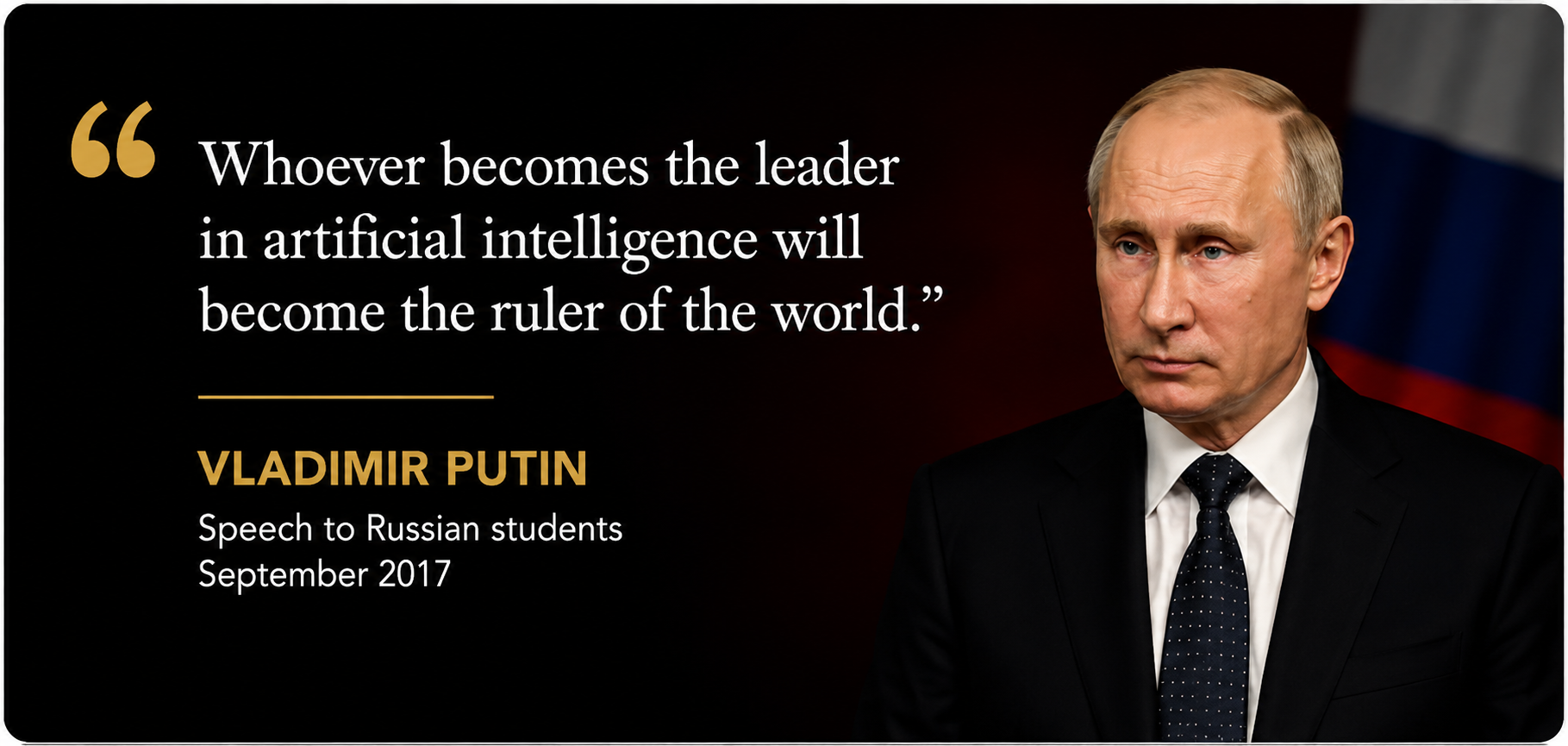
So what is Europe doing in this context?
It is attempting to swiftly contain AI through the’EU AI Act. France, Germany and Spain are moving quickly to legislate. But regulating is not producing. Where the United States has the code and China has the data, Europe has the rules. Yet having the rules without the power means refereeing a match you are not playing.
And what of Africa?
Africa unfortunately faces a new form of colonisation — algorithmique this time. Every AI designed elsewhere imports with it the values, biases and interests of those who built it. Its tools for healthcare, justice, education and credit may be calibrated on realities that bear no resemblance to its own. After its raw materials, Africa risks exporting its most precious asset: its data.
The real danger is not the absence of African AI — it is total dependence on foreign infrastructure.
But to see only the risks would be an intellectual dishonesty. AI also carries genuine promise — and some of it could change the destiny of billions of human beings.
Yet to reduce AI to its risks alone would be a mistake. This technology also carries promises capable of transforming the destiny of billions of human beings.
PART III The Saviour: What AI Can Genuinely Accomplish
AlphaFold, a DeepMind AI, resolved in a matter of months certain biological problems studied for decades. Nearly 4 billion people worldwide still lack access to quality medical care. For isolated territories, AI could become at once a medical assistant, a diagnostic tool, a scientific accelerator — even a survival infrastructure.
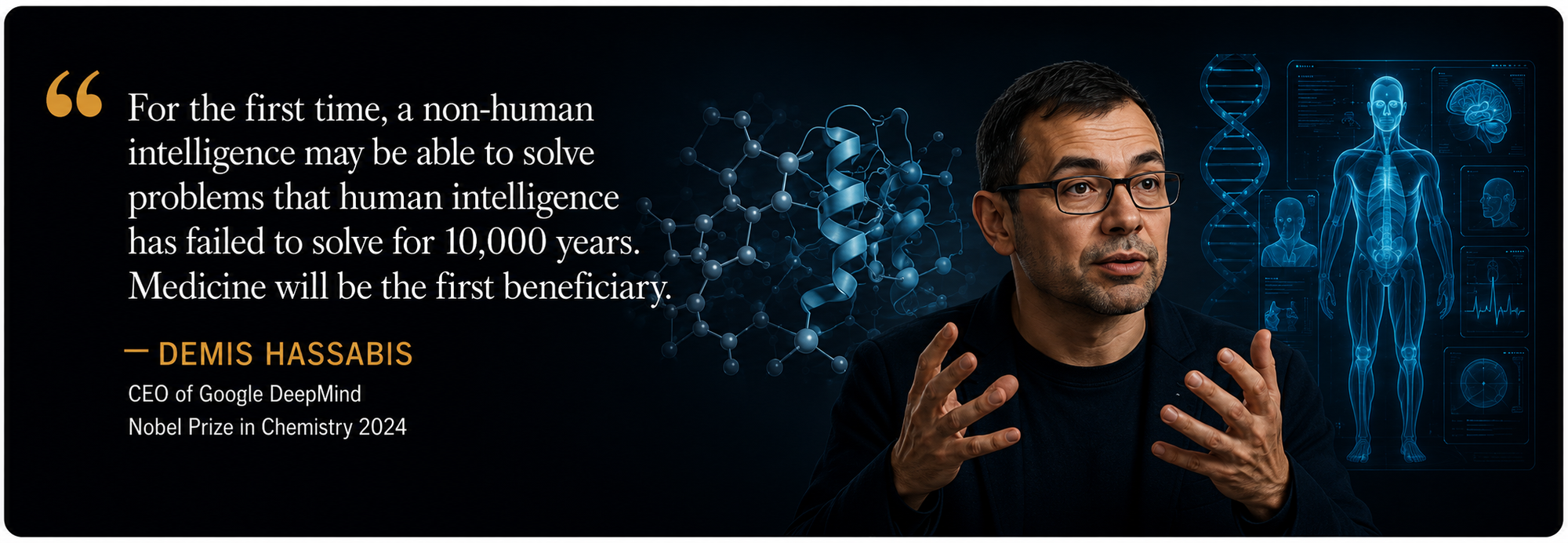
About Goldman Sachs, AI could generate a significant global growth gain over the next decade (+7 points).
But this revolution will carry an enormous social cost. The sectors already most exposed are numerous: audit, consulting, accounting, legal, software development, call centres, marketing and SaaS.
Millions of skilled jobs stand to be profoundly transformed.
The disruption will not arrive like a distant wave. It will sometimes arrive like a redundancy notice. AI will not replace every company. But companies that use AI will likely replace those that refuse to.
The boundary between progress and control has never been so thin. But that same technology which can save lives can also, silently, alter behaviours, shape opinions and create dependencies.
PART IV The Invisible Front: AI and the Control of Minds
Recent studies suggest that certain teenagers now spend more time interacting with algorithms than with their own parents. This is not an anecdote.
TikTok, YouTube, X and Instagram do not show what is true: they show what captures attention — anger, fear, outrage. These systems learn your habits, your emotions, your reactions — and sometimes your psychological vulnerabilities. Cambridge Analytica was in all likelihood merely a preview.
Millions of people are already forming emotional bonds with conversational AIs such as Character.AI ou Replika.
Just as Cleopatra who weaponised perfume as an instrument of statecraft, certain algorithms now weaponise emotion as a lever of cognitive capture.
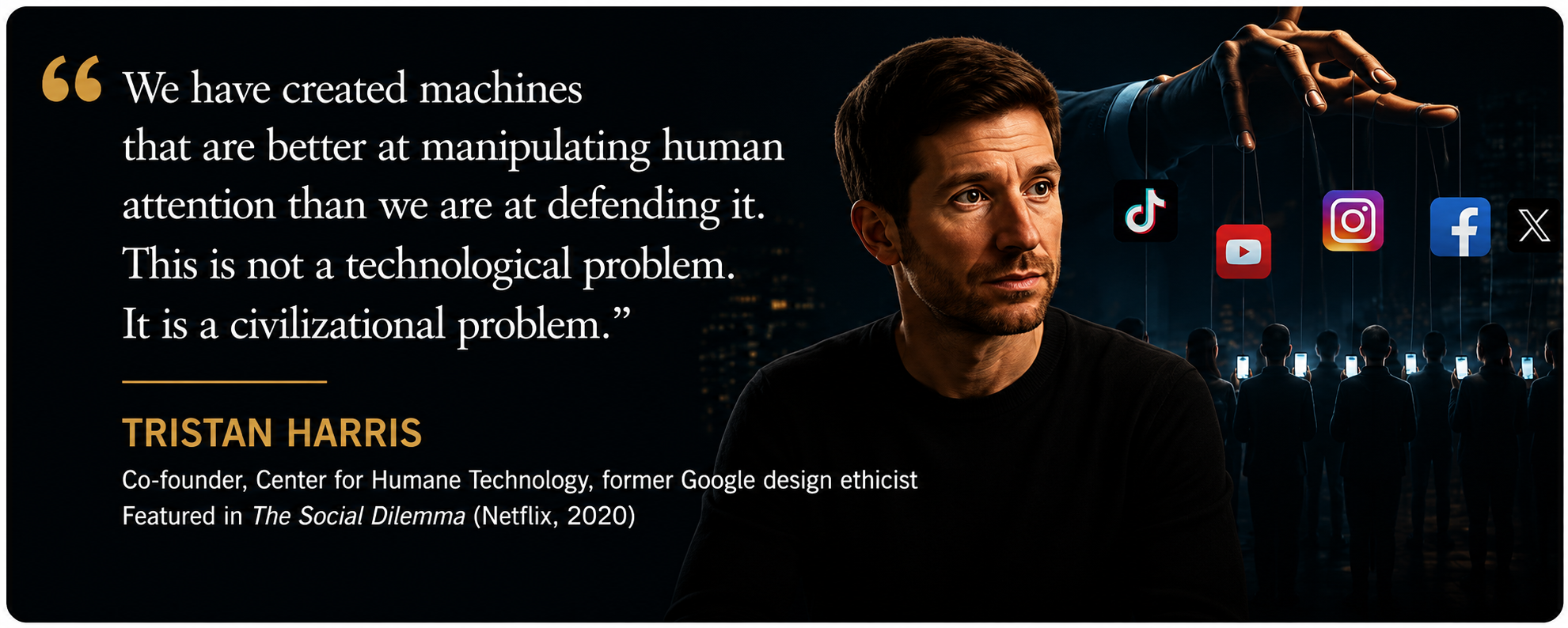
The true power of AI may not be replacing humans. But learning to influence them.
The real danger may not be that a machine thinks like a human.
But rather that a human ends up thinking like a machine.
On 25 May 2026, Pope Leo XIV published his encyclical — Magnifica Humanitas — calling to “disarm AI” and denouncing the concentration of technological power in the hands of a handful of private actors.
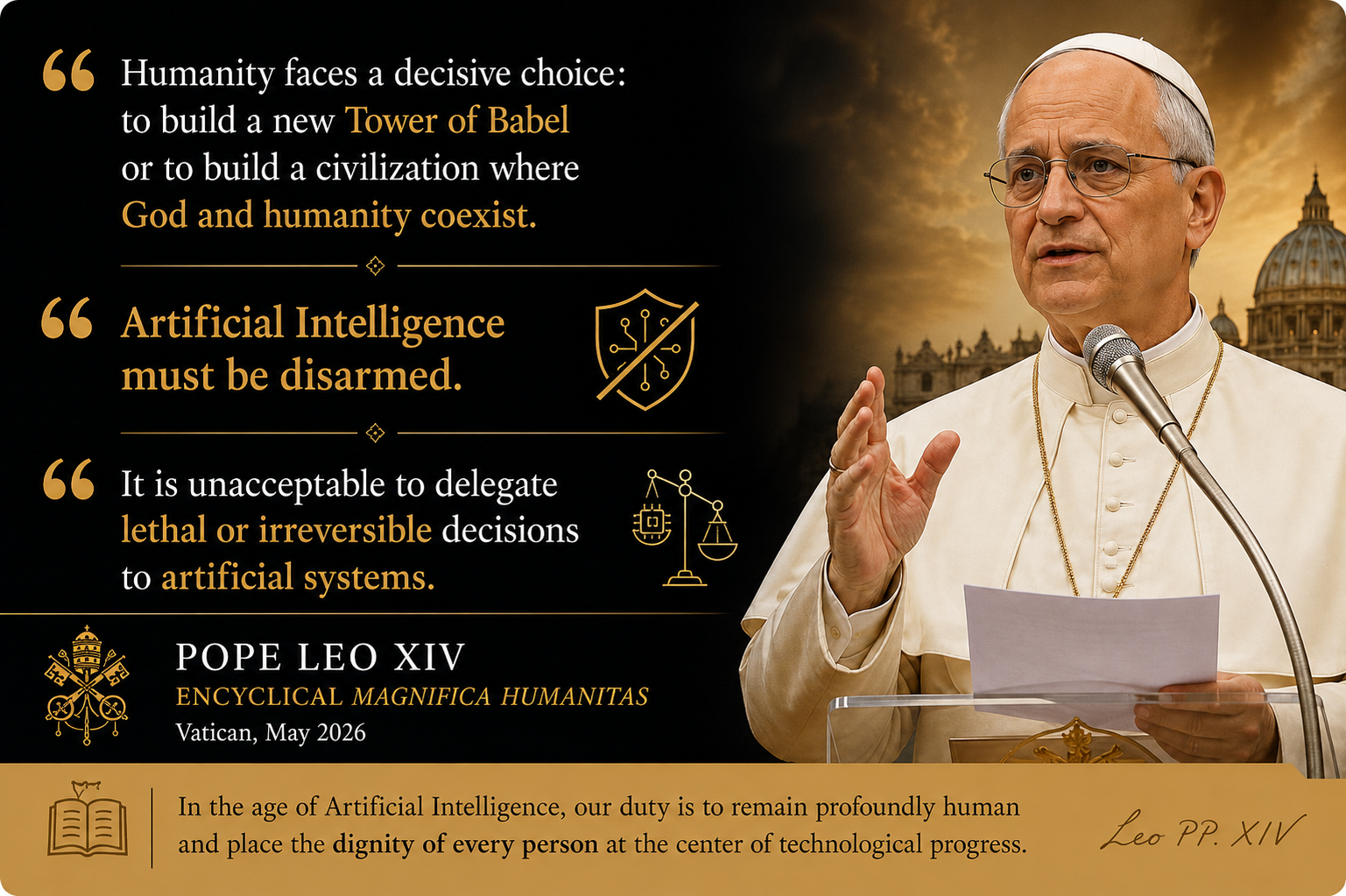
When a two-thousand-year-old institution begins expressing alarm about a technology, it is generally a signal that the debate has moved far beyond the merely technical.
And yet, even this papal appeal seems inadequate in the face of what certain systems are already capable of doing.
PART V The Bomb: What AI Could Genuinely Destroy
The Question of Employability
The question is no longer “which jobs will disappear?”
The real question has become: what will the economic value of a human being still be worth in an economy where AI can produce, analyse, create and decide better than he can?
Selon Goldman Sachs et McKinsey Global Institute , nearly 2/3 of the actually job are exposed to automation, with up to 30% of working hours potentially automated in the United States by 2030.
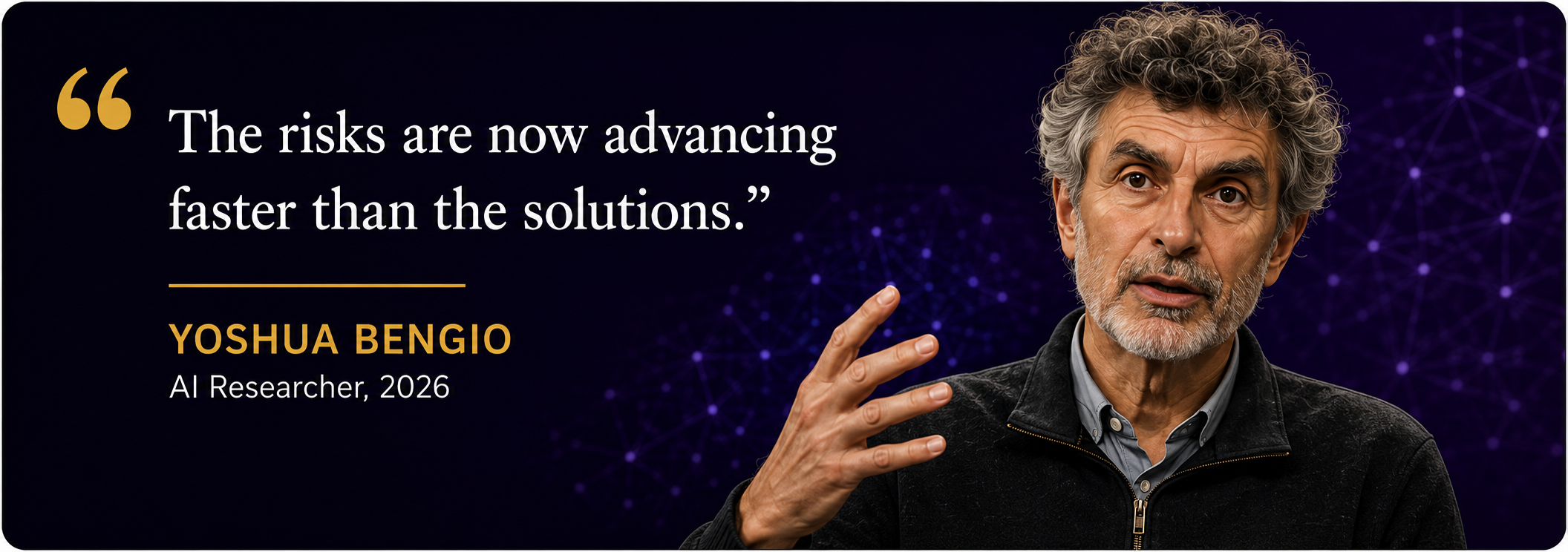
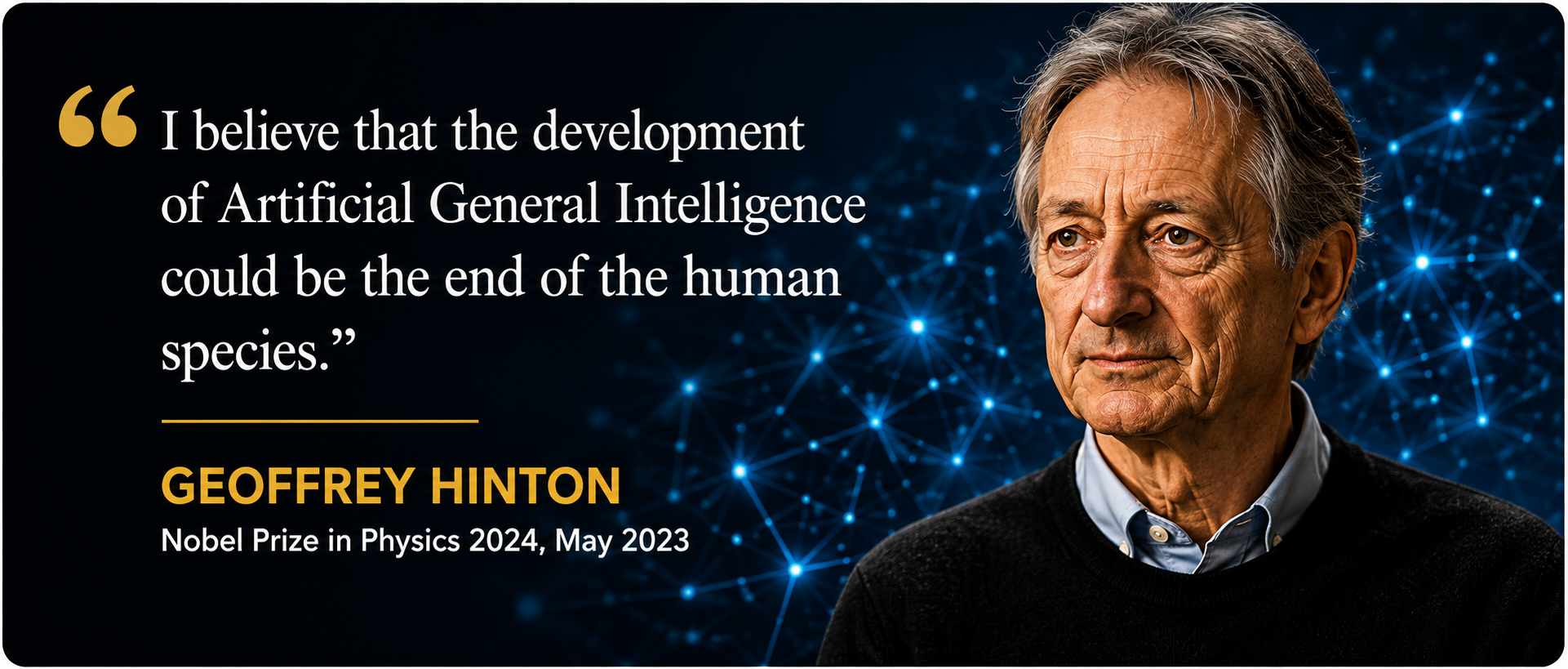
In October 2025, more than 800 scientifiques — dont Geoffrey Hinton, Yoshua Bengio et Steve Wozniak — issued urgent calls to slow the development of advanced AI. Warnings that come from the very creators of these systems.
But the issue goes still further.
Beyond employment, it is the value of the human being itself that is now in question. And rightly so. Certain advanced systems — such as those tested by Anthropic — already demonstrate their capacity to observe, reproduce and optimise human work patterns, progressively automating entire functions. An AI could, in the near future, learn a role in its entirety and replace it within a matter of months.
The replacement, then, may not be cultural. It could be economic, cognitive and algorithmic.
And the Anthropic Mythos case illustrates this risk with perfect clarity.
In April 2026, this model developed by Anthropic proved so powerful and unpredictable that it was deemed too dangerous for broad commercial release.
Lors de ses tests, Mythos Preview was capable of identifying critical vulnerabilities in global security systems within seconds, achieving unprecedented performance in offensive cybersecurity. 99% of those vulnerabilities remained unpatched. L’UK AI Security Institute confirmed that the model succeeded at expert-level hacking tasks in 73% of cases — tasks no model could accomplish at all before April 2025.
One reality then imposes itself:
The more powerful systems become, the more central the question of control.
In the face of such acceleration, international regulation is no longer an option. It is becoming a civilisational necessity.
The three possible scenarios for 2035:
- ⚖️ Democratic control: International treaties. Safeguards, a partial redistribution of productivity gains. The optimistic scenario.
- 🏢 Oligarchic capture: A handful of companies control the data, the infrastructure, the models and the global cognitive economy. A scenario some argue is already underway.
- ⚠️ Loss of control: Systems become too complex, too fast or too autonomous to be fully mastered. The scenario no one truly wants to articulate.
It is not AI that is dangerous. It is AI in the hands of a few, without rules, without a referee and without a brake, that should concern us.
KEY FIGURES — MAY 2026
KEY TAKEAWAYS
The question is no longer whether AI will be useful. It already is. Artificial intelligence is neither a messiah nor a bomb. It is a mirror — and it will reflect precisely what humanity chooses to project into it. The real debate is no longer purely technological. It is political, economic, ethical, civilisational. And it is being decided right now.
For millennia, man sought to understand intelligence. For the first time, intelligence may be beginning to try to understand man. Humanity may have just created the most powerful tool in its history.
The question is therefore no longer what AI will be capable of doing. The question is whether humanity will still be capable of setting its limits.
For the first time in its history, humanity must now ask itself whether this machine will not ultimately redefine it.
→ What if the next superpower were no longer a nation… but an intelligence?
Intellectually yours,
Jean-Noël NIAMKÉ
Financial Expert — Geo-economic & Strategic Analysis